

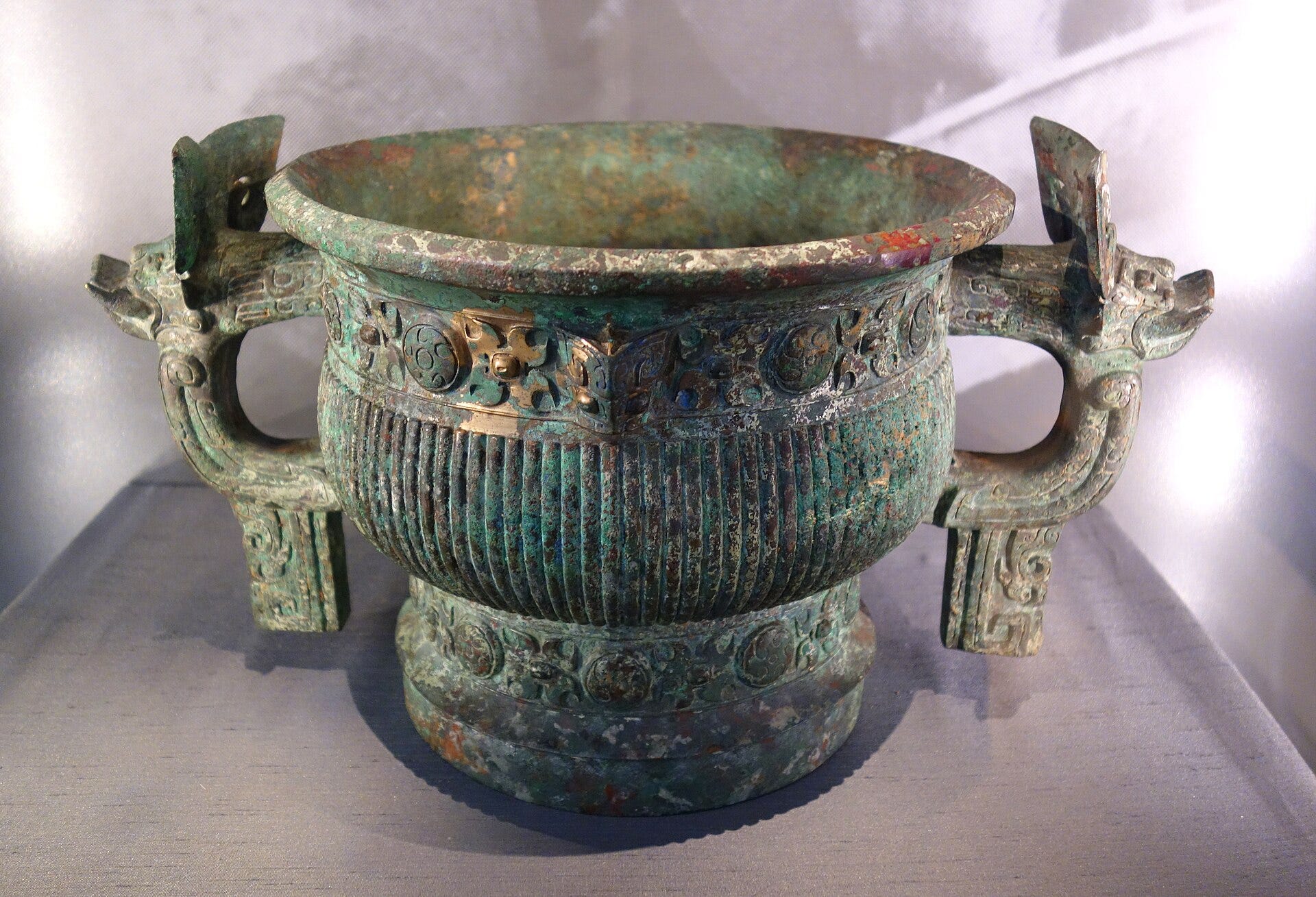
The Kang Hou Gui | Henan (China), ca. 1000 BCE
British Museum | Photo Credit: Wikimedia Commons
Overview
Paris has no galleries for ancient India or China, so this whole section lives in one room of the British Museum, Room 33, the long gallery of China and South Asia, with a side room for the sculptures of Amaravati. Four ideas organize this section, and each is an exam term.
Key Terms
Ashoka · Stupa · Ancestor Veneration · Bianzhong
Timeline
• ca. 2500 BCE | Mohenjo-daro and Harappa at their height
• ca. 1200 BCE | Shang kings cast bronze at Anyang
• 479 BCE | Confucius dies
• ca. 400 BCE | The Buddha dies, and eight mounds are raised over his ashes
• ca. 261 BCE | Ashoka conquers Kalinga
Ashoka | The Edicts in Stone
Civilization begins in India in the Indus Valley. The Indus Valley Civilization was the largest of the four river-valley civilizations, spread over more than 1,000 sites in what is now Pakistan and northwest India. What the Indus cities lack is as striking as what they have. No palace, no temple, no royal tomb, and no king's name. They had a written language based on picture signs, but we cannot decipher it. Some 400 signs survive on small stone seals, and no Rosetta Stone has turned up to unlock them. One of those seals is in Room 33: a stamp seal from Mohenjo-daro, less than an inch across, carved with a short-horned bull and a line of signs no one can read. Around 1900 BCE the cities emptied, and no later Indian text remembers them. India's first great ruler came sixteen centuries later. Ashoka is still viewed as one of the greatest rulers of India. Around 261 BCE he conquered Kalinga, on the Bay of Bengal, and then did something no conqueror had done before. He wrote down what the victory had cost and had it cut into rock faces and polished pillars from Afghanistan to the Deccan. His own count: 150,000 carried away captive, 100,000 slain, and many times that number dead. These are the Rock Edicts: proclamations from the emperor carved into rock to spread his commands, public sermons in stone. Ashoka had turned to the teaching of the Buddha, and the edicts preach what he calls dhamma, the right way: non-violence, kindness to animals, respect for every sect, and care for the subject. He referred to his subjects as his children. A piece of one of his pillars is in Room 33, a curved fragment of polished sandstone from Delhi carved with part of his sixth Pillar Edict; run your eye over the surface and notice the mirror polish, which no later Indian sculptor matched. Then India forgot how to read them. For well over a thousand years the inscriptions stood in plain sight, unread, until James Prinsep cracked the script in 1837. The empire had broken up within fifty years of Ashoka's death, but the rocks remained.
Stupa | A Mound for a Holy Man
Egypt built a mountain for a king, and Mesopotamia a mountain for a god. India built a mound for a teacher. When the Buddha died, about 400 BCE, his body was cremated and the ashes divided into eight portions, and over each, the tradition says, a mound was raised. A stupa is that mound made monumental: a solid hemisphere of brick or stone over a relic, crowned by a railed square and a stone umbrella, with a path around it where pilgrims walk clockwise, keeping the relic on their right. There is no inside. Nothing is entered and nothing is seen; the building is the act of going around it. The teaching's first great patron was an emperor with blood on his hands. Ashoka commissioned many of the stupas still in existence in Asia, and tradition credits him with 84,000. You cannot walk around a stupa in London, but you can see one carved in stone. The drum-slab from Amaravati in Room 33a once faced the base of a great stupa in southern India, and on its front it shows that very stupa, dome, railing, and umbrella, with the Buddha standing in the gateway and musicians flying above. Turn to the back, which is older, and he is gone. Here is the puzzle. For roughly five centuries after his passing, from Ashoka's day to the first century CE, Indian carvers showed the Buddha by everything except his body. A tree with a railing round it: the awakening. A wheel on a pillar: the first sermon. A pair of footprints, an empty seat, a stupa for the death. The back of this slab shows the tree, an empty throne, and two footprints on the step, with worshippers kneeling on either side of a man who is not there. The older reading is that the carvers were saying something: the Awakened One had passed beyond birth and death, and a portrait of him would be a contradiction. The newer reading is that the scenes are pictures of the holy places as pilgrims found them. Both readings agree on the fact. For 500 years, the most famous man in India had no face. On this one stone, you can see the face arrive.
Ancestor Veneration | Shang to Zhou
The questions carved on the Shang oracle bones were not addressed to the sky alone. They went to the royal ancestors, and to a high god called Shangdi, who sent the rain, wind, and thunder. The Shang king served as head of the ancestral rites and often read the cracks himself. Royalty were buried with articles of value, presumably for use in the afterlife, much as Egypt provisioned its tombs. The custom outlived the Shang by three thousand years. Chief among China's ideals is ancestor veneration. Families across China and the diaspora honor their forebears through offerings, incense, and memorial rites, a direct expression of filial piety that treats each generation as standing on the shoulders of those who came before. One must never bring dishonor to one's family. The offerings went into bronze. The Shang ding in Room 33 is a three-legged cooking vessel from Anyang, the last Shang capital, cast about 1200 BCE to hold food offered to the ancestors; look for the taotie, the staring face with eyes, horns, and claws that is almost an animal and never quite one. A few cases on, the Kang Hou gui is a deep bronze bowl with two heavy handles, cast for the same purpose by the kings who overthrew the Shang. It is famous for the inscription inside, which records the Zhou victory over the Shang and the installation of the Marquis of Kang in his new lands; it is one of the earliest datable Chinese texts, and it was written to be read by the dead. Confucius belongs to the next section, but his teaching grew from this household world, where the living owed the dead a meal and a bow.
Bianzhong | Rites & Music
The Shang had specialized in bronze craftsmanship, and the Zhou turned that craft into music. A bianzhong is a set of tuned bronze bells hung in order on a rack, played by striking them from outside with mallets. The greatest set ever found belonged to Marquis Yi of Zeng, buried around 433 BCE with 64 bells on an L-shaped rack about 24 feet long. Each bell rings two different notes, a third apart, depending on whether it is struck at the center or near the edge. The secret is the bell's shape. It is not round but almond-shaped in cross-section, so the two tones do not blur together. Marquis Yi's bells are in China, but one of their cousins is in Room 33: a bronze bell nearly two feet tall, cast in the age of Confucius, with staring monster faces above its mouth and rows of coiled bosses up its sides. Look at it end-on and you will see the almond shape. Bells like these were not played for entertainment. They were rung for rites: sacrifices in the ancestral temple, banquets for guests of state, and the ceremonies of the court. In Zhou China, rites and music were a single system, called liyue, rites and music. Music was li made audible, and it followed rank. According to the Rites of Zhou, a king could hang his bells on all four sides of the hall, a lord on three, a minister on two, and an officer on one. So when the head of the powerful Ji family in Confucius's home state staged eight rows of dancers in his own courtyard, Confucius took it as a sign of a world coming apart: “If he can bear to do this, what may he not bear to do?” A noble who took the king's music had already taken the king's place. Confucius loved music. He taught that a person is roused by poetry, established by li, and finished by music. That is how music can put a kingdom in order. It trains each listener to keep his own note and to sound with the rest.
Go Deeper
Culture & Values, 8th ed., Chapter 5, selections: the Indus Valley (pp. 161 to 162) and Buddhism and Buddhist art (pp. 167 to 173).
Zhou China (pp. 178 to 180, 183 to 185).
Where to Find These Artifacts
London
• Stamp seal from Mohenjo-daro: British Museum, Rm 33, China & South Asia, Cs 45b
• Fragment of an Ashoka pillar: British Museum, Rm 33, China & South Asia, Case 47b
• Drum-slab from Amaravati: British Museum, Rm 33a, India: Amaravati
• Shang ding: British Museum, Rm 33, China & South Asia, Case 3b
• Kang Hou gui: British Museum, Rm 33, China & South Asia, Case 4b
• Bronze bell: British Museum, Rm 33, China & South Asia, Case 7
Module I • The Ancient Galleries
Sec 1 • Prehistory & Mesopotamia
Sec 2 • Ancient Egypt
Sec 3 • India & China
Sec 4 • Ancient Greece
Sec 5 • Ancient Rome
Course Page: Humanities: Study Abroad | London & Paris