

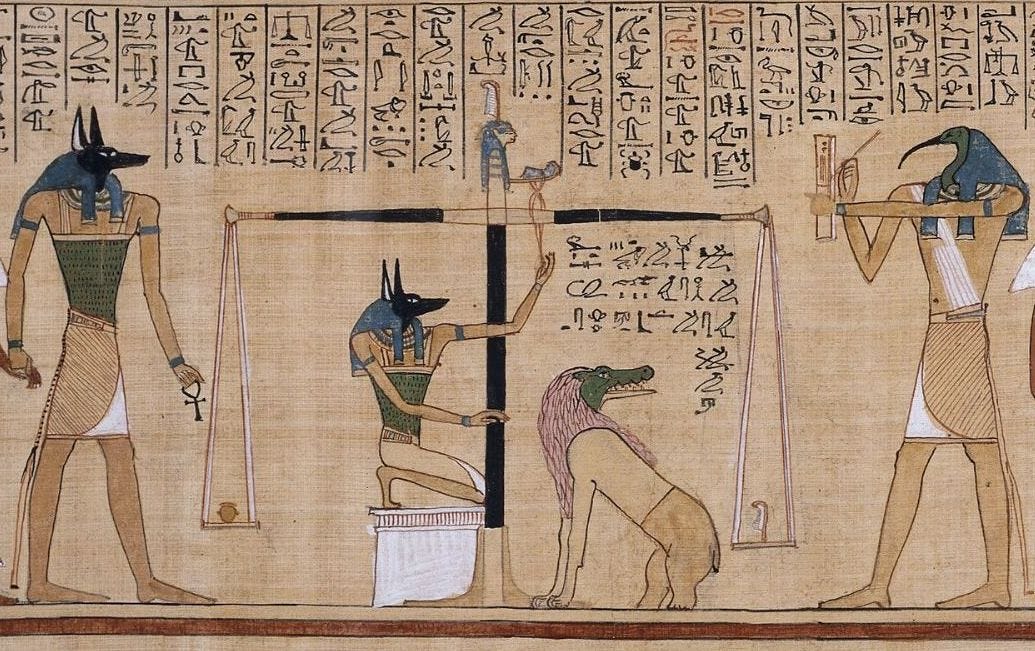
The Weighing of the Heart | Book of the Dead of Hunefer, Thebes, ca. 1275 BCE
British Museum | Photo Credit: Wikimedia Commons
Overview
Egypt is the ancient civilization most of us already know something about: pyramids, mummies, pharaohs. This section puts nine of its objects in front of you, in the British Museum's Egyptian rooms and the Louvre's. Four ideas organize this section, and each is an exam term.
Key Terms
Pharaoh · Hieroglyphs · Book of the Dead · Ma'at
Timeline
• ca. 3500 BCE | The Gebelein Man is buried in the desert sand
• ca. 3100 BCE | Narmer unites Upper and Lower Egypt
• ca. 2450 BCE | Akhethetep's tomb chapel is built at Saqqara
• 1279 to 1213 BCE | Ramses II rules Egypt
• 196 BCE | The Rosetta Stone is carved
Pharaoh | The Great House
The oldest Egyptian on our tour never saw a pharaoh. The Gebelein Man in the British Museum died about 5,500 years ago and was buried in a shallow grave in the desert, where the hot sand dried his body before it could decay; look for the red hair that earned him the nickname Ginger. Forget your TV-induced view of a desert-brown Egypt. In its time, Egypt was the breadbasket of the ancient world. Every summer the Nile rose and spilled over its banks. When the water drew back in the fall, it left a layer of black silt behind, and the crops could be planted and flourish. The Egyptians called the valley Kemet, the Black Land, and the desert on either side Deshret, the Red Land. Upper and Lower Egypt were two kingdoms, united ca. 3100 BCE under a king remembered as Narmer. Ever after, the pharaohs wore a double crown to symbolize sovereignty over both. The word pharaoh comes from the Egyptian per-aa, “great house,” the palace. The pharaoh was the head of the central government, regarded as a living god, and exercised absolute power. The ultimate pharaoh was Ramses II, who led Egypt for 66 years. The Younger Memnon in the British Museum's Room 4 is the head and shoulders of one of his colossal statues, cut from a single block of two-colored granite; notice how the sculptor used the pink stone for the face and the grey for the body, and the hole in the right shoulder, said to have been drilled by a French expedition that tried and failed to carry it off. The pharaoh was not the only Egyptian who built for eternity. The Louvre's mastaba of Akhethetep is an entire tomb chapel from the age of the pyramids, moved stone by stone from Saqqara; walk inside and find the scenes of farming, fishing, and accounts being presented to the owner, carved so that the dead man could keep his estate forever.
Hieroglyphs | Scribes & the Rosetta Stone
How do we know about Ancient Egypt? Scribes in Ancient Egypt recorded a wealth of information: personal letters, administrative decrees, legal rulings, tax records, wills, and a variety of other documents give insight into life in Egypt thousands of years ago. Writing was carved and painted on the walls of tombs and on the bases of statues, and written in ink on papyrus, the reed-paper that gave us the word paper. The Greeks called the picture-script hieroglyphs, “sacred carvings.” The Egyptians called it the god's words, and used it beside two faster scripts, hieratic and later demotic, for everyday ink. The Seated Scribe in the Louvre is one of those men at work: a painted limestone figure from the age of the pyramids, sitting cross-legged with a papyrus roll open on his lap, his eyes inlaid with rock crystal and copper so that they still seem to look up at whoever is dictating. Egyptian writing is found everywhere in the artifacts of Ancient Egypt, but until the Rosetta Stone was found, the writing remained an untranslatable mystery. The Rosetta Stone was carved in 196 BCE on a stele, like the one used by Hammurabi. It carries a royal decree of Ptolemy V, written in three scripts: hieroglyphs, the script of the gods and the temples; demotic, the common written script of Egypt; and Greek, the language of the Ptolemaic administration. No one had been able to read hieroglyphs for about 1,400 years when French soldiers dug the stone out of a fort wall in 1799. Because the Greek could be read, the Egyptian could be cracked, and in 1822 Jean-François Champollion did it. Everything on this page that quotes an Egyptian text goes back to that stone. It stands in the British Museum's Room 4, the most visited object in the building; look for the three bands of writing, hieroglyphs at the top and Greek at the bottom.
Book of the Dead | Coming Forth by Day
The Book of the Dead was the text used at funerals, and it included magic spells to help in the deceased's journey to the afterlife. It is not one book. It is a collection of about 190 spells, chosen and copied for each buyer, and the Egyptians called it the Spells of Coming Forth by Day. The dead man wants to come and go, to walk in the sunlight, and to sit down to a board game. The spells were the keys. One keeps his heart from testifying against him. Others give him breath, let him take the form of a falcon, and keep crocodiles away. One brings him to the Field of Reeds, a Nile valley with no bad years, where a little figure called a shabti, buried with him, answers “Here I am” when the gods call him to work the fields. The spells have a history. In the Old Kingdom they were carved inside the pyramids, for the king alone. In the Middle Kingdom they were painted inside the coffins of nobles. By the New Kingdom, anyone who could pay a scribe could own them on papyrus, and scribes sold ready-made copies with blanks for the buyer's name. The Louvre's Book of the Dead of Pasenedjemibnakht is one of the latest, a long papyrus made for a priest in the time of the Ptolemies; look for the small painted scenes running above the columns of text. Egypt's picture of the Field of Reeds hangs in the British Museum's Room 61, on the painted wall of the tomb-chapel of Nebamun: an official stands in a reed boat in the marshes, hunting birds with a throw-stick, his wife behind him, his daughter at his feet, and his cat catching three birds at once. Egypt buried the book because the dead would need to read it. It buried its animals too. The Gayer-Anderson Cat in Room 4 is a bronze coffin for a mummified cat, sacred to the goddess Bastet, with gold rings in its ears and nose.
Ma'at | The Weighing of the Heart
Hammurabi's answer to injustice was a law code: the strong held back from the weak by a stone full of if-then clauses. Egypt's answer was a single word. Ma'at means truth, justice, and right order all at once: the way the Nile rises on time, the way a scale balances, the way an honest man speaks. Its opposite, isfet, is wrong, disorder, the lie. Ma'at was also a goddess, a woman wearing a single ostrich feather on her head, and the pharaoh's first duty was to “put ma'at in the place of isfet” in the land. Where Hammurabi weighed a punishment against a crime, Egypt weighed the whole life. The most famous page in the Book of the Dead is in the British Museum's Room 62: the judgment of the scribe Hunefer, painted about 1275 BCE. The jackal-headed Anubis leads Hunefer into the Hall of Two Truths and sets his heart on one pan of a scale. On the other pan rests the feather of Ma'at. Ibis-headed Thoth stands ready with his pen to record the result, and beside him crouches Ammit, “the Devourer,” with a crocodile's head, a lion's forequarters, and a hippopotamus's hindquarters. If the heart is heavier than the feather, Ammit eats it, and the dead man ceases to exist. If it balances, Osiris declares him “true of voice,” and he passes into the Field of Reeds. Before the scale, the dead man speaks. He faces 42 gods, one for each province of Egypt, and to each he denies a wrong. Egyptologists call it the Negative Confession. Read the list as a philosophy, because that is what it is. The Egyptian did not list the laws he had obeyed. He listed the people he had not hurt. No murder, no theft, no lies, no false weights, no cheated field boundary, no one made to weep. Read the painting from left to right, the way Hunefer walks through it: the scale, the recording, and at the far right Osiris on his throne with Isis behind him, waiting. So what did the Egyptian soul weigh? Exactly as much as a feather, if the life had been lived rightly, and not one grain more.
Go Deeper
Culture & Values, 8th ed., Chapter 1, Beginnings (pp. 3 to 42): the Egyptian section.
Where to Find These Artifacts
London
• The Younger Memnon: British Museum, Rm 4, Egyptian Sculpture, Bay 9
• The Rosetta Stone: British Museum, Rm 4, Egyptian Sculpture, Central Saloon
• The Gayer-Anderson Cat: British Museum, Rm 4, Egyptian Sculpture, Bay 10
• Nebamun hunting in the marshes: British Mus., Rm 61, Egyptian Life & Death, Cs. 2
• The Book of the Dead of Hunefer: British Mus., Rm 62, Egyptian Afterlife, Case 24
• The Gebelein Man: British Museum, Rm 64, Early Egypt, Case 15
Paris
• The Seated Scribe: Louvre, Sully, Rm 635, Egyptian Antiquities, Case 10
• The Book of the Dead: Louvre, Sully, Rm 319, Egyptian Antiquities, Case 2
• The mastaba of Akhethetep: Louvre, Sully, Rm 333, Egyptian Antiquities
Module I • The Ancient Galleries
Sec 1 • Prehistory & Mesopotamia
Sec 2 • Ancient Egypt
Sec 3 • India & China
Sec 4 • Ancient Greece
Sec 5 • Ancient Rome
Course Page: Humanities: Study Abroad | London & Paris