

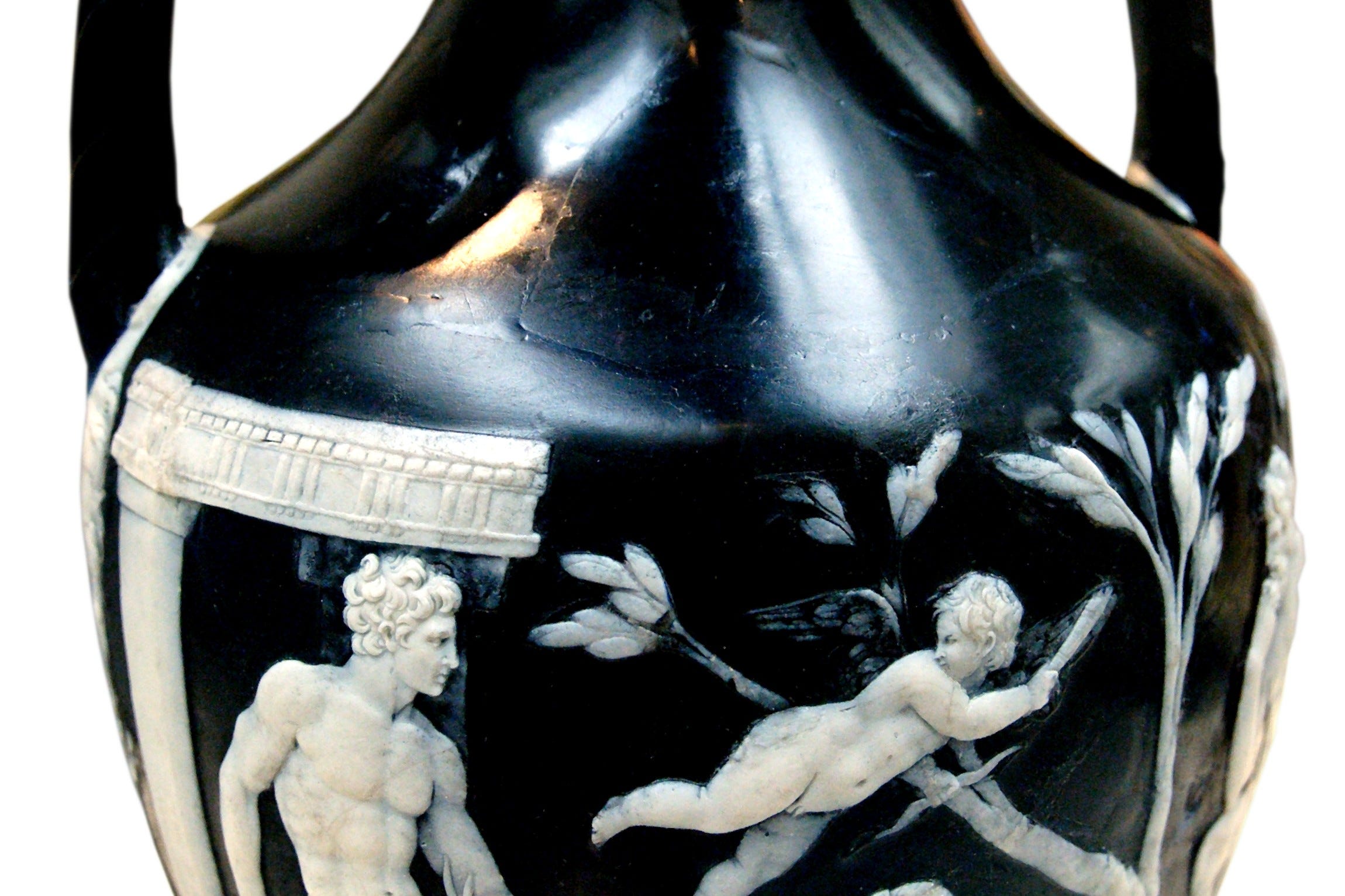
The Portland Vase | Rome, ca. 1-25 CE
British Museum | Photo Credit: Marie-Lan Nguyen via Wikimedia Commons

Overview
Rome is one room of the British Museum, Room 70, with the Roman Britain gallery upstairs to show what the empire looked like at its edge. The Louvre’s Roman wing is closed for renovation, so Paris lends only an Etruscan couple. Four ideas organize this section, and each is an exam term.
Key Terms
Republic · Pax Romana · Imperial Cult · Mos Maiorum
Timeline
• 509 BCE | Rome drives out its last king
• 146 BCE | Rome destroys Carthage and takes Corinth
• 44 BCE | Caesar is assassinated on the Ides of March
• 27 BCE | Octavian becomes Augustus
• 180 CE | Marcus Aurelius dies, and the Pax Romana ends
Republic | The Public Thing
Ancient Rome is divided into three ages: the Monarchy, the Republic, and the Empire. By Roman tradition, Rome was founded in 753 BCE by a tribe of farmers and herdsmen known as the Latins. To their north lived the Etruscans, who (tradition says) gave Rome its last kings. The Etruscans are in both of our museums. The Sarcophagus of the Spouses in the Louvre is a terracotta couple reclining together at a banquet, made in the years when Etruscan kings still ruled Rome; look at their hands, raised to offer something that has not survived. In the British Museum’s Room 71, the painted sarcophagus of Seianti Hanunia Tlesnasa shows an Etruscan noblewoman of Rome’s rising years, mirror in hand; look at her jewelry and her face, painted as she wished to be remembered. In 509 BCE (the traditional date), the Romans drove out their last king, Tarquin the Proud. The historian Livy says one of the first two consuls, Brutus, “made them take an oath that they would not suffer any man to reign in Rome.” What replaced the king was a Republic, from the Latin res publica, “the public thing.” Two consuls, elected for one year, led the city and its armies. The Senate, a council of some 300 elders drawn at first from the old aristocratic families (the patricians), advised them and held the purse. Assemblies of citizens elected the magistrates and passed the laws, and public life centered on the Forum, the city’s central public square. Rome was not a democracy like Athens, since its votes were weighted by wealth, but it was a constitution of shared power. It lasted nearly five hundred years. The Republic conquered the Mediterranean. In 146 BCE, Rome destroyed Carthage, and in the same year it captured Corinth. But victory enriched a few men and armed them. Generals began to raise armies loyal to themselves rather than to the Senate. In 49 BCE, Caesar led his army across the Rubicon, and civil war began. The Senate made him dictator for life in 44 BCE. A month later, senators who missed their power assassinated him at a meeting of the Senate on March 15, the Ides of March. One of them was a descendant of the Brutus who swore the oath, and Room 70 holds the silver coin he struck two years later to pay his army: his own face on one side and, on the other, two daggers flanking the cap of a freed slave, with the words EID MAR; look for the daggers, a murder announced as a liberation.
Pax Romana | The Roman Peace
Caesar’s adopted heir, Octavian, then defeated Mark Antony and Cleopatra of Egypt at Actium in 31 BCE. In 27 BCE, Octavian took the name Augustus and became the first emperor of Rome, though he never called himself a king. He was the princeps, the “first citizen,” and he kept the Senate, the consuls, and the elections. Augustus kept the forms of the Republic and the command of the armies, and a people worn out by a century of civil war let him. He wanted to be remembered as the leader who brought peace and splendor to Rome, and he boasted that he had found Rome “built of brick and left it in marble.” The marble head of Augustus in Room 70 may have been carved after his death, and it shows the face he chose; look for the calm, ageless features, since Augustus was never portrayed as an old man, though he lived to 76. His reign began the Pax Romana, the “Roman Peace,” some two centuries (27 BCE to 180 CE) of relative peace across the Mediterranean world. Roads, one coinage, and Roman law bound it together from Britain to Syria. The Portland Vase, the anchor image above, is the peace made in glass: white figures cut like a cameo over dark blue, made in Rome in the years of Augustus; look for the sea serpent rising between the lovers, and notice how thin the white layer becomes where the carver shaded a shoulder. The row of emperors along the wall ends with Marcus Aurelius, the philosopher whose death closed the peace; look at the curls of his beard, hollowed with a drill. Upstairs in Room 49, Roman Britain shows what the peace looked like at the edge of the world. The Vindolanda tablet is a birthday invitation written in ink on a sliver of wood around 100 CE by one officer’s wife, Claudia Severa, to another, Lepidina, at a fort in the north of Britain; look for the second hand at the end, where Severa adds a line herself, the earliest known Latin written by a woman. The military diploma of Reburrus is a bronze plate issued by the emperor Trajan in 103 CE to a Spanish cavalry officer after twenty-five years of service, granting him Roman citizenship; look at the names of the witnesses cut into the bronze, so that the grant could never be questioned. After the Pax Romana, the Western Empire lasted three more centuries, and it fell for a complex series of reasons. In 476 CE, a Germanic general deposed the last emperor in the West, a boy who bore the names of Rome’s founder and its first emperor: Romulus Augustulus, “little Augustus.”
Imperial Cult | Gods of the Empire
Rome’s religion was a state affair. Instead of the separation of church and state as we practice it in the United States, Rome’s sacred practices were integral to the government, with an official priesthood, public temples, and a calendar of festivals. The Romans welcomed new gods as readily as new citizens. They had long identified their own gods with the Greek gods, Jupiter with Zeus and Juno with Hera. This fusion of traditions is called syncretism. They also brought foreign gods to Rome outright: the Great Mother, Cybele, from Asia Minor, and Isis from Egypt. In Room 69 a small bronze Isis-Tyche wears the Egyptian goddess’s crown on the body of the Greek goddess of fortune, with a horn of plenty and a ship’s rudder; look at the rudder, because Isis steered sailors home. Across the room, Mithras slays the bull, a Persian god beloved of soldiers, in trousers and a Phrygian cap; look for the dog, the snake, and the scorpion at the wound. Rome could tolerate almost any god, as long as the gods of Rome received their due. Rome’s newest gods were its rulers. After the assassination of Julius Caesar in 44 BCE, a comet blazed over his memorial games, and many Romans took it for his soul rising to the heavens. In 42 BCE, the Senate declared him a god of the state, Divus Iulius, “the deified Julius,” and his temple rose in the Forum where his body had been burned. The ancient idea of the god-king had come to Rome. Augustus was declared divus after his death in 14 CE, and while he lived, the provinces built altars to “Rome and Augustus.” This was the Imperial Cult: temples, priests, and offerings for the emperors, living and deified, across the empire. The marble altar in Room 70 was dedicated around 3 BCE to Gaius and Lucius Caesar, the grandsons Augustus had adopted as his heirs, each named “leader of the youth”; look at the inscription, cut while both boys were alive, and know that both were dead within a few years. A pinch of incense before the emperor’s image was a public act of fides, loyalty to Rome made visible. In Room 49, the bronze head of Hadrian was pulled from the Thames in 1834, from a statue that once stood in Roman London, and beside it the head of Nero came out of a Suffolk river; look at Hadrian’s beard, the first on an emperor, worn in the Greek style he loved. Jews held an ancient exemption from these sacrifices. Around 112 CE, the governor Pliny the Younger wrote to the emperor Trajan about Christians in his province who refused them.
Mos Maiorum | The Way of the Ancestors
Central to Roman cultural life was the mos maiorum, the “way of the ancestors.” This term was not written in scripture. Instead, it refers to the values and traditions that each Roman generation inherited from those who came before. It was crucial to remain faithful to these ancestral norms, and to Rome itself, a commitment Romans called fides (Latin for “faithfulness”). We see echoes of this today in the U.S. Marine Corps motto, Semper Fidelis, “Always Faithful.” Ancestors were also esteemed and highly regarded, especially by families with a long and honored history of public service. Such families kept wax masks of their ancestors in the front hall, and at a funeral, men chosen for their likeness to the dead wore them in procession, so that the whole line of the family led its newest member to the Forum. Roman sculpture of the Republican period featured realistic details, wrinkles and all, that expressed the inner character of the sculpted figure. The portrait head of an old man in Room 70, carved in the last years of the Republic, is so exact in its folds and hollows that it may have been copied from one of those wax masks; look at the shaven scalp and the lines beside the mouth, which no Greek sculptor would have kept. At the same time, Romans practiced a simpler religion at home. It honored Vesta, the goddess of the hearth, and the Lares, minor guardian gods who protected the home and its land. Beside them stood the Penates, the gods of the storeroom. In many houses, a small shrine called a lararium stood in the kitchen or the front hall, often painted with the Lares as young dancers pouring from raised cups. The bronze Lar in Room 70 is one of those dancers, a figure a few inches high who once held a drinking horn high and a dish low; look at the swing of his tunic, caught mid-step. Every Roman house kept its own gods because the home, like the city, owed the gods its duty and needed their protection over its fire, its land, and its food. The house was a little city, and the city had a hearth of its own. In the Roman Forum, Vesta’s round temple kept a sacred fire that was never allowed to go out. Six priestesses, the Vestal Virgins, tended it, and as long as Vesta’s fire burned, Romans believed, Rome stood.
Go Deeper
Culture & Values, 8th ed., Chapter 4, Rome (pp. 117 to 156).
Where to Find These Artifacts
London
• Sarcophagus of Seianti Hanunia Tlesnasa: British Museum, Rm 71, Etruscan World, Case 15
• Ides of March coin of Brutus: British Museum, Rm 70, Roman Empire, Case 3, no. 14
• Marble head of Augustus: British Museum, Rm 70, Roman Empire
• Portland Vase: British Museum, Rm 70, Roman Empire, Case 12
• Bust of Marcus Aurelius: British Museum, Rm 70, Roman Empire
• Altar to Gaius & Lucius Caesar: British Museum, Rm 70, Roman Empire, Case 15
• Bronze Lar: British Museum, Rm 70, Roman Empire, Case 15
• Portrait head of an old man: British Museum, Rm 70, Roman Empire, Case 6
• Isis-Tyche: British Museum, Rm 69, Greek & Roman Life, Case 34
• Mithras slaying the bull: British Museum, Rm 69, Greek & Roman Life
• Head of Hadrian: British Museum, Rm 49, Roman Britain, Case 14
• Head of Nero: British Museum, Rm 49, Roman Britain, Case 14
• Vindolanda tablet (Claudia Severa’s invitation): British Museum, Rm 49, Roman Britain, Case 2
• Military diploma of Reburrus: British Museum, Rm 49, Roman Britain, Case 9
Paris
• Sarcophagus of the Spouses: Louvre, Sully 1, Rm 663, Etruscan Antiquities, Case 32
Module I • The Ancient Galleries
Sec 1 • Prehistory & Mesopotamia
Sec 2 • Ancient Egypt
Sec 3 • India & China
Sec 4 • Ancient Greece
Sec 5 • Ancient Rome
Course Page: Humanities: Study Abroad | London & Paris