

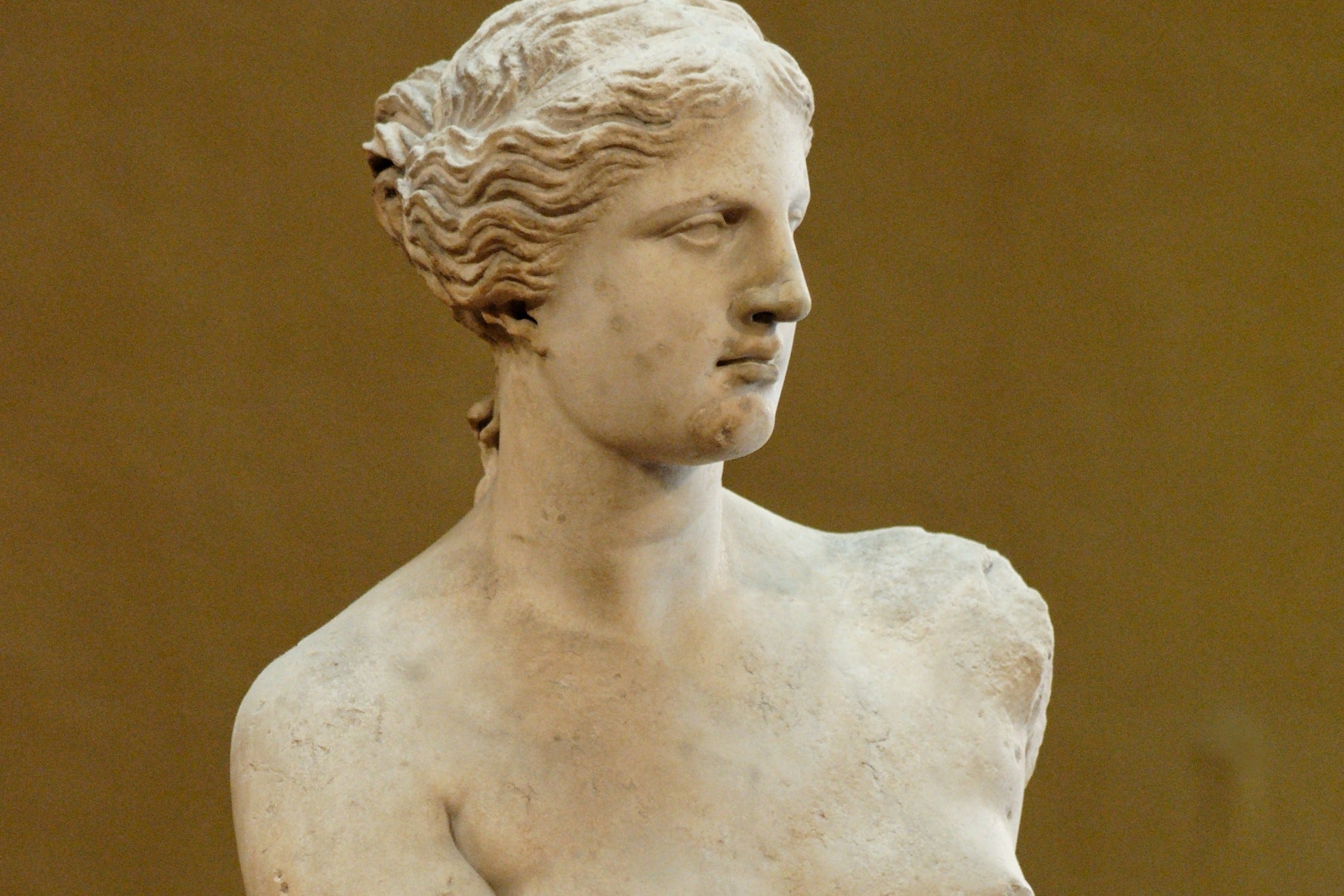
The Venus de Milo | Melos (Greece), ca. 150-125 BCE
Louvre | Photo Credit: Wikimedia Commons
Overview
Greece fills seven rooms of the British Museum and six of the Louvre, so this section runs the long way, from an Athenian grave vase to the Parthenon marbles to a goddess from the island of Melos. Four ideas organize this section, and each is an exam term.
Key Terms
Kouros · Parthenon · Classical Ideal · Hellenistic Period
Timeline
• ca. 750 BCE | Homer’s epics take shape
• 480 BCE | The Persians burn the Acropolis
• 447 BCE | Work begins on the Parthenon
• 404 BCE | Athens surrenders to Sparta
• 323 BCE | Alexander dies in Babylon
Kouros | The Archaic Youth
Evidence for the arts in the Heroic Age is mainly limited to pottery, because very little other evidence has survived. For some 300 years, Greek potters covered their vessels in bands of geometric design: circles, zigzags, and the meander, a maze-like key pattern still painted on Greek restaurants today. The Elgin Amphora in Room 13 is one of these, a grave vase from Athens with a double meander around its neck; look for a human figure anywhere on it, and you will not find one. The human form did not emerge on Greek pottery until the 700s BCE. A few cases on, the Sophilos Dinos is a black-figure wine bowl ringed with lions and sphinxes and, on top, the wedding of Peleus and Thetis, the parents of Achilles; look between the columns of Peleus’s house for the words “Sophilos painted me,” the earliest Athenian painter whose name we know. Homer’s two masterpieces, the Iliad and the Odyssey, grew out of centuries of oral tradition, sung by bards before the Greeks borrowed their alphabet from the Phoenicians and wrote the poems down. Greek sculpture also began under Egypt’s influence. Egyptian statues had stood stiffly for centuries, left foot forward, arms at their sides. The Greek equivalent of this look was the kore (maiden) and the kouros (youth), first sculpted in the late 600s BCE. The kore is a clothed female figure, often painted, and the kouros an unclothed male figure. Both wear the faint “Archaic smile.” The Louvre’s Room 170 holds the sequence. The Dame d’Auxerre is the oldest, a column of limestone with her hand flat on her chest; look at her hair, cut in the heavy locks of an Egyptian wig. The Rampin Horseman is a head that turns and smiles under a wreath of leaves. The Kouros of Paros stands left foot forward, arms at his sides, exactly as Egypt had taught. Then the stiff kore and kouros became more realistic and natural looking. The Strangford Apollo in the British Museum’s Room 15 is a kouros from the end of that road; look at his left knee, which bends, and at his hips, where the weight has begun to shift. The piece to know is the Kritios Boy in Athens, the first sculpture of a human that steps away from the rigid, Egyptian-inspired kouros design. His weight rests on one leg while the other relaxes, so his hips tilt and his shoulders answer them. The Egyptians carved for eternity, and so their statues never move. The Greeks carved a living moment.
Parthenon | Athena’s Temple & the Allies’ Silver
The Acropolis (the “high city”) of Athens had been a citadel for centuries, and in 480 BCE the Persians burned the temples on it. For some thirty years, the Athenians left the ruins as they were. Then came Pericles’ building program, paid for in part with the silver of the Delian League, the alliance against Persia that Athens had turned into an empire. His portrait bust in Room 15 is a Roman copy with his name cut in Greek; look for the helmet pushed back on his head. The Parthenon is the temple of Athena Parthenos, Athena the Maiden. Ictinus and Callicrates were its architects, and the sculptor Phidias oversaw the work. It is built of white marble in the Doric order, with Ionic touches such as its continuous frieze. Yet the Parthenon has almost no straight lines. Its floor rises gently toward the center, and its columns lean slightly inward and swell a little at the middle, so that, to the eye, it looks perfectly straight and solid. Lord Elgin’s agents shipped much of its sculpture to London in the early 1800s, and Room 18 holds it in three kinds. The pediments are the triangular gables under the roof, and the east one showed the birth of Athena. From it come the reclining Dionysos, look for the ease of a god who has just watched the sun come up, and the horse of Selene, the moon’s chariot horse sinking below the frame; look at its flared nostrils and bulging eye. The metopes are square panels carved in high relief, and on South Metope XXVII a Lapith and a centaur pull against each other; look at the cloak that falls between them like a stage curtain. The relief that runs around the top of the Parthenon’s inner walls, called a frieze, depicts a procession, showing Athenians on their way to the Acropolis to honor Athena. It runs some 524 feet, and there is a great variety of movement, gesture, and rhythm even in this low relief. On the north frieze riders crowd forward in overlapping ranks; look for the one who glances back. The Louvre has a block of its own, the Plaque of the Ergastines, six girls who wove Athena’s robe walking toward two marshals; look at the folds of their dresses, which fall like the fluting of columns. The Erechtheion next door is in the more graceful Ionic order, and its Porch of the Maidens rests on six Caryatids. These statues are columns in the shape of women that held up the roof of its south porch. One of the six is in Room 19, a Caryatid; look at her right leg, straight under the weight she once bore.
Classical Ideal | Nothing in Excess
The Classical Age of Greece is known for the Classical Ideal, which was the idea of perfection that was promoted during the time in many artistic endeavors. Qualities of the Classical Ideal are order and control. Most important to these artists and philosophers was the principle of balance. Their works showed the value of human potential and capability. In a nutshell, the Classical Ideal holds that existence can be ordered and controlled, that human ability can triumph over chaos, that society should be balanced, in equilibrium, that proportion can be perfect, that nothing should be in excess, and that human motivations can be understood. The Greeks carved the fifth line in stone at Delphi, where Apollo’s temple bore the words “Nothing in excess.” One of the first great achievements after the Persian Wars was the Temple of Zeus at Olympia. It shows the proportion and balanced interrelationships typified by the Classical Ideal. The Louvre holds a piece of it, a metope of Heracles and the Stymphalian birds in which Athena sits on a rock to receive the dead birds from the hero; look for the calm of a goddess who already knows how the labor ends. Sculpture changed in the same decades. Myron’s Discus Thrower (in the Greek, Discobolus), known today from Roman copies, is an excellent example of realism in Greek sculpture: the idealized portrayal of an athlete, showing the ideals of proportion, symmetry, and balance. The British Museum’s copy, the Townley Discobolus, stands in Room 1 among the cases of the Enlightenment gallery; look at the head, which an eighteenth-century restorer set facing the wrong way, so that the athlete looks down instead of back at his discus. The Greeks also credited Ictinus, the Parthenon’s architect, with the temple of Apollo at Bassae in the hills of Arcadia, and one slab of its frieze is upstairs in Room 16: a centaur thrown down by two Lapiths while another gallops to the rescue. The subject is the one the Parthenon metopes tell, and so is the lesson. The Lapiths are men, the centaurs are appetite, and the Classical Ideal is the side that keeps its footing.
Hellenistic Period | Alexander’s World
After the Peloponnesian War, Athens is no longer the center of Greek power. Power passed at last to a kingdom on the northern edge of the Greek world, Macedon, where Philip II ruled. He was assassinated, and his son Alexander the Great, a pupil of Aristotle, succeeded him. In eleven years, Alexander and his army conquered the Persian Empire. He took Egypt, where he founded Alexandria, then Babylon, Persia, and Bactria, and he reached the Indus. He died in Babylon at the age of 32. The time between the death of Alexander the Great in 323 BCE and the rise of Rome is known as the Hellenistic Period, from Hellēnes, the Greeks’ name for themselves. Alexander’s generals divided his empire, and Greek culture went with them. The Ptolemies took Egypt, and the Seleucids took Asia. This intermingling of cultures spread Greek culture from Egypt to India, while bringing the cultures of Egypt and Asia back to Greece. Koine, the “common” Greek of these kingdoms, would one day be the language of the New Testament. Room 22 of the British Museum is called the world of Alexander. The portrait head of Alexander there was found in Alexandria and carved a century or more after his death, when every king wanted his face; look for the upward tilt of the head and the hair rising from the brow, the signs by which the ancient world knew him. On the wall, the Apotheosis of Homer shows the poet enthroned, crowned by Time and the World while Zeus, Apollo, and the Muses look on; it was carved for a Ptolemy, the dynasty that built the library of Alexandria. The Louvre has the three Hellenistic statues the whole world knows. The Winged Victory of Samothrace lands on a ship’s prow at the top of the Daru staircase; look at the wind pressing her dress against her, the sculptor’s way of carving air. The Venus de Milo, the Aphrodite from the island of Melos, is the anchor image above; look for the twist at her waist, a spiral no kouros ever dared. The Borghese Gladiator is no gladiator at all but a warrior lunging up at a rider, signed by Agasias of Ephesus on the tree trunk at his leg; look at the single line that runs from his back heel to his raised arm. Rome finished what Alexander began. In 146 BCE Rome captured Corinth, the symbol of Greek independence. Even though Greece was politically conquered by Rome, Greek art and culture made a pronounced impression on Rome.
Go Deeper
Culture & Values, 8th ed., Chapter 2, Early Greece (pp. 45 to 77), and Chapter 3, Classical Greece and the Hellenistic Period (pp. 79 to 115).
Where to Find These Artifacts
London
• Elgin Amphora: British Museum, Rm 13, Greece 1050-520 BC, Case 1
• Sophilos Dinos: British Museum, Rm 13, Greece 1050-520 BC, Case 9
• Strangford Apollo: British Museum, Rm 15, Athens & Lycia
• Portrait bust of Pericles: British Museum, Rm 15, Athens & Lycia
• Bassae frieze slab: British Museum, Rm 16, Bassai Sculpture (upstairs)
• Dionysos, east pediment of the Parthenon: British Museum, Rm 18, Parthenon
• Horse of Selene, east pediment: British Museum, Rm 18, Parthenon
• South Metope XXVII: British Museum, Rm 18, Parthenon
• North frieze, Block XLVI: British Museum, Rm 18, Parthenon
• Caryatid from the Erechtheion: British Museum, Rm 19, Athens
• Townley Discobolus: British Museum, Rm 1, Enlightenment, near Wall Press 64
• Portrait head of Alexander: British Museum, Rm 22, World of Alexander
• Apotheosis of Homer: British Museum, Rm 22, World of Alexander, wall
Paris
• Dame d’Auxerre: Louvre, Denon -1, Rm 170, Preclassical Greece, Case 26
• Rampin Horseman (head): Louvre, Denon -1, Rm 170, Preclassical Greece, Case 43
• Kouros of Paros: Louvre, Denon -1, Rm 170, Preclassical Greece
• Metope of Heracles & the Stymphalian birds: Louvre, Denon 0, Rm 407, Olympia
• Plaque of the Ergastines: Louvre, Denon 0, Rm 347, Salle de Diane
• Venus de Milo: Louvre, Sully 0, Rm 345
• Borghese Gladiator: Louvre, Sully 0, Rm 348, Salle des Caryatides
• Winged Victory of Samothrace: Louvre, Denon 1, Rm 703, Daru staircase
Module I • The Ancient Galleries
Sec 1 • Prehistory & Mesopotamia
Sec 2 • Ancient Egypt
Sec 3 • India & China
Sec 4 • Ancient Greece
Sec 5 • Ancient Rome
Course Page: Humanities: Study Abroad | London & Paris