

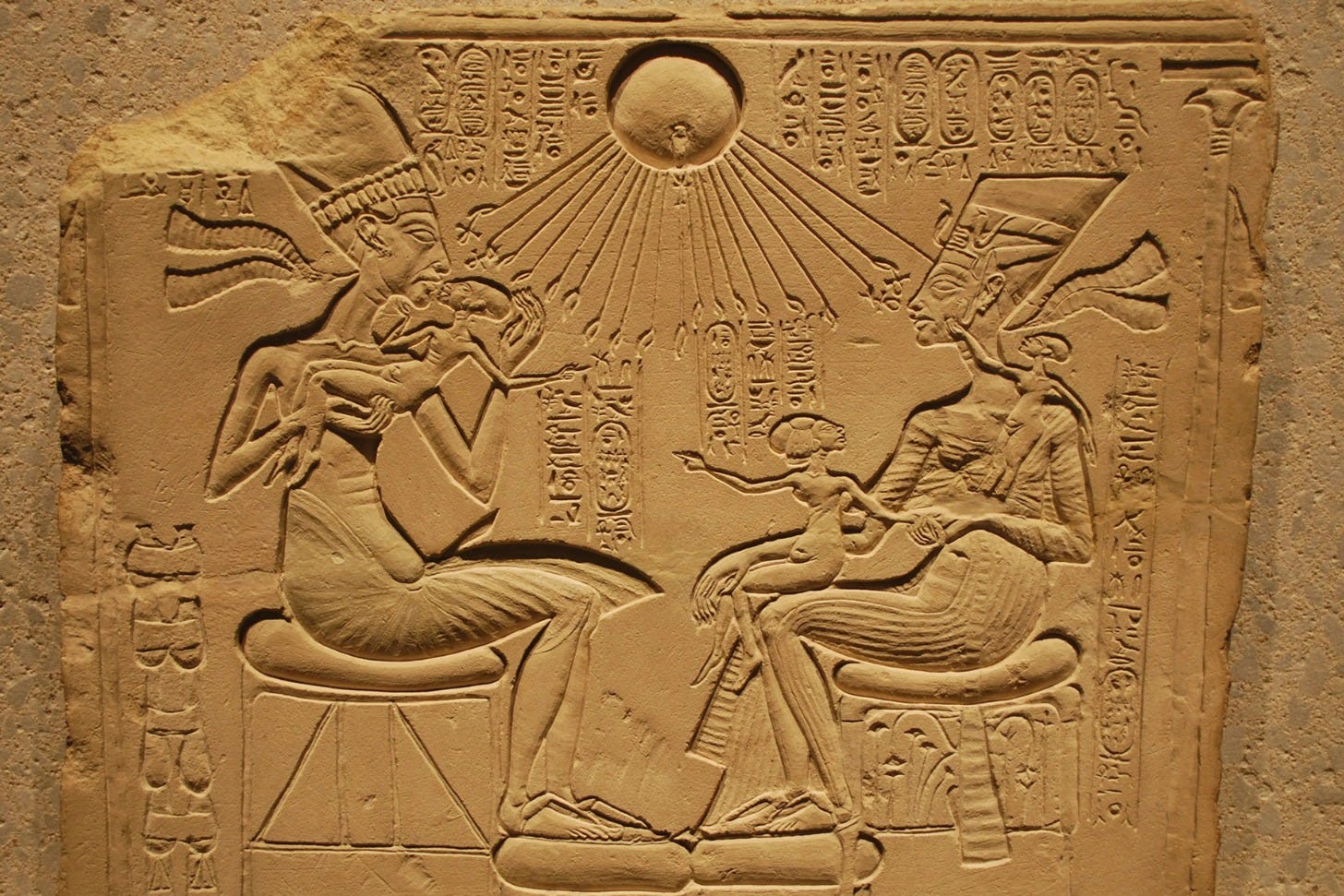
Akhenaten, Nefertiti, and Three of Their Daughters | Amarna, ca. 1340 BCE
(Egyptian Museum, Berlin)
Why do the gods of Egypt have the heads of animals?
Key Terms for this Lesson
Osiris · Isis · Aten
The Gods | Many Forms, One River
Egyptians believed deities, subdeities, and nature spirits are responsible for all aspects of existence. This is polytheism again (cf. Sec. 2.2), on a larger scale. A god could be shown as an animal, as a person, or as a person with an animal’s head. The head is not a portrait. It is a sign, like a hieroglyph carved onto a body, saying what the god does:
• Horus | the falcon, who sees the whole sky
• Anubis | the jackal, who prowled the desert cemeteries, so he guards the dead
• Thoth | the ibis, who writes
• Hathor | the cow, who nurses and gladdens (Sec. 3.3)
• Sobek | the crocodile, the river’s danger made a protector
No Egyptian thought Anubis was a jackal. The animal was the god’s power, worn as a mask. The same god could wear several. Ra, the sun, the chief god of Heliopolis, rises in the morning as a scarab beetle rolling its ball, crosses the sky at noon as a falcon-headed man crowned with the sun’s disk, and sails through the underworld by night as a ram-headed man, fighting the serpent Apophis so that the sun can rise again. From about 2500 BCE every pharaoh carried the title Son of Ra. In the New Kingdom Ra merged with Amun, the hidden god of Thebes, as Amun-Ra, head of the gods, whose priests commanded the wealthiest temples in Egypt.
Osiris & Isis | Death & Return
There are many Egyptian gods, but the two you should know are Osiris and Isis. Osiris was the judge and god of the dead, the good king of Egypt, and he was killed by his ambitious brother Set, who shut him in a chest and sent it down the Nile. Isis, Osiris’ sister and wife, mother goddess and protector of the living and the dead, brought him back to life. She found him and by her magic revived him long enough to conceive a son, Horus. Horus grew up, fought Set, and took back his father’s throne, while Osiris went below to rule the dead. Every pharaoh is Horus while he lives and Osiris when he dies, and every year the Nile’s return was Osiris returning, the black fields turning green again.
The story held a promise that Mesopotamia’s house of dust never made (cf. Sec. 2.2). There was a great preoccupation with immortality in Egypt. In Egyptian belief, the pharaoh was not the only person who could live forever. Anyone could, as long as they performed the correct rites and lived a good life (Secs. 3.5 and 3.6). Isis was one of the most well known Egyptian deities, and her worship outlived Egypt itself. A temple of Isis was found in the ruins of Pompeii, a Roman city in Italy, buried in 79 CE (cf. Sec. 8.2).
Akhenaten | The God Without a Face, ca. 1353–1336 BCE
Akhenaten (d. ca. 1336 BCE), born Amenhotep, is most known for his attempt to completely reform Egyptian religious and political life. He inherited a wealthy, peaceful kingdom. At the time of his reign, Egypt is the most powerful and wealthiest nation on earth, and at peace with all of its neighbors. Akhenaten changes all of that. He declares that there is only one god, the sun’s disk itself, the Aten. He changes his name to Akhenaten, “effective for the Aten,” and moves his capital from Thebes (where the priests of Amun are) to a new desert city, Amarna, to escape their influence. He closes the temples of Amun and the old gods and evicts their priests. As you might imagine, this made him rather unpopular in Thebes.
You’ll find no animal heads here. The Aten was carved as a plain disk whose rays end in small human hands, reaching down to the king and his family. The relief above, of Akhenaten and his family sitting in the sun, is a casual portrait that would never have been made in the Old Kingdom. Its great temple at Amarna had no roof, so the sun could shine on the worshippers. The king’s own hymn survives on the wall of a courtier’s tomb:
Thy dawning is beautiful in the horizon of the sky, / O living Aton, Beginning of life! / When thou risest in the eastern horizon, / Thou fillest every land with thy beauty. … / How manifold are thy works! / They are hidden from before (us), / O sole God, whose powers no other possesseth. The Hymn to the Aten (trans. James Henry Breasted, 1912)
Readers have long noticed that Psalm 104 praises the Creator in some of the same images, down to “O LORD, how manifold are thy works!” (cf. Sec. 9.4).
Akhenaten’s reforms didn’t last long. When he died, Egypt’s leaders rushed back to Thebes to renew the old ways. The boy pharaoh Tutankhamun (d. ca. 1323 BCE), probably Akhenaten’s son, was 9 years old, and the priests and generals who ruled through him reopened the temples, abandoned Amarna, and changed his name from Tutankhaten, “living image of the Aten,” to Tutankhamun, “living image of Amun.” Akhenaten was branded a heretic, and very few of his monuments survive. Within a generation the falcon, the jackal, and the ibis were back on the temple walls. Egypt had tried a god with no face, and chose the masks.
Sec 3 • Ancient Egypt
3.1 History & Politics • The Gift of the Nile
3.2 Sacred Life • Ra, Osiris, & Isis
3.3 Music • Hathor & the Sistrum
3.4 Art & Architecture • The Pyramids of Giza
3.5 Literature & Drama • The Book of the Dead
3.6 Wisdom • Ma’at & the Weighing of the Heart
Course Page: Humanities I & II