

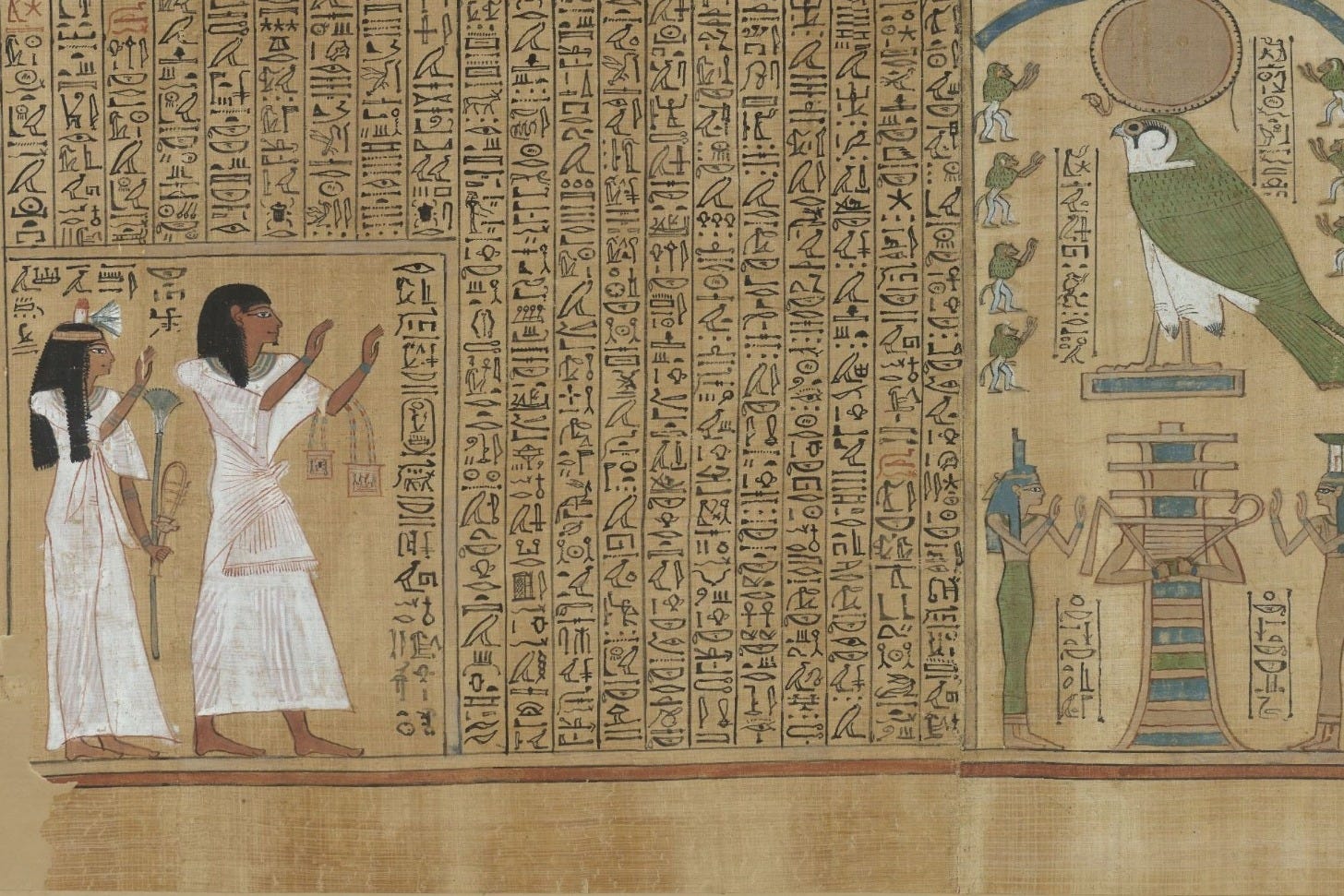
The Book of the Dead of Hunefer | Thebes, ca. 1275 BCE (British Museum)
Why did Egypt bury a book with the dead?
Key Terms for this Lesson
Hieroglyphs · Rosetta Stone · Book of the Dead
Scribes | Hieroglyphs & the Rosetta Stone
How do we know about Ancient Egypt? Scribes in Ancient Egypt recorded a wealth of information: personal letters, administrative decrees, legal rulings, tax records, wills, and a variety of other documents give insight into life in Egypt thousands of years ago. Writing was carved and painted on the walls of tombs and on the bases of statues, and written in ink on papyrus, the reed-paper that gave us the word paper. The Greeks called the picture-script hieroglyphs, “sacred carvings.” The Egyptians called it the god’s words, and used it beside two faster scripts, hieratic and later demotic, for everyday ink. Egyptian writing is found everywhere in the artifacts of Ancient Egypt, but until the Rosetta Stone was found, the writing remained an untranslatable mystery.
The Rosetta Stone was carved in 196 BCE on a stele, like the one used by Hammurabi (cf. Sec. 2.6). It carries a royal decree of Ptolemy V (d. 180 BCE), written in three scripts:
• Hieroglyphs | the script of the gods and the temples
• Demotic | the common written script of Egypt
• Greek | the language of the Ptolemaic administration
No one had been able to read hieroglyphs for about 1,400 years when French soldiers dug the stone out of a fort wall in 1799. Because the Greek could be read, the Egyptian could be cracked, and in 1822 Jean-François Champollion (d. 1832) did it. Everything in this section that quotes an Egyptian text goes back to that stone.
Coming Forth by Day | The Book of the Dead
The Book of the Dead was the text used at funerals, and it included magic spells to help in the deceased’s journey to the afterlife. It is not one book. It is a collection of about 190 spells, chosen and copied for each buyer, and the Egyptians called it the Spells of Coming Forth by Day. Its title spell says what the whole thing is for:
Here begin the praises and glorifyings of coming out from and going into the glorious Neter-khert in the beautiful Amenta, of coming out by day in all the forms of existence which please him, of playing at draughts and sitting in the Seh hall, and of coming forth as a living soul. The Book of the Dead, Papyrus of Ani, Chapter XVII (trans. E. A. Wallis Budge, 1895)
Neter-khert is the realm of the dead, and Amenta the West, where the sun goes down (Sec. 3.3). The dead man wants to come and go, to walk in the sunlight, and to sit down to a board game. The spells were the keys. One keeps his heart from testifying against him (Sec. 3.6). Others give him breath, let him take the form of a falcon, and keep crocodiles away. One brings him to the Field of Reeds, a Nile valley with no bad years, where a little figure called a shabti, buried with him, answers “Here I am” when the gods call him to work the fields.
The spells have a history. In the Old Kingdom they were carved inside the pyramids, for the king alone (Sec. 3.4). In the Middle Kingdom they were painted inside the coffins of nobles. By the New Kingdom, anyone who could pay a scribe could own them on papyrus, and scribes sold ready-made copies with blanks for the buyer’s name. The Papyrus of Ani (ca. 1250 BCE), 78 feet long, is the most famous copy. The papyrus of the scribe Hunefer, above, is another. Both are in the British Museum. Egypt buried the book because the dead would need to read it.
Sinuhe & Abydos | Story & Stage
Egypt’s favorite story was about a man who nearly died in the wrong place. In the Tale of Sinuhe (ca. 1900 BCE), a courtier panics at the news that the king has died, flees across the border into Canaan, and prospers there for decades, even killing a local champion in single combat (a scene readers have set beside David and Goliath, cf. Sec. 9.1). Then he grows old, and his one fear is being buried abroad. The new pharaoh writes to call him home, and Sinuhe ends his story in a stone tomb in Egypt. Schoolboys copied the tale for centuries.
Egypt had a stage too. At Abydos, the holy city of Osiris, the god’s death and return were acted out every year in a Great Procession, with a mock battle on the road and the god’s boat carried to his tomb. A Middle Kingdom official named Ikhernofret left a stela describing how he staged it, and some historians call it the oldest drama on record. The audience of pilgrims knew the ending. Osiris would rise (Sec. 3.2), and the dead who had the right words would rise with him.
Sec 3 • Ancient Egypt
3.1 History & Politics • The Gift of the Nile
3.2 Sacred Life • Ra, Osiris, & Isis
3.3 Music • Hathor & the Sistrum
3.4 Art & Architecture • The Pyramids of Giza
3.5 Literature & Drama • The Book of the Dead
3.6 Wisdom • Ma’at & the Weighing of the Heart
Course Page: Humanities I & II