

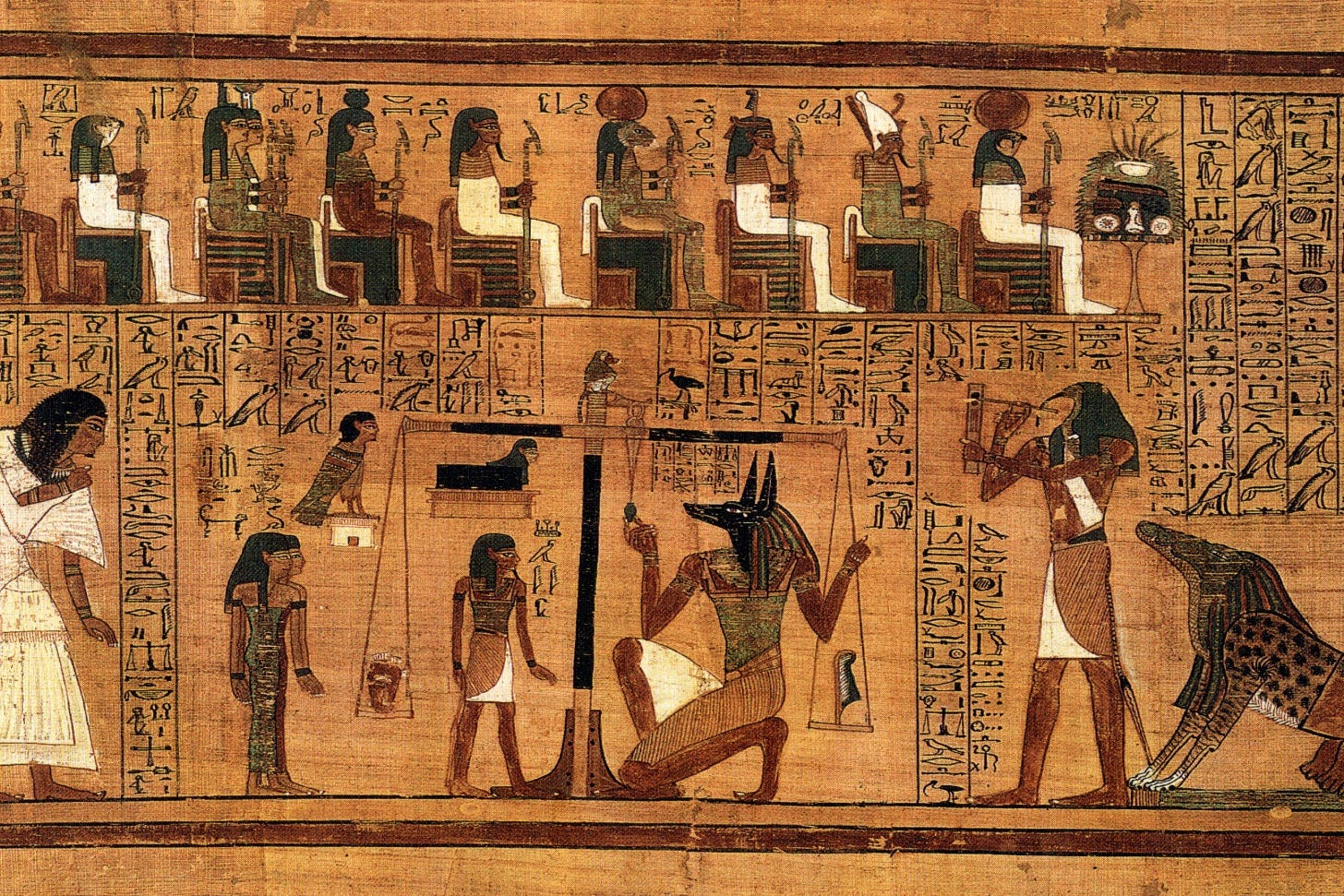
The Weighing of the Heart | Papyrus of Ani, Thebes, ca. 1250 BCE (British Museum, detail)
The weight of the Egyptian soul.
Key Terms for this Lesson
Ma’at · Negative Confession · Ammit
Ma’at | Truth, Order, & the Feather
Hammurabi’s answer to injustice was a law code: the strong held back from the weak by a stone full of if-then clauses (cf. Sec. 2.6). Egypt’s answer was a single word. Ma’at means truth, justice, and right order all at once: the way the Nile rises on time, the way a scale balances, the way an honest man speaks. Its opposite, isfet, is wrong, disorder, the lie. Ma’at was also a goddess, a woman wearing a single ostrich feather on her head, and the pharaoh’s first duty was to “put ma’at in the place of isfet” in the land. His chief judge, the vizier, was called the priest of Ma’at.
No Egyptian law code survives. What survives are stories about justice. In the Tale of the Eloquent Peasant (ca. 1850 BCE), a poor man is robbed of his donkeys by a local official and goes to the high steward to complain. He pleads nine times, and his speeches are so fine that the steward, on the king’s secret orders, keeps refusing him just to hear more. “Thou art appointed,” the peasant tells him, “to hear causes, to judge two litigants, to ward off the robber,” and then the line Egypt remembered: “Thou art set for a dam for the afflicted, to save him from drowning” (trans. Breasted, 1912). In the end the peasant gets justice and the robber’s estate. The point of the story is that the poorest man in Egypt had a claim on ma’at, and knew it.
The Weighing of the Heart | Chapter 125
Where Hammurabi weighed a punishment against a crime, Egypt weighed the whole life. The scene above is the most famous page in the Book of the Dead (Sec. 3.5). The jackal-headed Anubis leads the scribe Ani into the Hall of Two Truths and sets his heart on one pan of a scale. On the other pan rests the feather of Ma’at. Ibis-headed Thoth stands ready with his pen to record the result, and beside him crouches Ammit, “the Devourer,” with a crocodile’s head, a lion’s forequarters, and a hippopotamus’s hindquarters. If the heart is heavier than the feather, Ammit eats it, and the dead man ceases to exist. If it balances, Osiris declares him maa-kheru, “true of voice,” and he passes into the Field of Reeds (Sec. 3.5).
Before the scale, the dead man speaks. In Chapter 125 he faces 42 gods, one for each province of Egypt, and to each he denies a wrong. Egyptologists call it the Negative Confession:
I have not done iniquity. … I have not robbed with violence. … I have not made any to suffer pain. … I have done no murder. … I have told no lies. … I have not snatched away food. … I have not been angry without a cause. … I have not caused [any] to weep. … I have not stopped my ears against the words of Right and Truth. The Book of the Dead, Chapter 125, Papyrus of Nebseni (trans. E. A. Wallis Budge, 1895)
Read the list as a philosophy, because that is what it is. The Egyptian did not list the laws he had obeyed. He listed the people he had not hurt. No murder, no theft, no lies, no false weights, no cheated field boundary, no one made to weep. Most of it concerns neighbors, not gods. The heart was the seat of mind and memory, and the Egyptians knew their hearts might betray them, so the book also supplied a spell to keep it quiet, carved on a stone heart scarab laid over the heart in the wrappings: “My heart my mother, my heart my mother, my heart my coming into being! May there be nothing to resist me at my judgment” (Chapter 30B, trans. Budge). Even the Egyptian took a lawyer into the courtroom.
A Life on the Scale | Egypt & Its Neighbors
Mesopotamia sent every soul, good or wicked, down to the same house of dust (cf. Sec. 2.2). Egypt is the first civilization we know of to say that how you lived decided where you went. Israel’s scriptures know a weighed life too: “Let me be weighed in an even balance, that God may know mine integrity,” says Job 31:6, and the writing on Belshazzar’s wall reads “Thou art weighed in the balances, and art found wanting” (Daniel 5:27, cf. Sec. 9.5). Lady Justice still holds a scale outside our courthouses.
So what did the Egyptian soul weigh? Exactly as much as a feather, if the life had been lived rightly, and not one grain more. Egypt asked its people to live so that, at the end, their hearts would be light. That is a philosophy, more than a thousand years before the Greeks gave the subject its name (Sec. 6.5). Next, we look east to the Indus (Sec. 4.1).
Sec 3 • Ancient Egypt
3.1 History & Politics • The Gift of the Nile
3.2 Sacred Life • Ra, Osiris, & Isis
3.3 Music • Hathor & the Sistrum
3.4 Art & Architecture • The Pyramids of Giza
3.5 Literature & Drama • The Book of the Dead
3.6 Wisdom • Ma’at & the Weighing of the Heart
Course Page: Humanities I & II
Next Section: Ancient India