

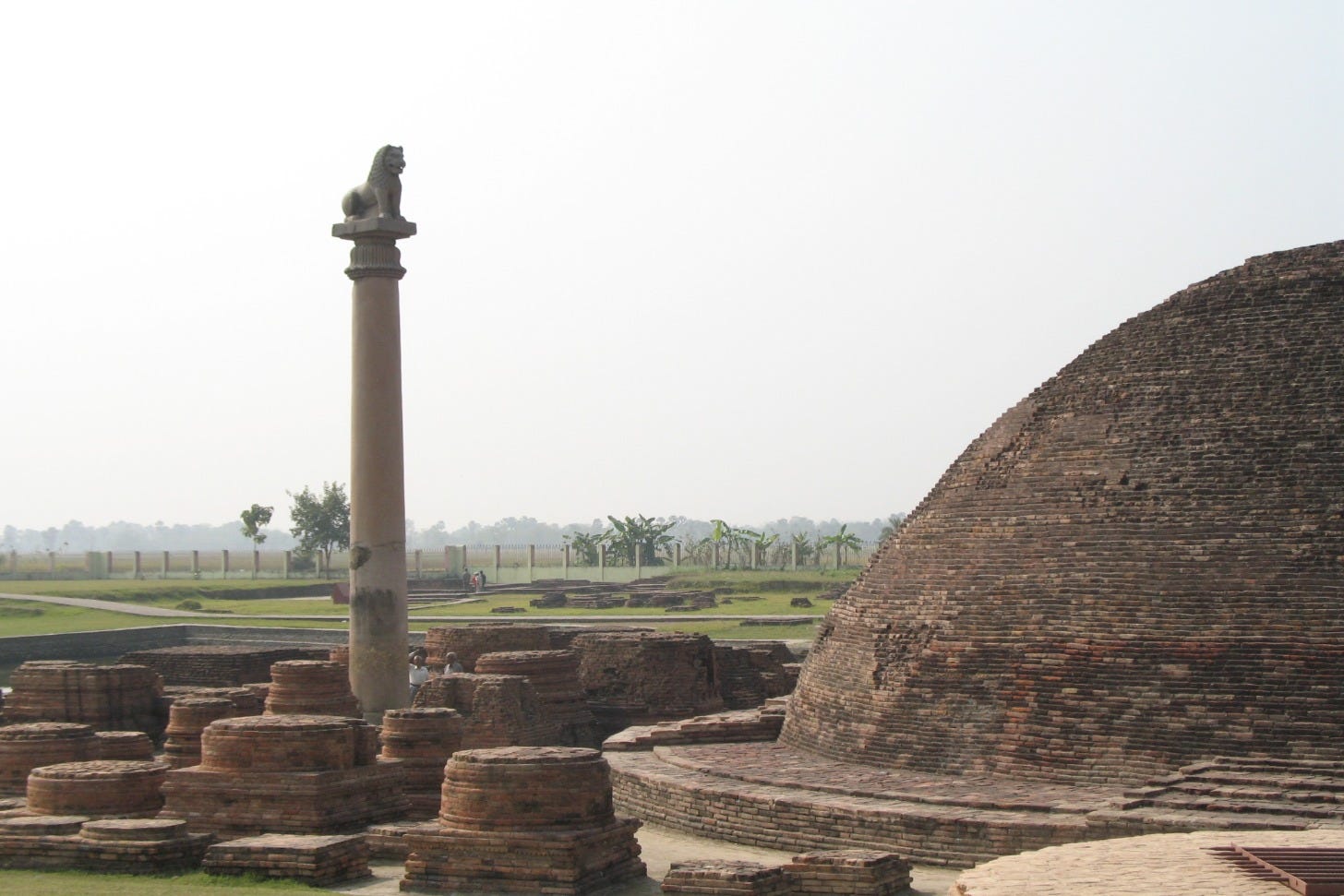
Ashoka’s Lion Pillar & Stupa | Vaishali, Bihar, ca. 250 BCE
Photo Credit: Manoj nav via Wikimedia Commons
Why did an emperor carve his regrets into rock?
Key Terms for this Lesson
Indus Valley Civilization · Ashoka · Rock Edicts
The Indus Valley | ca. 2600–1900 BCE
In the 1850s, British engineers laying a railway across the Punjab needed ballast for the track. They found it in a mound of old fired bricks beside a village called Harappa and laid nearly a hundred miles of line on top of them. No one asked who had made the bricks. The answer came in the 1920s, when digs at Harappa and at Mohenjo-daro, 400 miles south, uncovered a civilization no surviving text had ever mentioned.
Civilization begins in India in the Indus Valley. The Indus Valley Civilization was the largest of the four river-valley civilizations (cf. Sec. 2.1), spread over more than 1,000 sites in what is now Pakistan and northwest India. Its two great cities were planned on a grid: streets crossing at right angles, houses of standard-sized brick, and covered drains under the streets. Its best-known building is the Great Bath, a watertight brick tank 39 feet long. It was an agricultural-based society, and archaeological evidence has shown us that they grew cotton, among the oldest cotton textiles known anywhere.
What the Indus cities lack is as striking as what they have. No palace, no temple, no royal tomb, and no king’s name. Ur had its ziggurat and Giza its pyramids (cf. Sec. 2.3, 3.4). They had a written language based on picture signs, but we cannot decipher it. Some 400 signs survive on small stone seals, and no Rosetta Stone has turned up to unlock them (cf. Sec. 3.5). Around 1900 BCE the cities emptied — most likely because the rivers shifted and the rains failed. The Indus script died with its cities, and no later Indian text remembers them.
From the Vedas to the Mauryas | ca. 1500–261 BCE
• ca. 2600 BCE | Mohenjo-daro and Harappa at their height
• ca. 1500 BCE | Indo-Aryan speakers reach the Punjab and sing the Rig Veda (Sec. 4.2)
• 326 BCE | Alexander the Great crosses the Indus
• ca. 321 BCE | Chandragupta founds the Mauryan Empire
• ca. 261 BCE | Ashoka conquers Kalinga
Around 1500 BCE, herding peoples speaking an early form of Sanskrit moved into the Punjab from the northwest. They called themselves arya, “noble,” and their language is a cousin of Greek, Latin, and English (Sanskrit pitr, Latin pater, English father). Their hymns, the Vedas, were sung for centuries before anyone wrote them down (Sec. 4.2). The caste system is ancient. The Rig Veda names four broad classes: the Brahmins (priests and scholars), Kshatriyas (warriors and rulers), Vaishyas (merchants and farmers), and Shudras (laborers).
By 600 BCE the center of gravity had moved east to the Ganges plain, where iron tools and rice fed the first true cities of the subcontinent. The Buddha lived during this time (Sec. 4.3). In 326 BCE Alexander the Great (d. 323 BCE) crossed the Indus, and was stopped only by his own soldiers, who refused to go farther. Within a decade Chandragupta Maurya (d. ca. 297 BCE) had taken the Punjab from Alexander’s successors and founded the Mauryan Empire at Pataliputra (modern Patna).
Ashoka | The Edicts in Stone
Chandragupta’s grandson Ashoka (r. ca. 268–232 BCE) is still viewed as one of the greatest rulers of India. Around 261 BCE he conquered Kalinga, on the Bay of Bengal, and then did something no conqueror had done before. He wrote down what the victory had cost and had it cut into rock faces and polished pillars from Afghanistan to the Deccan. His own count: 150,000 carried away captive, 100,000 slain, and many times that number dead.
Thence arises the remorse of His Sacred Majesty for having conquered the Kalingas, because the conquest of a country previously unconquered involves the slaughter, death, and carrying away captive of the people. That is a matter of profound sorrow and regret to His Sacred Majesty. Rock Edict XIII (trans. Vincent A. Smith, 1920)
These are the Rock Edicts: proclamations from the emperor carved into rock to spread his commands, public sermons in stone. Ashoka had turned to the teaching of the Buddha (Sec. 4.3), and the edicts preach what he calls dhamma (his spelling of dharma, the right way): non-violence (ahimsa), kindness to animals, respect for every sect, and care for the subject. He referred to his subjects as his children (”All men are my children”). He planted shade trees, dug wells, and set up medical care for people and animals. Rock Edict XIII even names five Greek kings his envoys reached, Antiochus of Syria and Ptolemy of Egypt among them, and at Kandahar one of his edicts is carved in Greek (cf. Sec. 7.1).
Then India forgot how to read them. The edicts were written in Brahmi, the ancestor of most of India’s scripts, and within a few centuries the letters had changed past recognition. For well over a thousand years the inscriptions stood in plain sight, unread, until James Prinsep (d. 1840) cracked the script in 1837. The same Brahmi script carried India’s numerals, the ancestors of the digits the world now calls “Arabic” (cf. Sec. 11.3). The empire had broken up within fifty years of Ashoka’s death, but the rocks remained. H. G. Wells (d. 1946) looked over the thousands of kings in the record and wrote that “the name of Asoka shines, and shines almost alone, a star.” Ashoka is so significant that the emblem of the Republic of India is a modified version of his Lion Capital at Sarnath.
Sec 4 • Ancient India
4.1 History & Politics • The Indus Valley
4.2 Music • Singing the Vedas
4.3 Sacred Life • Dharma
4.4 Philosophy • The Middle Way
4.5 Literature & Drama • The Mahabharata & the Gita
4.6 Art & Architecture • Stupas & the Buddha
Course Page: Humanities I & II