

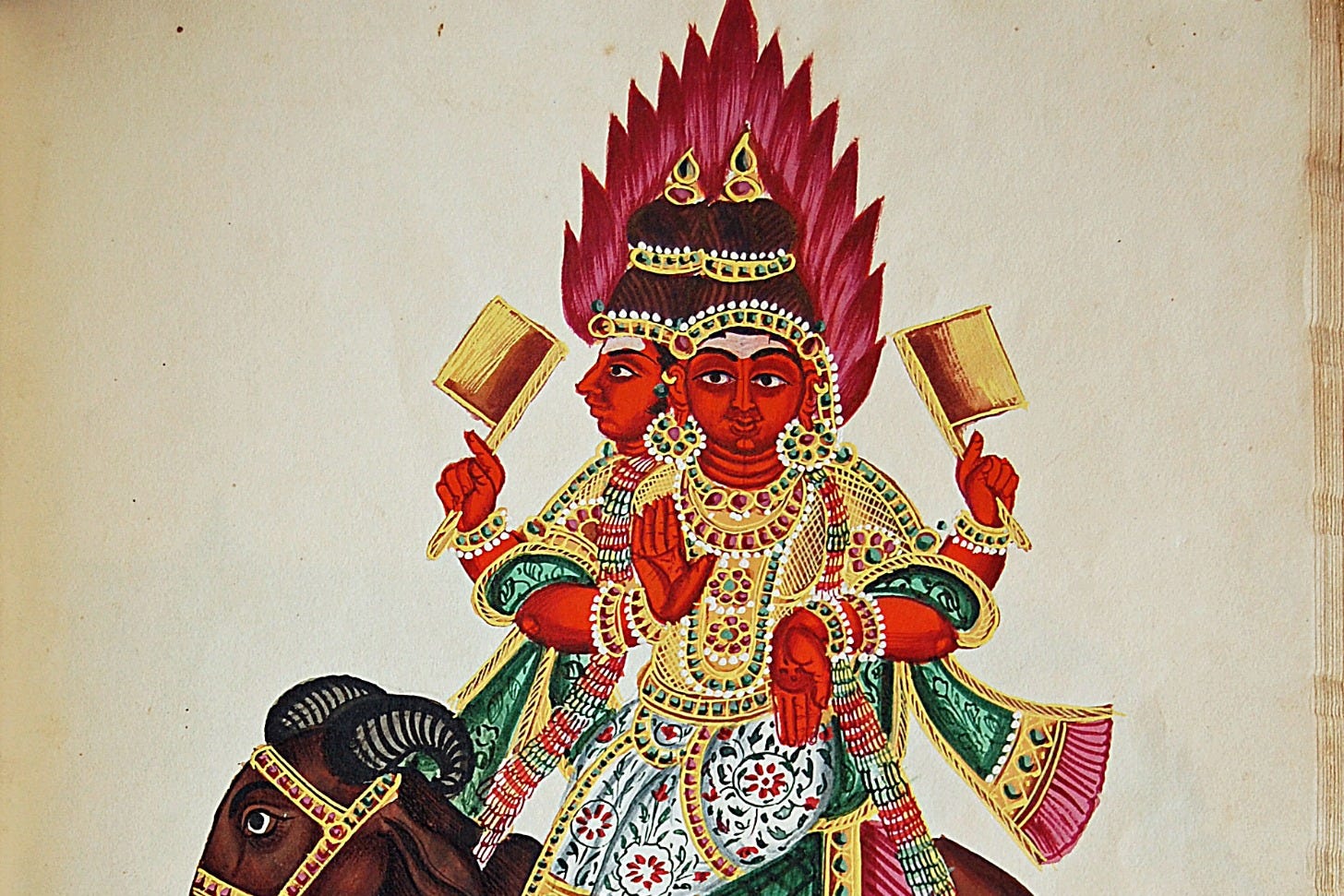
Agni, God of Fire | Company-school painting, India, ca. 1830 (British Museum, detail)
What is the oldest song still sung?
Key Terms for this Lesson
Rig Veda · Sama Veda · Mantra
The Rig Veda | ca. 1500–1200 BCE
Every morning, before sunrise, millions of Hindus face the east and sing a verse that is more than 3,000 years old. The Vedas are the world’s oldest scripture in continuous use. More than mere ritual instruction, the Vedas represent India’s first reflections on the mystery of existence. The word Veda means “knowledge,” from the Sanskrit root vid-, to know (the same root as Latin videre, to see, and English wit and wisdom). Mesopotamia buried a lyre with a king (cf. Sec. 2.4), and Egypt painted its harpers on tomb walls and never wrote down a note (cf. Sec. 3.3). India did something stranger — it kept its oldest songs alive by singing them.
The oldest of the four Vedas is the Rig Veda, “the Veda of verses”: 1,028 hymns in ten books, composed in the Punjab between about 1500 and 1200 BCE, in a form of Sanskrit older than any other surviving text of the language. The hymns praise the powers that sustain the world. Indra is the storm god who kills the dragon and frees the rains. Ushas is the dawn, and Soma the pressed plant of the rite. Above all stands Agni, the fire, and the very first hymn in the collection is his:
I Laud Agni, the chosen Priest, God, minister of sacrifice, / The hotar, lavishest of wealth. / Worthy is Agni to be praised by living as by ancient seers. / He shall bring hitherward the Gods. Rig Veda 1.1 (trans. Ralph T. H. Griffith, 1896)
Fire & Song | What the Singing Was For
Why Agni first? Fire, the primary conduit to the divine, is a consecrated meeting point of mortal and eternal. The mantras and hymns specify offerings and invocations meant to sustain a harmonious bond between worshippers and the sacred. By carefully tending this fire and chanting Vedic verses, Hindu priests invoke blessings for prosperity, well-being, and cosmic alignment. The offering (clarified butter, grain, the pressed soma) goes into the flames, and the smoke carries it up. Agni is the gods’ mouth. A hymn sung into the fire is a hymn delivered.
Rituals had to be carried out exactly according to tradition in order for the ceremonies to attain their goal, commonly the fertility of the soil or the arrival of the rains. So the sound mattered as much as the gift. A mantra is a sacred utterance whose power lies in its exact sound, syllable and pitch alike. A Vedic rite needed four priests, and two of them did nothing but make sound: the hotar recited the Rig Veda’s verses, and the udgatar sang. His book was the Sama Veda, “the Veda of melodies,” 1,875 verses lifted almost entirely from the Rig Veda and set to tunes. The Rig Veda is chanted on three pitches, a raised, a lowered, and a falling tone. The Sama singer used up to seven, and Indian tradition traces the seven notes of its music (sa, re, ga, ma, pa, dha, ni) to his singing. The sacrifice was not spoken. It was sung. The gods were summoned the way a host calls guests to the table, by name and in order, and a hymn sung wrong was a guest not called.
Shruti | Kept by Ear
Here’s the wrinkle. India had writing. Ashoka was carving edicts into rock by 250 BCE (Sec. 4.1), yet the Vedas went on being passed from mouth to ear for more than a thousand years after that. The oldest surviving manuscript of the Rig Veda was copied around 1040 CE, some 2,500 years after the hymns were composed. The tradition’s own word for scripture explains why: shruti, “what is heard.” The seers did not write the Veda. They heard it, and a Veda lives in the voice, not on a page.
Keeping it there took a discipline that no other ancient people matched. A Brahmin boy could spend twelve years learning one Veda by heart, reciting each hymn forward, then word by word, then in woven patterns (the first word with the second, the second with the first, the second with the third) so that a single slipped syllable showed at once. When scholars finally compared manuscripts from opposite ends of India, the texts agreed almost letter for letter. The Buddha’s own sermons were kept the same way for four centuries (Sec. 4.3). In 2008 UNESCO listed Vedic chanting as part of the intangible heritage of humanity, among the oldest unbroken oral traditions on earth.
The Hurrian hymn of ca. 1400 BCE survives as a written melody no one can sing with confidence (cf. Sec. 2.4). The Psalms, sung in temple, synagogue, and church, kept their words and lost their tunes (cf. Sec. 9.4). The Rig Veda kept both, and it did it without ink. The most sung of its verses is the Gayatri (3.62.10), a prayer to the sun that Griffith renders “May we attain that excellent glory of Savitar the God: / So may he stimulate our prayers.” It is the verse the morning begins with, and it has begun the morning since before Rome was founded.
Sec 4 • Ancient India
4.1 History & Politics • The Indus Valley
4.2 Music • Singing the Vedas
4.3 Sacred Life • Dharma
4.4 Philosophy • The Middle Way
4.5 Literature & Drama • The Mahabharata & the Gita
4.6 Art & Architecture • Stupas & the Buddha
Course Page: Humanities I & II