

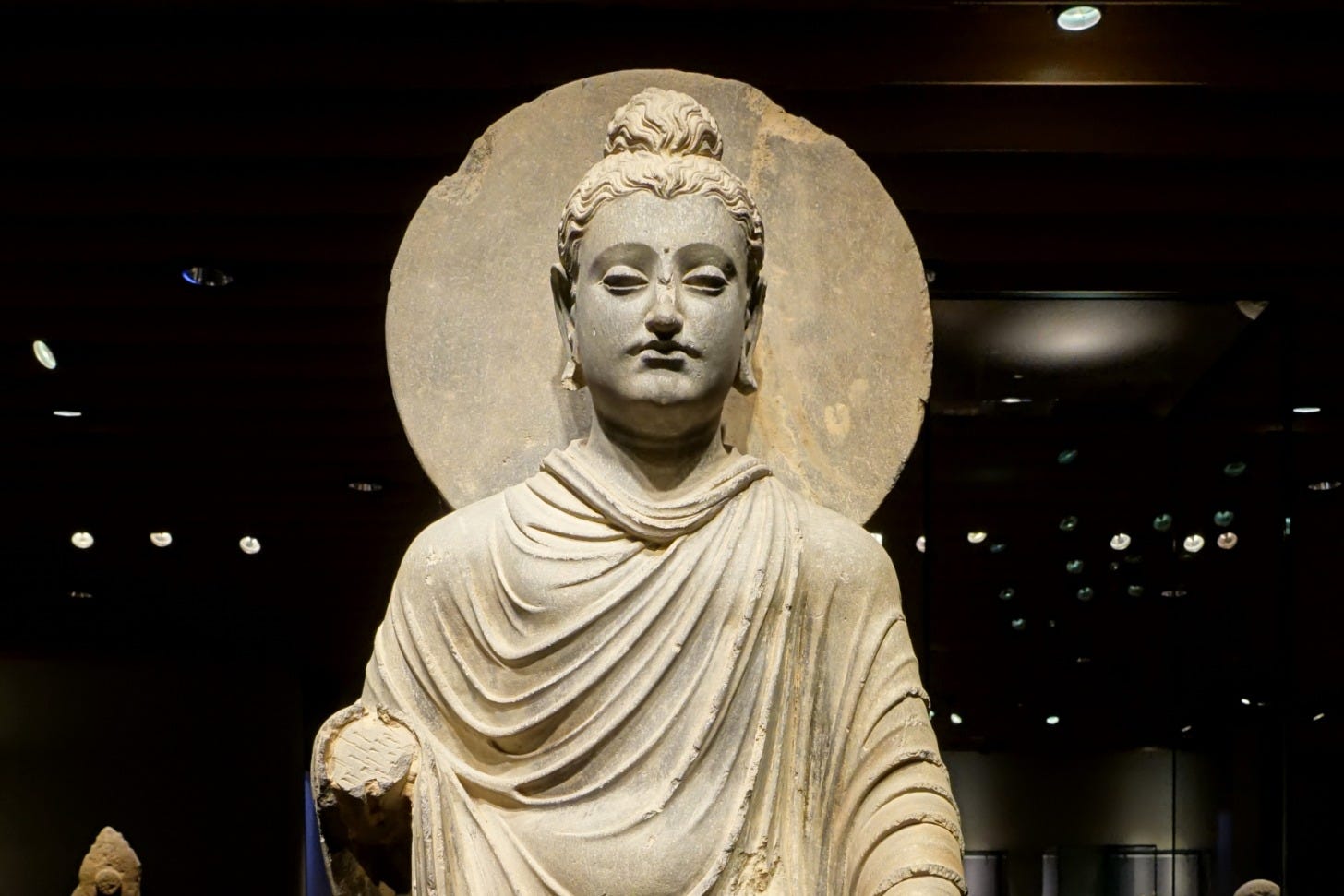
Standing Buddha | Gandhara, near Peshawar, 100s–200s CE (Tokyo National Museum)
Photo Credit: Daderot via Wikimedia Commons
Why did no one carve the Buddha for 500 years?
Key Terms for this Lesson
Stupa · Sanchi · Gandhara
The Stupa | A Mound for a Holy Man
Egypt built a mountain for a king (cf. Sec. 3.4), and Mesopotamia a mountain for a god (cf. Sec. 2.3). India built a mound for a teacher. When the Buddha died, about 400 BCE, his body was cremated and the ashes divided into eight portions, and over each, the tradition says, a mound was raised. He had asked for exactly that:
At the four cross roads a dâgaba should be erected to the Tathâgata. And whosoever shall there place garlands or perfumes or paint, or make salutation there, or become in its presence calm in heart—that shall long be to them for a profit and a joy. Mahaparinibbana Sutta 5.26 (trans. T. W. Rhys Davids, 1881)
A stupa is that mound made monumental: a solid hemisphere of brick or stone over a relic, crowned by a railed square and a stone umbrella, with a path around it where pilgrims walk clockwise, keeping the relic on their right. There is no inside. Nothing is entered and nothing is seen — the building is the act of going around it. The teaching’s first great patron was an emperor with blood on his hands (Sec. 4.1). Ashoka commissioned many of the stupas still in existence in Asia, and tradition credits him with 84,000. The greatest survivor is the Great Stupa at Sanchi, begun by Ashoka about 250 BCE and cased in stone a century later: 120 feet across, 54 feet high, with four carved gateways added around the time of Christ. Sarnath, where the Buddha gave his first sermon (Sec. 4.3), has a stupa of its own, 143 feet high, on the site Ashoka marked. Pilgrims came to these places to meditate on the Buddha, and they are commonly built on sacred sites.
The Empty Throne | 500 Years Without a Face
Here is the puzzle. The gateways at Sanchi tell the Buddha’s whole life story, and he is not in it. A riderless horse leaves the palace under a parasol: the Great Departure. A tree with a railing round it: the awakening. A wheel on a pillar: the first sermon. A pair of footprints, an empty seat, a stupa for the death. For roughly five centuries after his passing, from Ashoka’s day to the first century CE, Indian carvers showed the Buddha by everything except his body. Meanwhile the Hindu gods were taking form in stone, and the Jain teachers too.
Scholars read the absence two ways. The older reading is that the carvers were saying something: the Awakened One had passed beyond birth and death, and a portrait of him would be a contradiction, so they carved the tree he sat under and the wheel he set turning. The newer reading is that the scenes are not pictures of the Buddha’s life at all but pictures of the holy places as pilgrims found them, tree, wheel, and footprints, in the century after Ashoka. The texts do not settle it, since no early Buddhist scripture forbids an image. Both readings agree on the fact. For 500 years, the most famous man in India had no face.
Gandhara | The Buddha in a Greek Robe
The face arrived from the northwest. Alexander’s soldiers had settled there (Sec. 4.1), and after the Mauryas fell, Greek kings from Bactria ruled the Punjab for nearly two centuries (ca. 180 BCE–10 CE). One of them, Menander (d. ca. 130 BCE), is the hero of a Buddhist book, the Questions of King Milinda, in which a Greek king debates a monk and loses. Under the Kushan emperors (ca. 30–375 CE) the region of Gandhara, around modern Peshawar, produced the first statues of the Buddha, and the sculptors who made them had been trained in the Greek manner. The Buddha above wears a Roman toga, has the wavy hair of an Apollo, and stands like a Greek orator (cf. Sec. 6.6). At the same time, at Mathura on the Ganges, Indian carvers made him in their own way, broad-shouldered and smiling in red sandstone. Both gave him the marks the texts describe: the bump of wisdom on the crown of the head, the dot between the brows, the long earlobes of a prince who once wore heavy gold.
Following the disappearance of the Indus Valley people, the first monumental art that we can find is heavily influenced by nearby Persia. The Lion Capital of Ashoka (Sec. 4.1), the earliest monumental Indian sculpture, is very similar to Persian statues that existed at the time. The image of the Buddha was India’s second great borrowing, and India made it its own. By the Gupta age (Sec. 4.5), the Sarnath Buddha of the 400s CE has shed the toga for a robe so thin it seems to be only light, and the painted caves of Ajanta show the same calm. Buddhist art is more solemn than Hindu art in its focus on spirituality. It frequently depicts the Buddha and bodhisattvas with calm and transcendent expressions, often in prayer or meditation. That calm traveled with the dharma to China, Korea, and Japan, and every Buddha image on earth descends from the two workshops of the first century: one Greek-trained, one Indian, both answering a question the stupa had left open. What does an awakened man look like?
Sec 4 • Ancient India
4.1 History & Politics • The Indus Valley
4.2 Music • Singing the Vedas
4.3 Sacred Life • Dharma
4.4 Philosophy • The Middle Way
4.5 Literature & Drama • The Mahabharata & the Gita
4.6 Art & Architecture • Stupas & the Buddha
Course Page: Humanities I & II
Next Section: Ancient China