

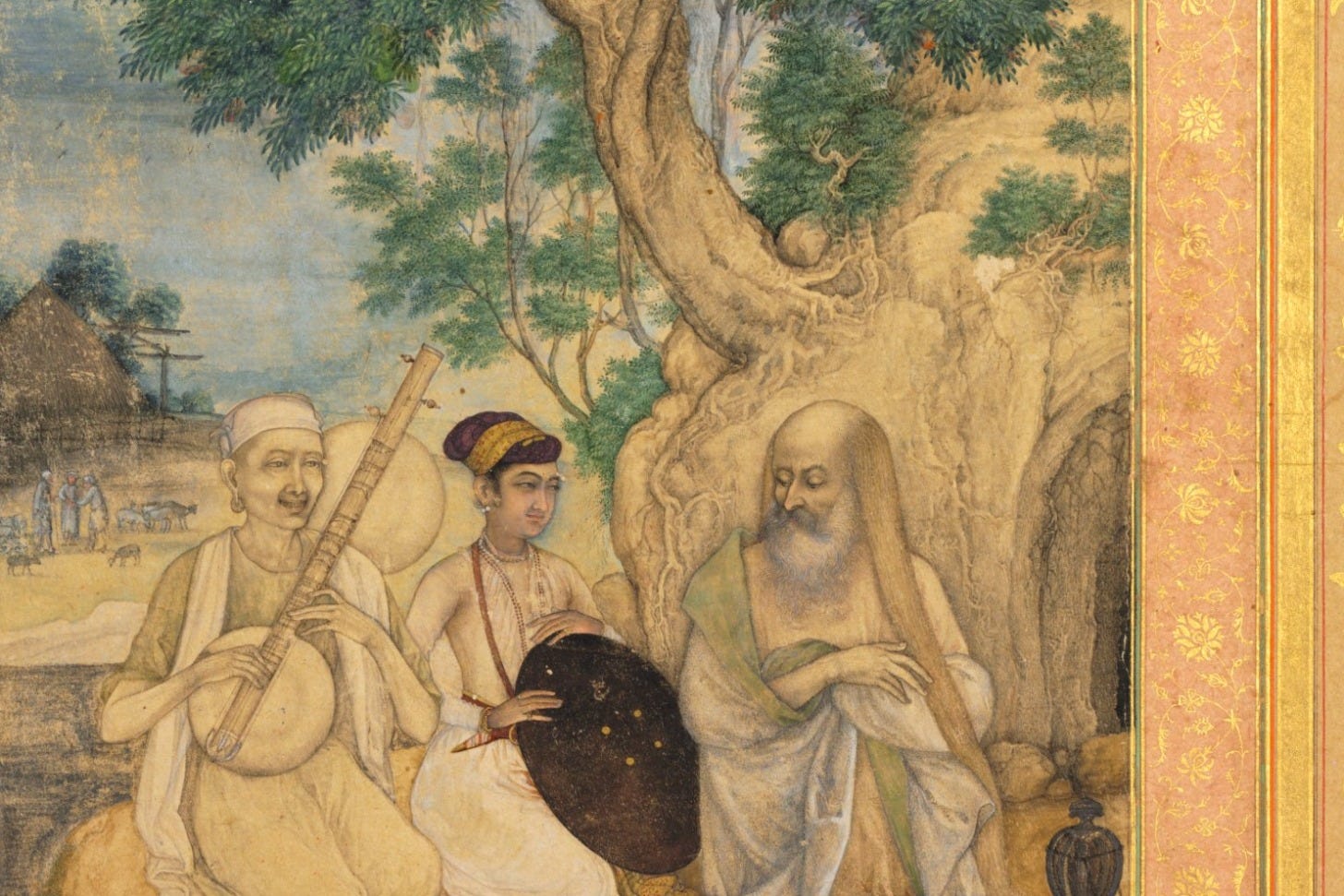
Prince and Ascetics | Govardhan, Mughal India, ca. 1630 (detail)
How can we end suffering?
Key Terms for this Lesson
Middle Way · Three Fires · Nirvana
The Lute String | Two Ways to Waste a Life
The painting above sets a young prince between a musician with a stringed veena and an old ascetic: the palace, the string, and the forest. Siddhartha left the palace for the forest, and for six years he adopted an extreme bodily discipline, meditating intensely and subsisting on minimal food (Sec. 4.3). This practice of denying the physical body (asceticism) was thought by some wise men in India to lead to enlightenment. One day, meditating by a stream with his fellow seekers, he heard music coming from down the river. Contemplating the stringed instrument, Siddhartha realized that in order for the instrument to work, its strings can be neither too loose nor too tight. If the strings are too tight, they’ll snap. If the strings are too loose, they won’t play.
Just as the strings of an instrument, Siddhartha reasoned that a person must seek the middle way between the two extremes of life: the path of hedonism (when one seeks only to feed base desires, as Siddhartha once did in the palace) and the path of asceticism (when one denies the most basic needs). When he ate, and told his companions about the middle way, they shunned him. The shunning of Siddhartha’s Middle Way, about 450 BCE, marks the division between what will later be called Hinduism and Buddhism. His first sermon, preached to those same five men after his awakening, opens on it:
There is a middle path, O Bhikkhus, avoiding these two extremes, discovered by the Tathâgata—a path which opens the eyes, and bestows understanding, which leads to peace of mind, to the higher wisdom, to full enlightenment, to Nirvâna! Dhammacakkappavattana Sutta (trans. T. W. Rhys Davids, 1881)
The Middle Way is not a compromise between two good things, but a rejection of two ways to waste a life. In all things, Buddhists seek it: all things should be done in moderation, which is a turning away from extremism and dualism.
The Three Fires | What Goes Out
If the middle way is the path, then what is the destination? Buddhist thought names the specific causes that keep human beings trapped in dissatisfaction even when basic needs are met. These are the Three Fires: greed, ignorance, and hatred. Greed is excessive attachment and craving, and it fuels dissatisfaction because what is clung to is always unstable. Ignorance is the denial of impermanence. Hatred is aversion and resentment, toward others or toward oneself. Where greed involves wanting too much, hatred involves wanting too little.
The metaphor of fire is central to Buddhist moral psychology. Fires consume, spread, and demand fuel. The ethical task, therefore, is not to satisfy the Three Fires, nor to repress them through force, but to extinguish them by removing their fuel. The literal meaning of nirvana is “extinguishing,” as when a flame goes out. When greed, ignorance, and hatred no longer dominate perception, the mind can rest in clarity and stability. Extinguishment does not mean numbness. Compassion deepens as hatred recedes. The oldest Buddhist verses say it in one line: “For hatred does not cease by hatred at any time: hatred ceases by love, this is an old rule” (Dhammapada 5, trans. F. Max Müller, 1881).
Three steps of the Eightfold Path (Sec. 4.3) belong to the mind: Right Effort, Right Mindfulness, and Right Concentration. Effort initiates change, mindfulness clarifies it, and concentration stabilizes it. A monk named Malunkyaputta once pressed the Buddha on the great metaphysical riddles. The Buddha replied with a parable. Imagine a man struck by a poisoned arrow who refuses treatment until he learns who shot it, from what clan, with what kind of bow. He would die with his questions unanswered. The point was not that the riddles are unworthy. It was that they do not stop the bleeding.
The Axial Age | India & Greece
The Buddha was not alone. In the same few centuries, Confucius (d. 479 BCE) and the Daoist masters were teaching in China, the prophets of Israel were writing scripture, and the first philosophers were arguing in Greece (cf. Sec. 5.5, 6.5, 9.5). Scholars call it the Axial Age (cf. Karl Jaspers, d. 1969). Aristotle (d. 322 BCE) would teach that every virtue is a mean between an excess and a deficiency, courage between recklessness and cowardice (cf. Sec. 7.6), and the lute string is the same thought a century earlier. Later, Epicurus (d. 270 BCE) would aim at ataraxia, an untroubled mind, and the Stoics at something near it (cf. Sec. 8.6). Nirvana functions in many ways as the Eastern analogue to Greek ataraxia, but with a crucial difference. Western tranquility stabilizes the self within the world, while Buddhist tranquility loosens the grip of the self altogether. Where Epicurus limits desire, and Stoicism corrects judgment, Buddhism dissolves attachment at its root.
The two worlds met in person. Pyrrho (d. ca. 270 BCE), the founder of Greek skepticism, marched to India with Alexander in 326 BCE (Sec. 4.1) and, the ancient biographers say, learned from the “naked philosophers” there to suspend judgment and keep an untroubled mind. The Middle Way had found its first Western student.
Sec 4 • Ancient India
4.1 History & Politics • The Indus Valley
4.2 Music • Singing the Vedas
4.3 Sacred Life • Dharma
4.4 Philosophy • The Middle Way
4.5 Literature & Drama • The Mahabharata & the Gita
4.6 Art & Architecture • Stupas & the Buddha
Course Page: Humanities I & II