

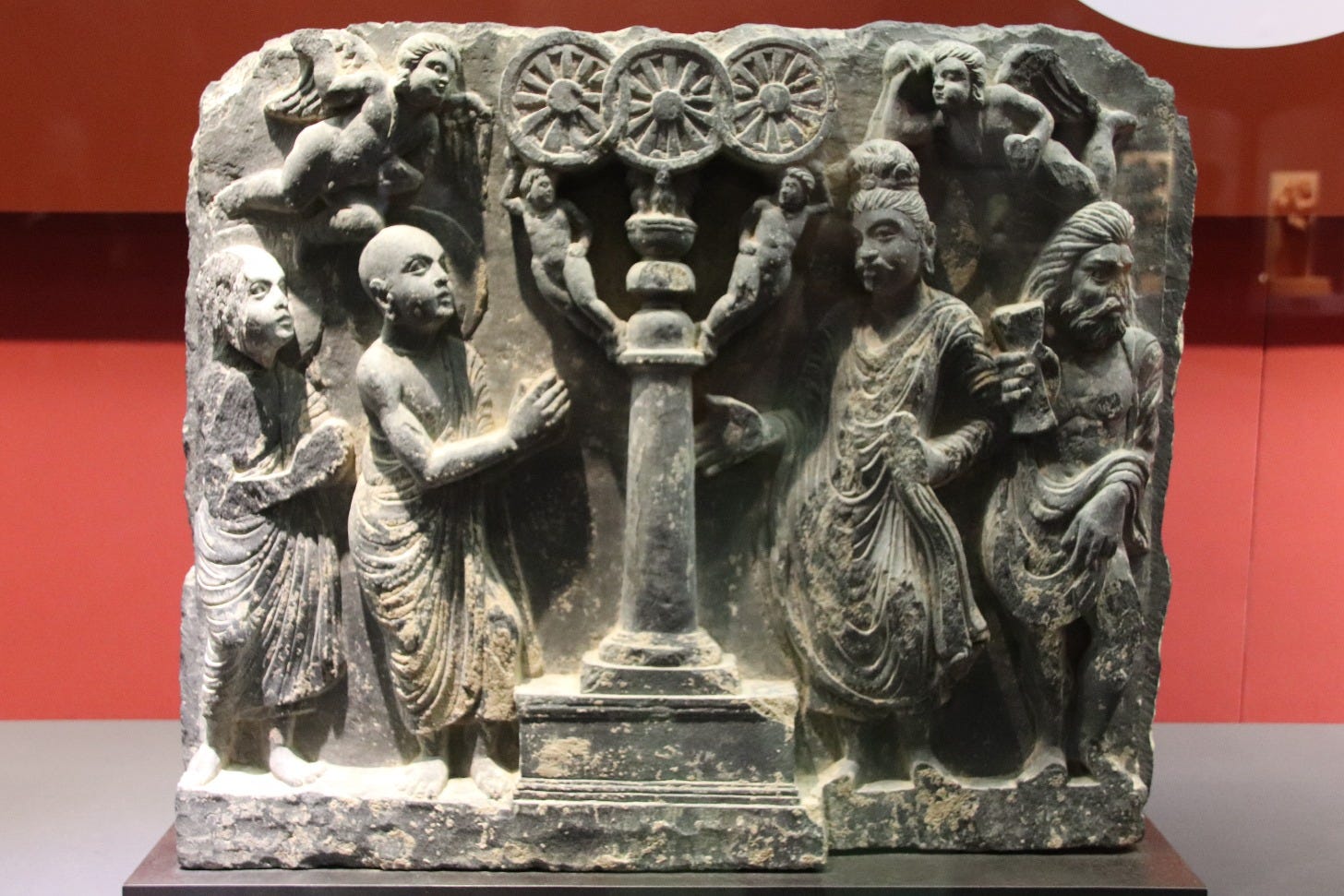
The Buddha’s First Sermon | Gandhara, 100s–200s CE
Photo Credit: Gary Todd via Wikimedia Commons, CC0
Why do we suffer?
Key Terms for this Lesson
Dharma · Samsara · Four Noble Truths
Dharma | Samsara, Karma, & Moksha
The closest word to “religion” in the Vedas is dharma, which also translates as “law” or “duty.” Dharma is the order of things and a person’s place in it: the duty a person has relative to his caste or state in life (cf. Sec. 4.1). Each person is to fulfill his or her role in society to its fullest, not out of ambition or greed, but out of duty. In the Bhagavad Gita, a warrior is told exactly that (Sec. 4.5).
Why does the duty matter so much? Because in Hindu thought a life does not end when the body does. Hindus believe we stay in the material world, maya, because of samsara, the unending cycle of birth, death, and rebirth. While Westerners sometimes romanticize the notion of reincarnation, within Hindu culture samsara is recognized as a profound existential challenge. Our destiny in the next life is dependent upon our karma, an accumulation of our actions, positive or negative. Egypt weighed the heart before a judge (cf. Sec. 3.6). In Hindu thought there is no judge, because all is Brahman (from the root bṛh-, to grow): karma operates as a kind of Newtonian system of cause and effect, much like the ripples in a pond after a stone is thrown in. The way out is moksha, liberation from samsara, akin to a raindrop merging back into a vast sea.
That teaching comes from the Upanishads, the last layer of the Vedas (ca. 700–500 BCE), which turned from the fire altar inward. Their central question is the relationship between atman, the innermost self, and Brahman, the ultimate reality. Their radical answer is that the two are one. In the Chandogya Upanishad a father tells his son that the essence of all things “is the Self, and thou, O Svetaketu, art it” (6.8.7, trans. F. Max Müller, 1879). Tat tvam asi. In the Upanishads’ answer, to know yourself truly is to find Brahman.
The Four Sights | ca. 450 BCE
In the same centuries, seekers wandered the Ganges plain testing every path out of samsara. Buddhism begins with the Buddha, who, tradition asserts, was a man named Siddhartha Gautama (ca. 480–400 BCE) who lived in the 400s BCE. He lived his childhood and early adulthood as a sheltered prince who never saw suffering or death. His father saw to it that he had only seen young, vibrant, happy people within the walls of his palace.
At 29, Siddhartha left his father’s palace on supervised outings and witnessed suffering for the first time in his life. From these experiences came what are called the Four Sights. On his first tour, Siddhartha saw his first elderly man, and his charioteer explained that no one is exempt from old age. On his second tour, he saw his first sick person, and on his third, his first corpse. No one is exempt from sickness. No one is exempt from death. On his fourth and final tour, Siddhartha saw his first wandering holy man, who had left everything behind in search of liberation. These sights motivated Siddhartha to make what Buddhists now call the Great Departure. He became a wandering ascetic, eating only one leaf, or nut, or grain of rice per day. But Siddhartha’s asceticism would not last (Sec. 4.4).
At about 35, he came to sit under a huge Bodhi tree at Bodh Gaya, where, according to tradition, he achieved enlightenment in a single night and then sat for seven weeks. When one listener asked this teacher who he was, Siddhartha replied, “I am Awake.” From that day on, Siddhartha was known as “the Buddha,” which in Sanskrit means the “Awakened One.”
The Four Noble Truths | The Buddha as Physician
In short, Buddhism is aiming for an end to suffering. The tradition often frames the diagnosis the way a doctor would. You go to the doctor because you are ready to acknowledge that you are suffering (dukkha). The doctor names the cause, gives a prognosis (it can end), and writes a prescription. These are the Four Noble Truths, and the Buddha’s first sermon states the first of them this way:
Now this, O Bhikkhus, is the noble truth concerning suffering. Birth is attended with pain, decay is painful, disease is painful, death is painful. Union with the unpleasant is painful, painful is separation from the pleasant; and any craving that is unsatisfied, that too is painful. Dhammacakkappavattana Sutta (trans. T. W. Rhys Davids, 1881)
Dukkha does not mean “life is suffering.” Life contains joy, pleasure, and love too, but even life in a beautiful palace will eventually be ended by death. The second truth is that the origin of suffering is desire (tanha, thirst): clinging to what cannot last. The third is that liberation (nirvana) from suffering is possible. The fourth is the path, eight components of right living: right view, right thought, right speech, right conduct, right livelihood, right effort, right mindfulness, and right concentration. In short, the Eightfold Path is to be kind, wise, and mindful.
The Buddha kept samsara and the karma that turns it, and changed the question. Buddhism does not begin as a rejection of India’s questions. It begins as a new answer to them.
Sec 4 • Ancient India
4.1 History & Politics • The Indus Valley
4.2 Music • Singing the Vedas
4.3 Sacred Life • Dharma
4.4 Philosophy • The Middle Way
4.5 Literature & Drama • The Mahabharata & the Gita
4.6 Art & Architecture • Stupas & the Buddha
Course Page: Humanities I & II