

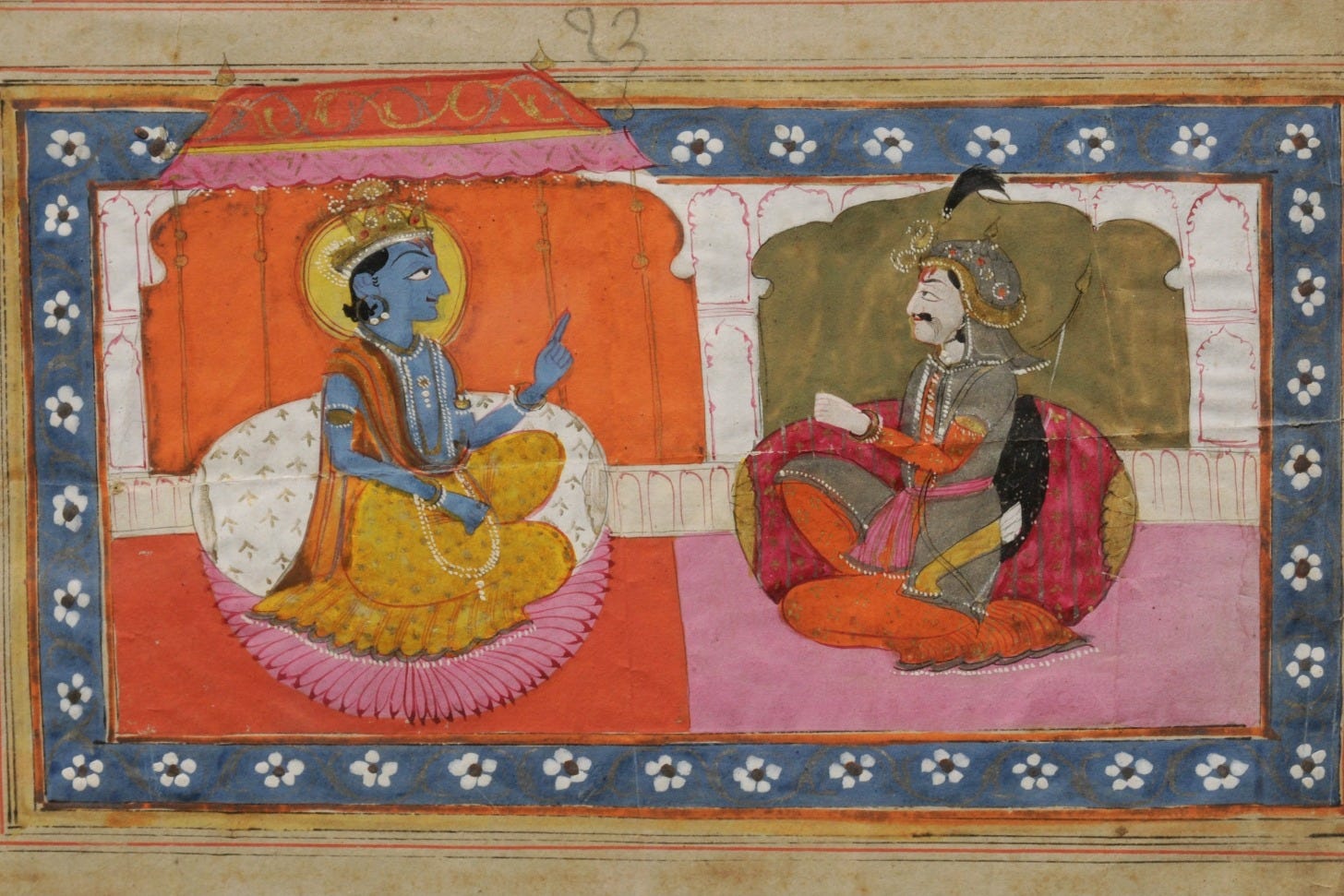
Krishna Teaches Arjuna | Kashmir, ca. 1875–1900 (cropped)
Why does India’s holiest song begin on a battlefield?
Key Terms for this Lesson
Mahabharata · Bhagavad Gita · Natyashastra
The Mahabharata | The Longest Poem in the World
Mesopotamia’s epic is the story of one king (cf. Sec. 2.5). India’s is the story of a family at war with itself. The Mahabharata (”the Great Tale of the Bharatas”) stands as one of the two greatest epics in the Hindu tradition, composed in Sanskrit between about 400 BCE and 400 CE and credited to the sage Vyasa, who is also a character in it. Its vast narrative integrates legendary tales, moral puzzles, and reflections on divine intervention. With a total length exceeding the Bible, the Iliad, and the Odyssey combined, some 100,000 couplets, the Mahabharata‘s richness covers many facets of dharma (Sec. 4.3) and human struggle. The poem’s own boast is that whatever is not found in it is found nowhere.
The spine of the story is a feud between cousins. The five Pandava brothers and their hundred Kaurava cousins both claim the throne of Hastinapura. The eldest Pandava loses the kingdom in a rigged game of dice, and the five go into exile for thirteen years. When they return to claim what is theirs, the cousins refuse. The war at Kurukshetra lasts eighteen days and leaves almost no one standing. The winners inherit a graveyard. The second epic, the Ramayana (its core ca. 400s–200s BCE), is twice the length of the New Testament and follows Prince Rama and his devoted wife, Sita, through exile and trial, holding up the ideals of loyalty, courage, and just kingship. Retold for centuries in dance, drama, and theater, it has carried Hindu identity across the whole of the Indian diaspora.
The Gita | A Warrior Lays Down His Bow
The most famous passage of the Mahabharata is the Bhagavad Gita, literally the “Song of the Lord,” 700 verses set down between about 200 BCE and 200 CE. Its first word in Sanskrit is dharma. The blind king asks what happened “on the field of dharma, the field of the Kurus,” and the poem answers with a battle that has not yet begun. As the two armies face each other, the warrior prince Arjuna freezes: the enemy ranks are full of his own family, and he cannot bring himself to fight. He drops his bow and says, in Edwin Arnold‘s (d. 1904) Victorian verse, “I will not fight!” His charioteer is the avatar Krishna, and the dialogue that follows is among the most beloved in world literature.
Krishna’s counsel is subtle: do your duty, but without attachment to its fruits. Act rightly, and let go of your expectations.
But thou, want not! ask not! Find full reward / Of doing right in right! Let right deeds be / Thy motive, not the fruit which comes from them. Bhagavad Gita 2.47 (trans. Edwin Arnold, The Song Celestial, 1885)
So the question on the lesson’s door has its answer. The Gita begins on a battlefield because a battlefield is where duty costs the most. The poem is not about the war. Eighteen chapters pass before an arrow flies — they are about the field of dharma inside the man holding the bow, which is why Gandhi (d. 1948), who read the Gita daily and taught non-violence from it, took the battle as the one every person fights within. It was from Krishna’s revelation of his own cosmic majesty that the twentieth century borrowed its most haunting line. Watching the first atomic bomb detonate, the physicist J. Robert Oppenheimer (d. 1967) recalled the Gita: “Now I am become Death, the destroyer of worlds.” A century before him, Thoreau (d. 1862) at Walden Pond wrote that each morning he bathed his intellect “in the stupendous and cosmogonal philosophy of the Bhagvat Geeta” (cf. Sec. 6.2, where the Iliad opens on another warrior who refuses to fight).
Sanskrit Drama | The Natyashastra & Kalidasa
India’s drama was born from the same stories. The Natyashastra (”the treatise on theater,” ca. 200 BCE–200 CE) is India’s oldest handbook of the stage, fuller than anything the Greeks left on the subject, and it treats theater as a fifth Veda, open to every caste. Its central idea is rasa, “flavor”: a play exists to let the audience taste a feeling, and it names eight, from the heroic to the comic to the marvelous, each with its own gestures and music (Sec. 4.2). Greek drama, a few centuries older, aimed at pity and fear (cf. Sec. 7.5). Indian drama aimed at every flavor at once, and it forbade a tragic ending.
The master of the form was Kalidasa (fl. ca. 400 CE), a poet of the Gupta court under Chandra Gupta II (r. ca. 380–415 CE), whose reign ushered in the Golden Age of India, a time famous for cultural achievements and royal patronage of the arts. Kalidasa’s Shakuntala takes its heroine from the Mahabharata: a king marries a hermit’s daughter, forgets her under a curse, and recognizes her again by a ring found in a fish. It was the first Sanskrit play translated into English, by William Jones (d. 1794) in 1789, and Goethe (d. 1832) wrote a poem in its praise. The epic that began on a battlefield ended up on Goethe’s desk in Weimar.
Sec 4 • Ancient India
4.1 History & Politics • The Indus Valley
4.2 Music • Singing the Vedas
4.3 Sacred Life • Dharma
4.4 Philosophy • The Middle Way
4.5 Literature & Drama • The Mahabharata & the Gita
4.6 Art & Architecture • Stupas & the Buddha
Course Page: Humanities I & II