

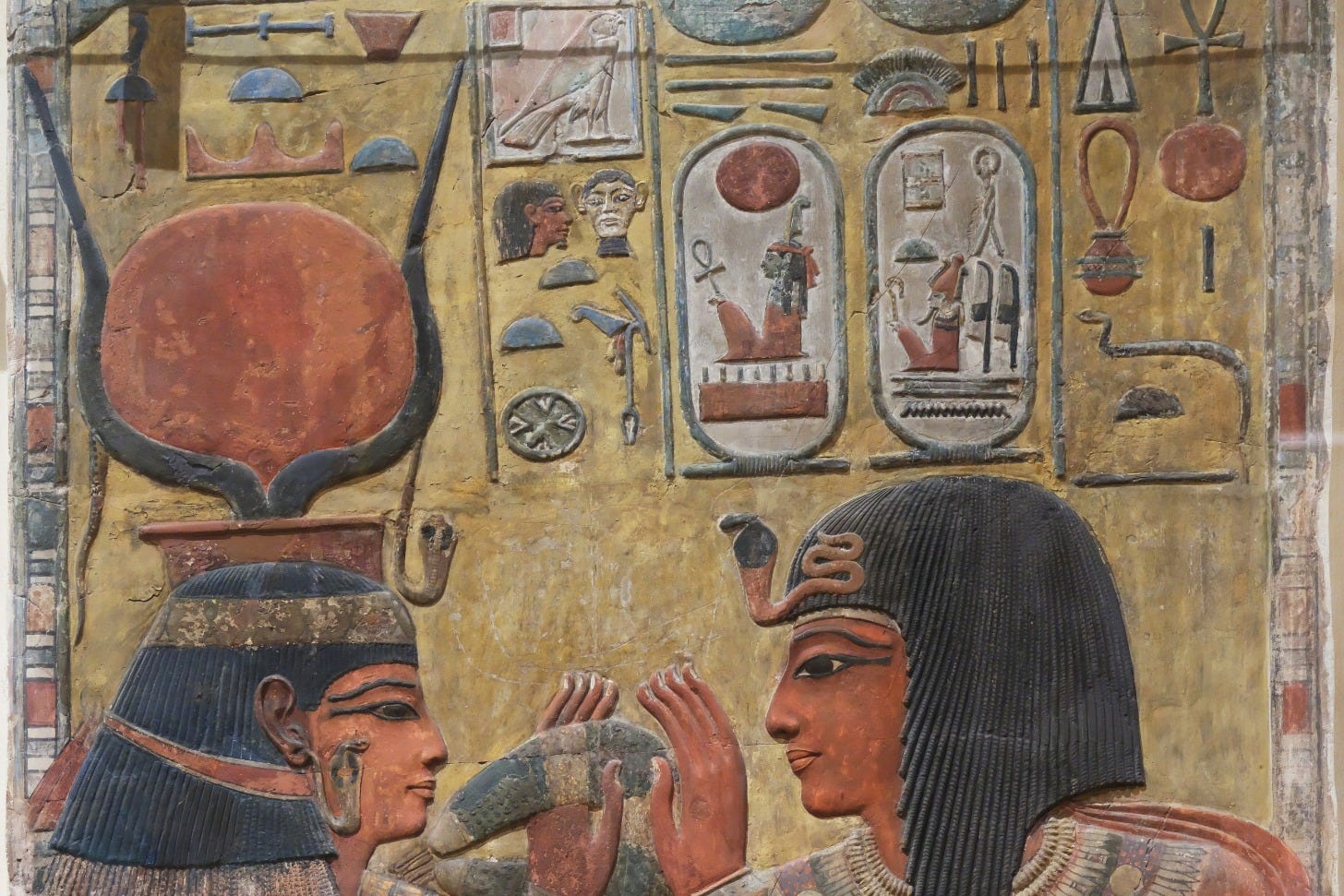
Hathor Welcomes Seti I | Valley of the Kings, ca. 1290 BCE (Louvre, detail)
Photo Credit: Shonagon via Wikimedia Commons, CC0
How do you calm an angry goddess?
Key Terms for this Lesson
Hathor · Sistrum · Harper’s Song
Hathor | The Eye of Ra
Mesopotamia buried its lyres with its kings (cf. Sec. 2.4). Egypt shook its rattles for a goddess who was still alive. Her name was Hathor, “House of Horus,” and she wears the cow’s horns with the sun’s disk between them (Sec. 3.2). Hathor was the goddess of music, dance, love, and joy, the nurse of the pharaoh, and the Lady of the West who welcomed the dead at the desert’s edge, as she welcomes Seti I (d. 1279 BCE) above. Her great temple stood at Dendera, where the columns of her hall still carry her face.
She was also the most dangerous goddess in Egypt. In the myth, Hathor is the Eye of Ra, the sun’s own fury sent out against mankind. When humanity plots against the aging sun god, Ra sends his Eye down as Hathor, who becomes the lioness Sekhmet and begins to destroy the human race. Ra relents, but the goddess will not stop. So Ra has the fields flooded with a red drink that she takes for blood. She drinks until she sleeps, and wakes as Hathor again, gentle, gladdened, and ready for music. The Egyptians drew the lesson for themselves: a goddess who can rage must be kept glad. That is what the temples were for.
The Sistrum | The Shaken Thing
The instrument of Hathor’s temple was the sistrum: a handle, usually topped with Hathor’s face, holding a metal loop strung with loose rods and disks that jingle when it is shaken. The Egyptian name, sesheshet, imitates the sound. The Greek name, seistron, means simply “the shaken thing.” Its rustle was said to echo the rustling of papyrus stalks in Hathor’s marsh. The sistrum was not mainly for dancing. Priestesses shook it before the god’s statue to drive away anger and bring gladness, and the temple hymns say so plainly: the queen or priestess “takes the sistrum” and the goddess’s face is made glad. The Greek writer Plutarch (d. ca. 120 CE), who studied the cult of Isis, adds that its rattle drives Set away (Sec. 3.2).
The office of temple singer was held by women of rank. In the New Kingdom the title Chantress of Amun appears on the monuments of hundreds of elite women, the wives and daughters of officials, and the highest priestess in Egypt, the God’s Wife of Amun, is shown shaking the sistrum before the god herself. Beside the sistrum they rattled the menat, the heavy beaded necklace Hathor holds out to Seti in the image above. Isis carried the sistrum with her into the Roman world (Sec. 3.2), and the Hebrew Bible knows the instrument too: when David dances before the Ark, the band includes mena’an’im, “things that are shaken,” often identified as sistra (2 Samuel 6:5, cf. Sec. 9.4).
The Harper | Music for the Living & the Dead
Hathor’s music was not confined to her temple. Tomb paintings show harps, lutes, lyres, double pipes, flutes, hand-shaped clappers of ivory, and frame drums, and banquets where women play and dance for the guests. Two trumpets of silver and bronze were found in Tutankhamun‘s tomb, and in 1939 a British bandsman played them live on BBC radio, the first sound from them in more than 3,000 years. Old Kingdom scenes even show the conductor: a man facing the players, making signs with his hands to tell them the pitch. Yet in all those thousands of pictures there is not one written note. The Egyptians never wrote their music down, and we know what their instruments looked like far better than how they sounded.
What we do have are the words. In the New Kingdom tombs of Thebes a blind harper is often painted beside the banquet, and the song written over his head is the strangest text in Egyptian religion. The Harper’s Song looks at the pyramids of the ancestors and finds them already in ruins:
Celebrate the glad day, / Be not weary therein. / Lo, no man taketh his goods with him. / Yea, none returneth again that is gone thither. The Song of the Harper, from the tomb of King Intef (trans. James Henry Breasted, 1912)
The same note sounds in the Bible’s Ecclesiastes 9: eat your bread with joy, for there is no work in the grave (cf. Sec. 9.5). Egypt, the civilization most preoccupied with the afterlife, kept a song in its tombs that told the living to enjoy the day. The harper sang it to the dead man’s guests, and the sistrum rang in Hathor’s hall, for the same reason. A god who is glad is a god who is kind.
Sec 3 • Ancient Egypt
3.1 History & Politics • The Gift of the Nile
3.2 Sacred Life • Ra, Osiris, & Isis
3.3 Music • Hathor & the Sistrum
3.4 Art & Architecture • The Pyramids of Giza
3.5 Literature & Drama • The Book of the Dead
3.6 Wisdom • Ma’at & the Weighing of the Heart
Course Page: Humanities I & II