

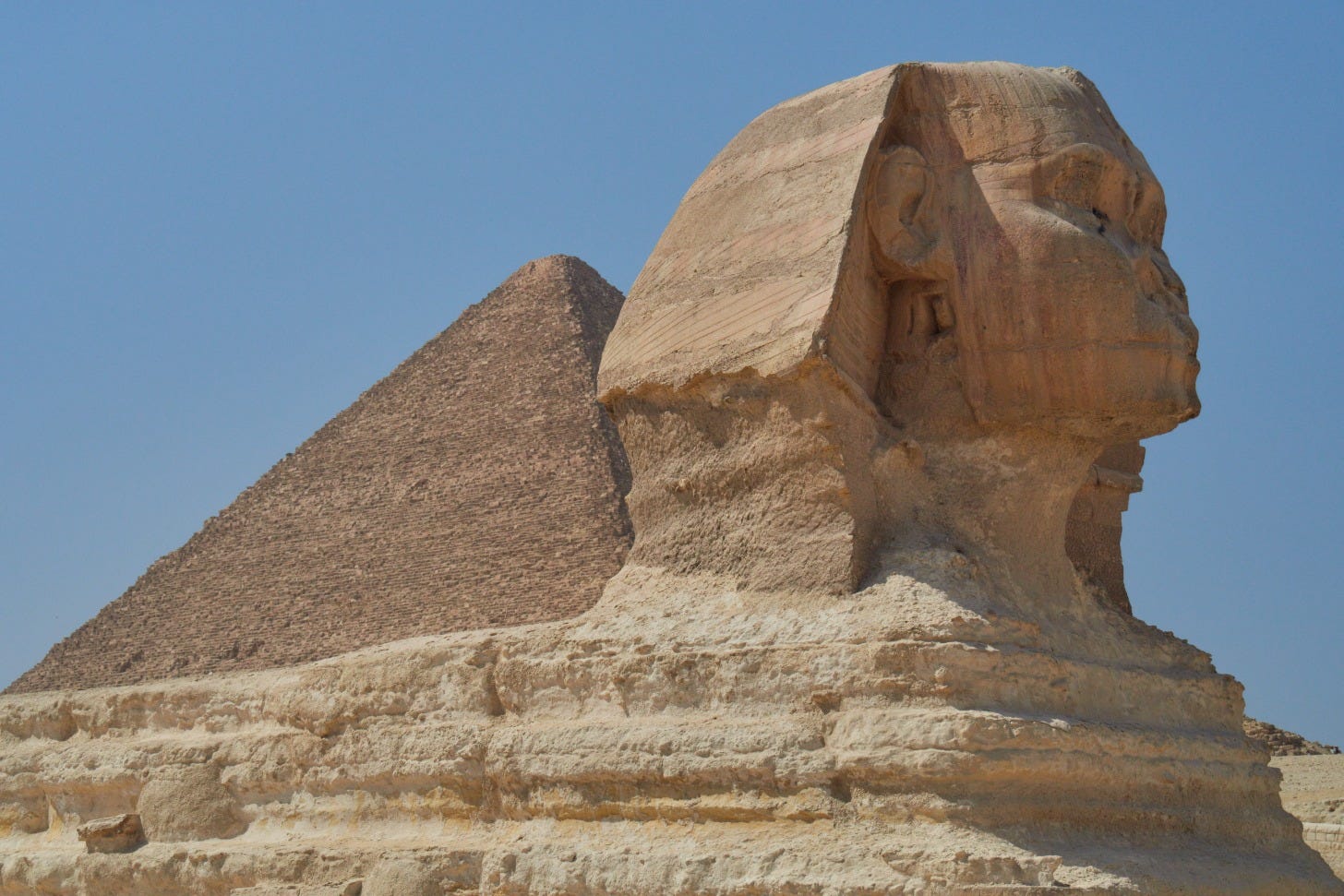
The Great Sphinx and the Pyramid of Khafre | Giza, ca. 2500 BCE
Photo Credit: lumoplank via Wikimedia Commons, CC0
How does a king achieve immortality?
Key Terms for this Lesson
Imhotep · Great Pyramid · Great Sphinx
Imhotep | The First Building in Stone
One of the things religion did for Egypt culturally was a regulation and encouragement of the arts. The principal function of artists in Ancient Egypt was to produce images of the gods for worship, and to design the temples and tombs that honored them. Before the pyramids, a king was buried under a mastaba, a flat-topped mound of mud brick (the Arabic word means “bench”). Then, ca. 2650 BCE, a royal architect stacked six stone mastabas on top of one another, each smaller than the last, and built the king Djoser (d. ca. 2648 BCE) a Step Pyramid at Saqqara, some 200 feet high. The first architect known to history was Imhotep. He designed the earliest pyramid as a tomb for his master the pharaoh, and it is the oldest large building of cut stone in the world. A thousand years later Egyptians still quoted Imhotep as a sage, and later still worshipped him as a god.
Mesopotamia had built its mountain of brick (cf. Sec. 2.3). Egypt built its mountain of stone, and built it for one man. The Pyramid Texts, carved inside the later Old Kingdom pyramids, say what the shape was for:
The spirits of Heliopolis, they set up for him a stairway in order to reach the top. … stairs to the sky are laid for him that he may ascend thereon to the sky. Pyramid Texts (trans. James Henry Breasted, 1912)
Giza | Khufu, Khafre, & the Sphinx
• ca. 2650 BCE | Imhotep builds the Step Pyramid at Saqqara
• ca. 2560 BCE | The Great Pyramid of Khufu at Giza
• ca. 2500 BCE | Khafre’s pyramid and the Great Sphinx
• ca. 1264 BCE | Ramses II cuts Abu Simbel into the cliffs of Nubia
• 1922 | Howard Carter opens the tomb of Tutankhamun
The Old Kingdom was the age of the pyramids, massive funeral monuments for the pharaohs. The greatest stands at Giza, near modern Cairo, built for Khufu (d. ca. 2566 BCE) ca. 2560 BCE. It rose 481 feet, from some 2.3 million blocks of stone averaging two and a half tons each, and it was the tallest building on earth for nearly 4,000 years. The core was quarried on the spot. The gleaming white casing was limestone quarried across the Nile and floated over during the flood, when the water reached the edge of the plateau. Of the Seven Wonders of the Ancient World, it is the only one still standing.
Who built it? Not slaves. Since the 1990s archaeologists have dug up the builders’ own town beside the pyramids: barracks, bakeries, and the bones of the cattle they ate, with the workers’ own tombs nearby. The crews were Egyptians paid in rations of bread, a core of skilled masons joined by farmers during the months the Nile covered their fields, and they scrawled their gang names on the blocks, such as Friends of Khufu. A pyramid, it turns out, is also a jobs program.
Khufu’s son Khafre (d. ca. 2532 BCE) built the second pyramid, on higher ground so that it looks taller, and carved the Great Sphinx out of the bedrock beside it: a lion’s body with a king’s head, 240 feet long and 66 feet high, the guardian of his tomb. The Greeks borrowed the creature for their legends, where a sphinx guards the Greek city of Thebes and riddles with Oedipus. Khafre’s seated statue survives too, carved in hard dark stone: the falcon Horus perches behind his head, wings around the crown, the god and the king in one block (Sec. 3.2).
The King’s Body | From Mummy to Mask
The pyramid was a house. The tomb’s center chamber held the mummified body of the pharaoh surrounded by treasures. The Egyptians believed that the body had to last so that the soul could return to it, so the body was dried with natron salt and wrapped in linen, a process of seventy days, and a statue was placed nearby as a spare. The treasure attracted robbers, and nearly every pyramid was emptied in antiquity, so the New Kingdom hid its kings in rock-cut tombs in the Valley of the Kings (Sec. 3.1). Those were robbed too, with one famous exception. In 1922 the archaeologist Howard Carter (d. 1939) found Tutankhamun‘s tomb nearly intact. It took his team ten years to empty it: more than 5,000 objects, including the gold death mask, some 22 pounds of solid gold, that is now the most famous face in Egypt. The gold came from the mines of Nubia, which is why so much surviving Egyptian art is gold.
Ramses II took the other road to immortality. He had massive statues of himself placed all over Egypt, and at Abu Simbel in Nubia he cut a temple into a mountain, fronted by four seated figures of himself, each 65 feet tall, with his queen Nefertari’s smaller temple beside it. The whole site was sawn into blocks and moved uphill between 1964 and 1968, ahead of the waters of the Aswan dam. A body preserved, a house of stone, a name carved ten thousand times. The harper doubted it (Sec. 3.3), but Khufu’s name is still on everyone’s lips 4,500 years on, and his house is still standing.
Sec 3 • Ancient Egypt
3.1 History & Politics • The Gift of the Nile
3.2 Sacred Life • Ra, Osiris, & Isis
3.3 Music • Hathor & the Sistrum
3.4 Art & Architecture • The Pyramids of Giza
3.5 Literature & Drama • The Book of the Dead
3.6 Wisdom • Ma’at & the Weighing of the Heart
Course Page: Humanities I & II