

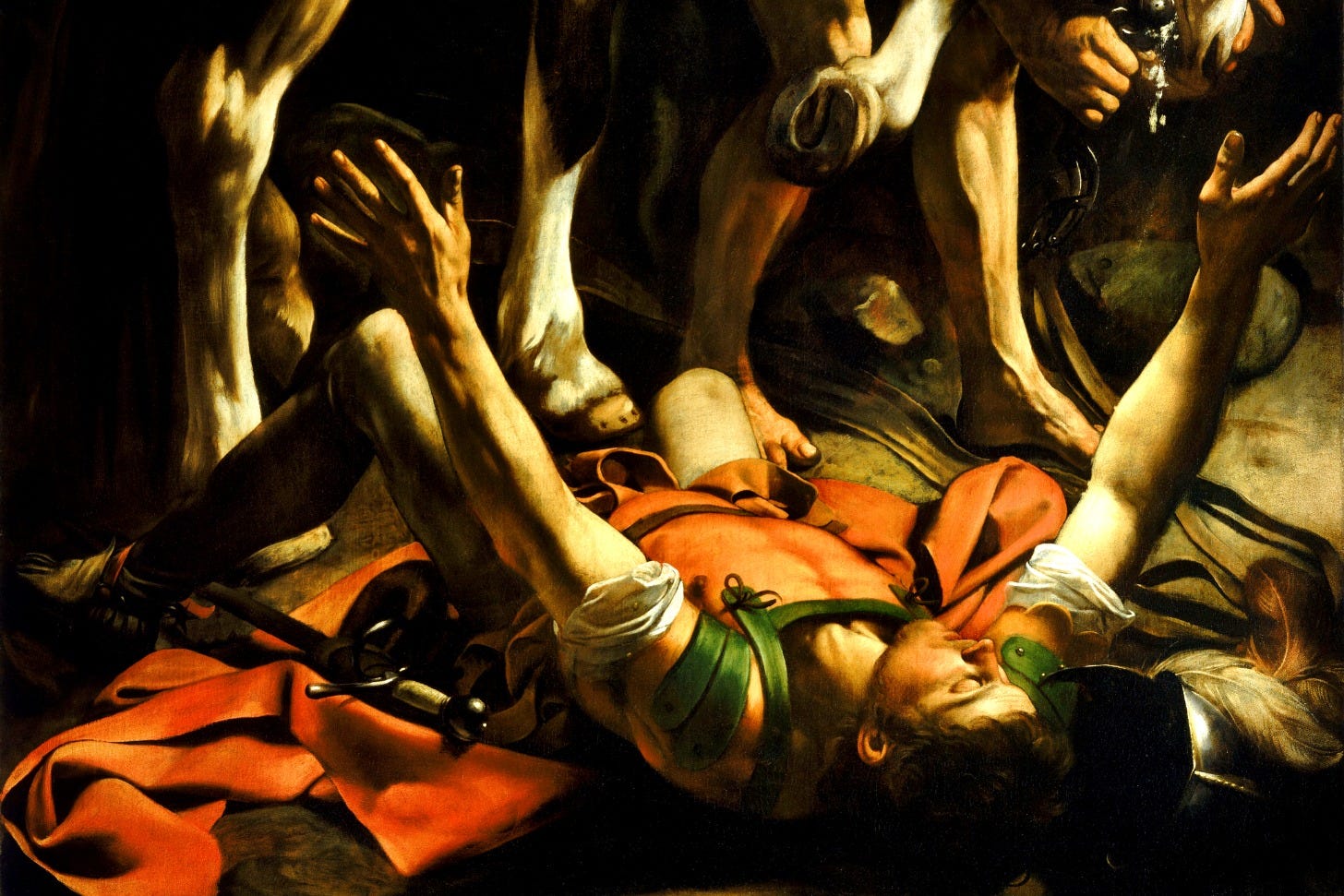
The Conversion of Saint Paul | Caravaggio, 1601 (cropped)
Why did a Roman emperor mark his soldiers’ shields with two Greek letters?
Key Terms for this Lesson
Apostles · Chi-Rho · Edict of Milan
The Apostles | ca. 30–64 CE
2,000 years ago, in Galilee, a Roman-controlled district in the north of Israel, a teacher from the small village of Nazareth gathers a following of women and fishermen. His disciples call him Rabbi (John 1:38). The movement eventually called Christianity began as a movement of Jews. After all, Jesus was a Jew, and so were his first followers.
The Gospels tell how Jesus was crucified in Jerusalem under the Roman governor Pontius Pilate, and Christians confess that he rose again on the third day. Earlier Jewish reformers, like John the Baptist, had preached in a single place. Jesus sent his followers out: “Go ye therefore, and teach all nations” (Matthew 28:19). They are the apostles (Gr. apostolos, “one who is sent”), led at first by Peter (d. ca. 65 CE) in Jerusalem.
The most traveled of them was Paul (d. ca. 65 CE), a Pharisee (cf. Sec. 9.5) who had once persecuted the Church, until, as Acts tells it, the risen Jesus stopped him on the road to Damascus (Acts 9:3–6). A Roman citizen, Paul could move with ease through the empire. In three long journeys (ca. 46–57 CE), Paul planted churches across Asia Minor (~Türkiye) and Greece, preaching first in the synagogues, where the Jews already knew the one God of Israel (cf. Sec. 9.2). At Antioch, “the disciples were called Christians first” (Acts 11:26).
The faith traveled on Rome’s own roads. There was relative peace in the empire (the Pax Romana), Roman roads made travel easier (cf. Sec. 8.1), and almost everyone in the East spoke a common language called koine, a form of Greek (cf. Sec. 7.1). And there was no class distinction among the believers. As Paul wrote:
There is neither Jew nor Greek, there is neither bond nor free, there is neither male nor female: for ye are all one in Christ Jesus. Galatians 3:28 (KJV)
The Martyrs | 64–313 CE
The Christians were few. In the mid-100s CE, Christians in the empire probably numbered fewer than 50,000 among some 60 million Romans, while nearly one in ten Roman subjects was a Jew (cf. Robert Wilken).
Why persecute so few? Rome could tolerate almost any god. Jews held an ancient exemption from Rome’s sacrifices (cf. Sec. 8.2). Gentile Christians had no such standing, and they would not offer the pinch of incense before the emperor’s image. In imitation of Christ, they prayed for those who persecuted them, and some died rather than sacrifice. The Greek word for “witness” is martys, and the Church remembers them as martyrs.
Persecution was erratic, flaring and fading with the emperor and the province:
• 64 CE | Nero blames Rome’s Christians for the Great Fire
• ca. 112 CE | Pliny asks the emperor Trajan what to do with them (cf. Sec. 8.2)
• 250 CE | Decius orders every subject to sacrifice
• 303 CE | Diocletian begins the Great Persecution
Constantine | 312–337 CE
For three centuries the Christians had been a small, sometimes hunted minority.
Their fortunes turned when a warlord had a dream.
In 312 CE, Constantine (d. 337 CE) marched on Rome against a rival emperor, Maxentius, whose army was larger than his own. The night before the battle at the Milvian Bridge, the Christian teacher Lactantius (d. ca. 325 CE) records:
Constantine was directed in a dream to cause the heavenly sign to be delineated on the shields of his soldiers, and so to proceed to battle. He did as he had been commanded, and he marked on their shields the letter Χ, with a perpendicular line drawn through it and turned round thus at the top, being the cipher of Christ. On the Deaths of the Persecutors (44, trans. William Fletcher)
Constantine marked the shields because, as Lactantius tells it, a dream told him to. The sign is the Chi-Rho, the first two letters of Christ in Greek (ΧΡΙΣΤΟΣ). Years later, the bishop Eusebius (d. ca. 339 CE) wrote that the emperor himself had told him of a cross of light in the sky around midday, with the words “Conquer by this.”
He won the battle, the day, and in 324 CE, the entire Roman Empire.
In 313 CE, Constantine and his fellow emperor Licinius agreed at Milan that “the Christians and all others should have liberty to follow that mode of religion which to each of them appeared best” (Lactantius 48). The Edict of Milan gave Christians full liberty of worship across the empire, and churches had their confiscated property restored. Constantine went on to call the bishops to Nicaea (cf. Sec. 10.3) and to found a new Christian capital on the Bosporus, Constantinople (330 CE). In 380 CE, the emperor Theodosius (d. 395 CE) made Nicene Christianity the official religion of Rome.
Sec 10 • Early Christendom
10.1 History & Politics • Apostles to Constantine
10.2 Literature & Drama • Gospels & Epistles
10.3 Religion • Nicaea & the Creed
10.4 Music • Hymns of the Early Church
10.5 Philosophy • St. Augustine
10.6 Art & Architecture • Catacombs & the Hagia Sophia
Course Page: Humanities I & II