

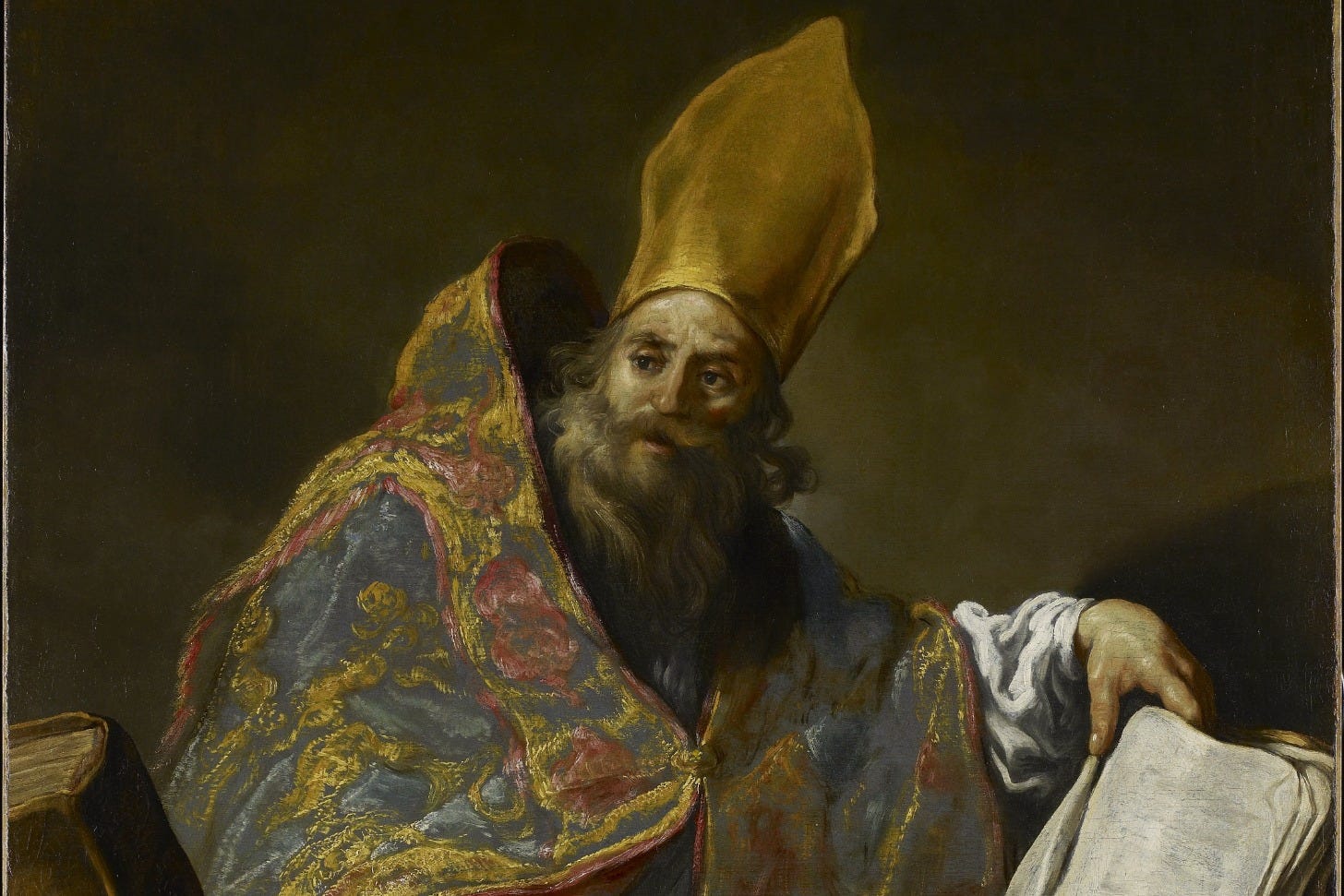
Saint Ambrose | Claude Vignon, ca. 1624 (detail)
Why did the early church sing without instruments?
Key Terms for this Lesson
Antiphony · Cantor · Oxyrhynchus Hymn
Psalms & Hymns | ca. 30–112 CE
The first singing the Gospels record among Jesus and his disciples comes on the night of the Last Supper: “And when they had sung an hymn, they went out into the mount of Olives” (Mark 14:26). Jesus and his disciples were Jews keeping the Passover, and early Christian music was based on Jewish tradition: chanting the sacred texts, and above all chanting the Psalms (cf. Sec. 9.4). In prison at Philippi, Acts tells us, “at midnight Paul and Silas prayed, and sang praises unto God” (Acts 16:25). Paul told his churches to speak to one another “in psalms and hymns and spiritual songs” (Ephesians 5:19).
The first outsider to describe Christian worship heard the singing. Around 112 CE, the governor Pliny the Younger (d. ca. 113 CE) questioned Christians in his province for the emperor Trajan (cf. Sec. 8.2). People who had once been Christians told him:
…that the whole of their guilt, or their error, was this: that they were accustomed to meet on a fixed day before dawn and to sing a hymn to Christ, as to a god, by turns among themselves. Letters (10.96.7, my translation)
The fixed day was almost certainly Sunday, a working day in Rome, so they met before work. And by turns is a musical detail. One group sang a line and the other answered it, the way Psalm 136 answers every verse with the same refrain: “for his mercy endureth for ever” (Psalm 136). This is antiphony (Gr. antiphōnos, “sounding in answer”).
Voices Alone | Why No Instruments?
In the Temple, the Levites had sung with harps, cymbals, and the shofar (cf. Sec. 9.4). Christian worship took the songs and left the instruments behind.
First, the synagogue, where the first Christians had prayed, sang its scripture without instruments. The Temple’s orchestra had fallen silent with the Temple in 70 CE.
Second, the instruments of the Roman world belonged to its temples, theaters, banquets, and arena. The pipe played at pagan sacrifices, and the water organ played at the games (cf. Sec. 8.5). A Christian who heard an aulos (cf. Sec. 7.4) heard the old gods.
Third, the early Christian teachers had read their Plato. Recall the Greek doctrine of ethos, wherein music is profoundly influential (cf. Sec. 6.4). Early Christians didn’t like the idea of music doing anything but expressing religious truths. An instrument could stir the passions without saying a word. A voice carried the words themselves.
The teacher Clement of Alexandria (d. ca. 215 CE) read Psalm 150’s whole orchestra as the human body: “the tongue is the psaltery of the Lord,” and the mouth is its lyre. “The one instrument of peace,” he wrote, “the Word alone by which we honour God, is what we employ” (Paedagogus 2.4, trans. William Wilson). So the early church sang without instruments because it wanted nothing between the worshipper and the words. The Orthodox churches of the East still sing that way today. In the West, the organ would not reach the churches for centuries (cf. Sec. 8.5).
The Cantor & the Hymn | ca. 250–397 CE
Who should sing? Some wanted a trained choir. Others wanted a single cantor (Lat. “singer”), so that the rest were free to concentrate on the message of the song. Around 363 CE, the Council of Laodicea ruled that “no others shall sing in the Church, save only the canonical singers, who go up into the ambo and sing from a book” (Canon 15, trans. Henry R. Percival). The cantor sang the verses, and the congregation answered with a simple repeated phrase, like “Alleluia.”
In 1922, scholars published a scrap of papyrus from Oxyrhynchus, a town in Egypt, bearing a hymn in Greek with musical notes written above the words. Copied in the late 200s CE, the Oxyrhynchus Hymn is the oldest Christian song whose tune we can still sing. Near its close, it praises “Father, Son, and Holy Spirit.”
In 386 CE, the empress’s soldiers surrounded the church of Milan, where its bishop, Ambrose (d. 397 CE), had shut himself in with his people. To keep their spirits up, Ambrose had them sing hymns and psalms in the Eastern manner, by turns. A young teacher in the city, Augustine, remembered that “from that day to this the custom is retained” (cf. Sec. 10.5). Ambrose wrote hymns for the people to sing, eight stanzas of four short lines each:
Maker of all, the Lord,
And Ruler of the height,
Who, robing day in light, hast poured
Soft slumbers o’er the night Deus, Creator omnium (Confessions 9.12, trans. E. B. Pusey)
Every line of Ambrose’s Latin has eight syllables. Hymnals still call his four-line stanza of eights Long Meter, and it is the meter of the Doxology, “Praise God, from whom all blessings flow.”
Sec 10 • Early Christendom
10.1 History & Politics • Apostles to Constantine
10.2 Literature & Drama • Gospels & Epistles
10.3 Religion • Nicaea & the Creed
10.4 Music • Hymns of the Early Church
10.5 Philosophy • St. Augustine
10.6 Art & Architecture • Catacombs & the Hagia Sophia
Course Page: Humanities I & II