

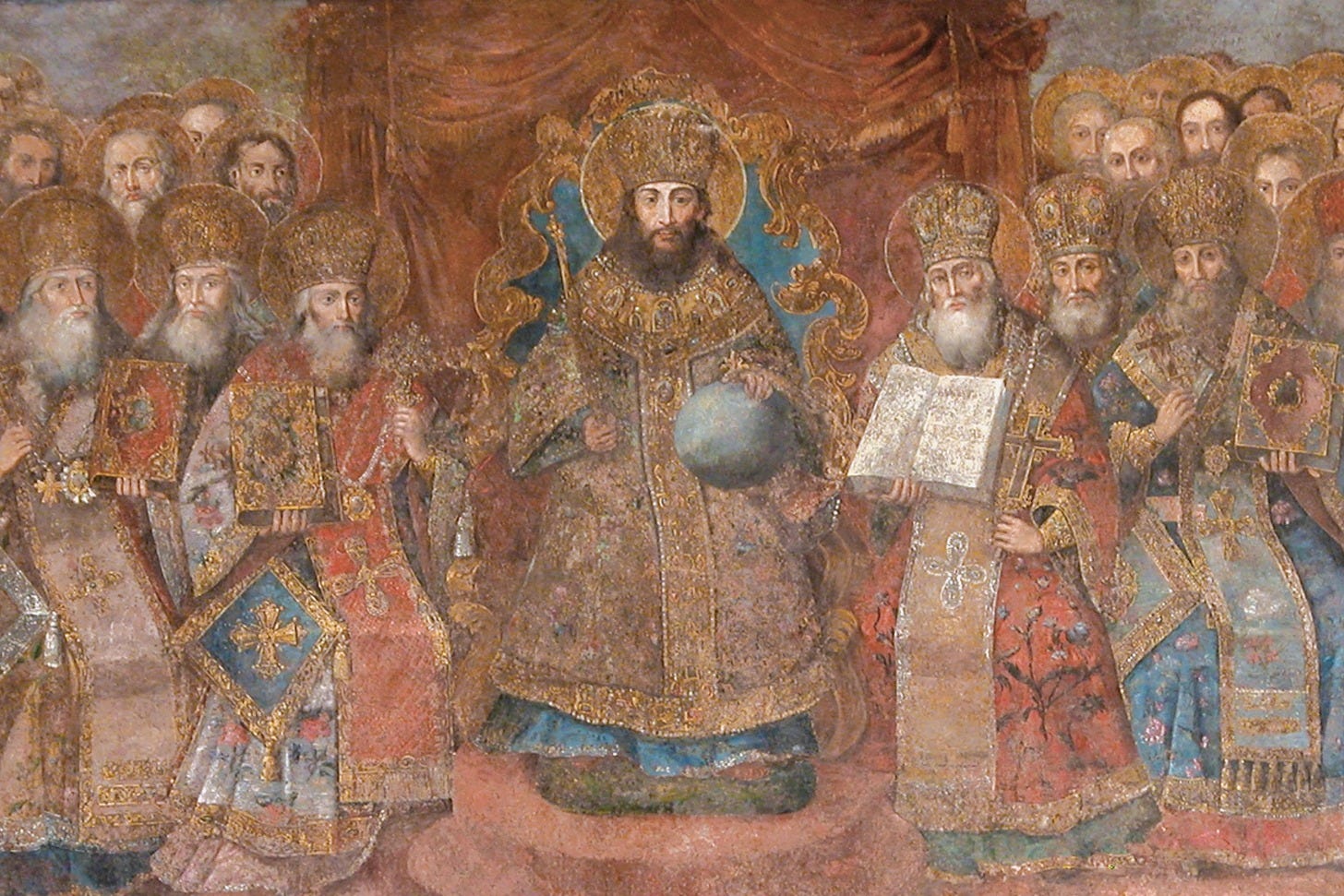
The First Ecumenical Council | St. Sophia Cathedral, Kyiv, ca. 1700 (detail)
Why did some three hundred bishops cross the empire to settle one word?
Key Terms for this Lesson
Council of Nicaea · Homoousios · Nicene Creed
Arius & Alexander | ca. 318–325 CE
After the Edict of Milan (cf. Sec. 10.1), the churches could meet in the open, and an old question became a public quarrel. In Alexandria, Egypt’s great harbor city, a popular priest named Arius (d. 336 CE) taught that Jesus was God’s Son, created by God and subordinate to God. The Son was the first and greatest of God’s works, but a work all the same: “There was a time when he was not.”
His bishop, Alexander (d. 328 CE), answered that the Son had always been, as the Father had always been. Arius was put out of the church in Alexandria, and he found friends among bishops elsewhere. Letters crossed the Mediterranean, and Arius set his ideas to verse so that ordinary people could sing them.
In 324 CE, Constantine defeated his co-emperor in the East and ruled the whole empire alone. In this way, Constantine unified the fracturing empire politically. But the people’s hearts were still divided. An emperor who owed his victory to the sign of Christ (cf. Sec. 10.1) did not want a Church at war with itself.
The Council of Nicaea | 325 CE
So in 325 CE, Constantine called on all Christian bishops throughout the empire to meet at Nicaea (today, İznik in Türkiye). He paid their travel by the imperial post. Tradition counts 318 bishops, most of them from the Greek-speaking East. Some still bore the scars of the Great Persecution, which had ended only twelve years before (cf. Sec. 10.1). It was the first council of the whole Church, the Council of Nicaea.
The bishops searched the scriptures for words that would settle the question, and Arius’ friends could read each one their own way. So the council reached for a word that is not in the Bible: homoousios (Gr. homo-, “same,” + ousia, “being” or “substance”). Ousia was a word from Greek philosophy, the vocabulary Plato and Aristotle used for what a thing truly is (cf. Sec. 7.6). To say the Son is homoousios with the Father is to say the Son is of one being with the Father, not a creature the Father made.
The council’s creed closed by condemning those who say “There was a time when he was not.” In the end, only two bishops refused to sign, and Arius was sent into exile. The council also agreed that every church would keep Easter on the same Sunday. One thing it did not do was choose the books of the Bible. That list came later (cf. Sec. 10.2).
The bishops crossed the empire to settle one word because, for them, everything hung on it: whether the Jesus they worshipped is God, or the greatest thing God ever made.
The Nicene Creed | 325–381 CE
The quarrel did not end at Nicaea. For half a century, emperors took sides, and bishops were exiled and restored. Athanasius (d. 373 CE), Alexander’s young deacon at Nicaea and later his successor, was driven from Alexandria five times for defending the word. The argument even reached the market. In Constantinople, one bishop complained, ask the price of bread and you are told the Father is greater and the Son is less (Gregory of Nyssa, d. ca. 395 CE).
In 381 CE, a second council met at Constantinople. It confirmed Nicaea and expanded its creed on the Holy Spirit, “who with the Father and the Son together is worshipped and glorified.” Christians call this the Trinity: one God in three persons, Father, Son, and Holy Spirit (Matthew 28:19). Like Israel’s Shema (cf. Sec. 9.2), the creed begins with one God:
We believe in one God, the Father Almighty, maker of heaven and earth and of all things visible and invisible. And in one Lord Jesus Christ, the only begotten Son of God, begotten of his Father before all worlds, Light of Light, very God of very God, begotten not made, being of one substance with the Father, by whom all things were made. The Nicene Creed (trans. Henry R. Percival)
“Of one substance” is homoousios in English. The Nicene Creed is still recited in Orthodox, Catholic, and many Protestant churches, more than sixteen centuries after the bishops crossed the empire to write it. Arius’ teaching lived on too. It traveled north with missionaries to the Goths, who held it well into the 500s CE.
Sec 10 • Early Christendom
10.1 History & Politics • Apostles to Constantine
10.2 Literature & Drama • Gospels & Epistles
10.3 Religion • Nicaea & the Creed
10.4 Music • Hymns of the Early Church
10.5 Philosophy • St. Augustine
10.6 Art & Architecture • Catacombs & the Hagia Sophia
Course Page: Humanities I & II