

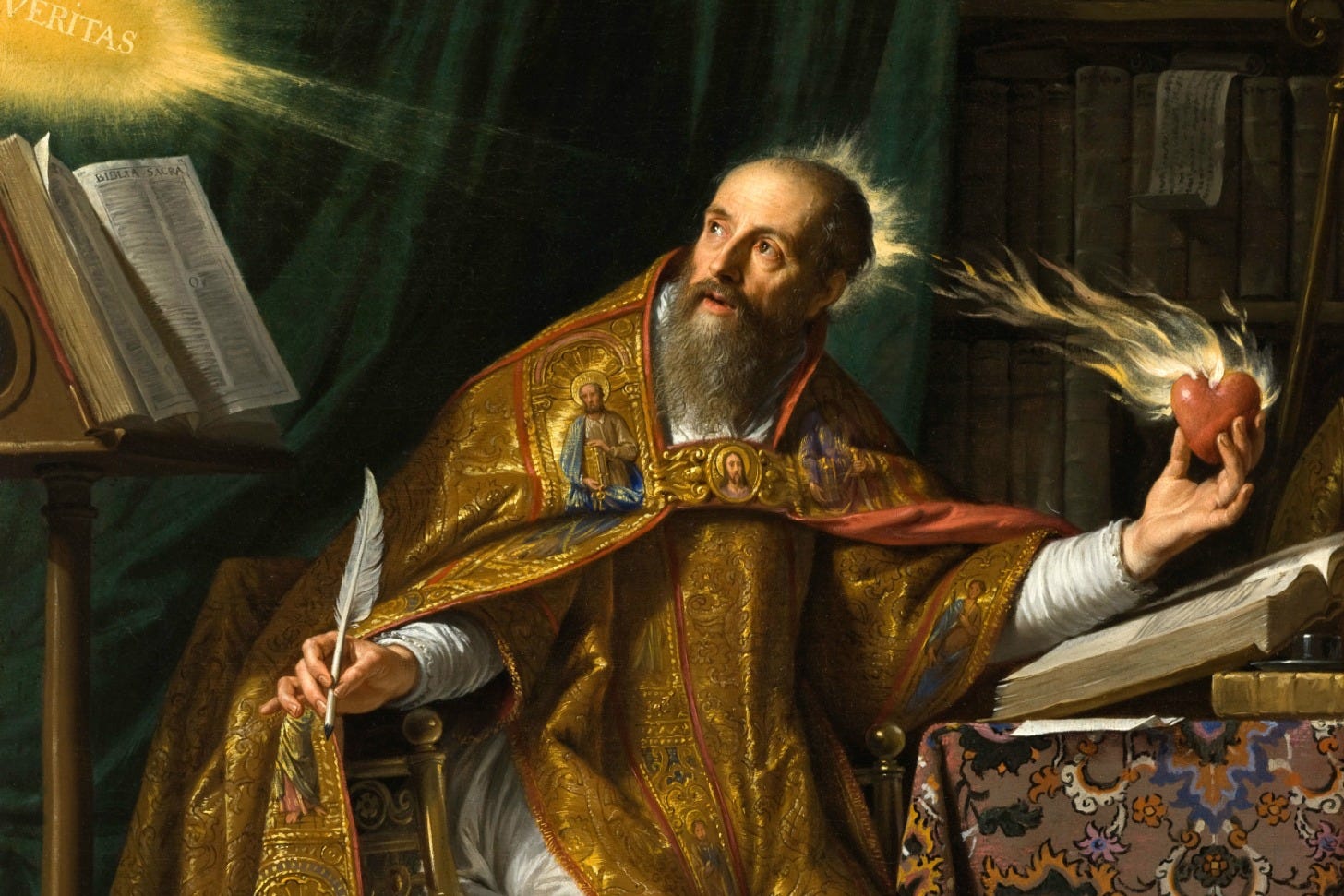
Saint Augustine | Philippe de Champaigne, ca. 1650 (detail)
Why did a bishop write the story of his life as a prayer?
Key Terms for this Lesson
Neoplatonism · Confessions · The City of God
A Restless Youth | 354–386 CE
Augustine of Hippo (d. 430 CE) was born in 354 CE in Thagaste, a small town in Roman North Africa (~Algeria). His father was a pagan. His mother, Monica (d. 387 CE), was a Christian, and she prayed for her son for years.
He was a gifted student and a restless one. At sixteen, he and his friends shook a neighbor’s pear tree late one night and carried off the fruit, “not for our eating, but to fling to the very hogs.” Years later, the theft still troubled him: he had not wanted the pears, only the wrong itself. He asked how a person could choose evil for no reason at all. It is a philosopher’s question, and it would take him the rest of his life.
At nineteen, reading Cicero (cf. Sec. 8.6), he fell in love with wisdom (Gr. sophia). He taught rhetoric in Carthage, then Rome, then Milan, the Western emperor’s capital. There he read “the books of the Platonists.” 600 years after Plato’s death, his ideas continued to evolve among his readers (cf. Sec. 7.6). The resulting philosophical school came to be known as Neoplatonism (lit. New Plato). Its founder, Plotinus (d. 270 CE), taught that all of existence flows from an ultimate, perfect source he called “the One,” and that the soul longs to return to it. Neoplatonism gave Augustine a way to think of God as spirit, not as a body in space.
Then came the sermons of Ambrose, Milan’s bishop. In 386 CE, weeping in a garden, Augustine heard a child’s voice from a neighboring house:
Take up and read; Take up and read. Confessions (8.12, trans. E. B. Pusey)
He opened Paul’s letters and read the first verse his eyes fell on (Romans 13:13–14): “No further would I read; nor needed I.” Ambrose baptized him at Easter, 387 CE.
The Confessions | ca. 397–400 CE
Augustine returned to Africa, and in 395 CE he became bishop of Hippo, a port city on the coast. Within a few years he wrote the Confessions, 13 books, the first nine telling the story of his life. It is often called the first autobiography in Western literature, and from its first page to its last, it is addressed to God. In Latin, confessio means both admitting one’s sins and praising God, and the Confessions do both. The book opens:
Thou awakest us to delight in Thy praise; for Thou madest us for Thyself, and our heart is restless, until it repose in Thee. Confessions (1.1, trans. E. B. Pusey)
The Greek command was “Know thyself” (cf. Sec. 7.3). Augustine’s prayer was to know himself and to know God together: “Let me know myself, let me know You” (Soliloquies 2.1, my translation). He wrote his life as a prayer because he believed no one can understand his own heart except before the God who made it. Nothing in the book is told to impress a reader. It is told to God, and the reader overhears.
Out of that self-examination came Augustine’s teaching on original sin and grace. Every human being, he taught, inherits from Adam a will turned away from God, and only God’s grace can turn it back. The pear tree was his example.
The City of God | 410–426 CE
In 410 CE, the Visigoths sacked Rome itself (cf. Sec. 8.1). Romans who still honored the old gods blamed the Christians: Rome had abandoned its gods, and its gods had abandoned Rome. Had the Christians brought Rome down?
Augustine answered in 22 books, written over thirteen years. His central argument rested on the dichotomy of two cities: the City of God and the City of Man. The City of God represents a kingdom of justice, peace, and eternal salvation under God’s rule. According to Augustine, true justice and peace can only be found there, and it will only be fully realized upon Jesus’ return. Until then, the world remains the City of Man, a temporary, fallible, and sinful earthly existence. What divides them is not a border but a love:
Accordingly, two cities have been formed by two loves: the earthly by the love of self, even to the contempt of God; the heavenly by the love of God, even to the contempt of self. The City of God (14.28, trans. Marcus Dods)
For Augustine, Christians are called to live according to the values of the City of God despite residing in the City of Man. While they live in the world and engage with its affairs, their ultimate allegiance belongs to God’s eternal kingdom, and not to any empire, Rome included. The City of God shaped medieval thinking about church and state for a thousand years. Augustine died in 430 CE, as a Germanic army, the Vandals, besieged Hippo.
Sec 10 • Early Christendom
10.1 History & Politics • Apostles to Constantine
10.2 Literature & Drama • Gospels & Epistles
10.3 Religion • Nicaea & the Creed
10.4 Music • Hymns of the Early Church
10.5 Philosophy • St. Augustine
10.6 Art & Architecture • Catacombs & the Hagia Sophia
Course Page: Humanities I & II