

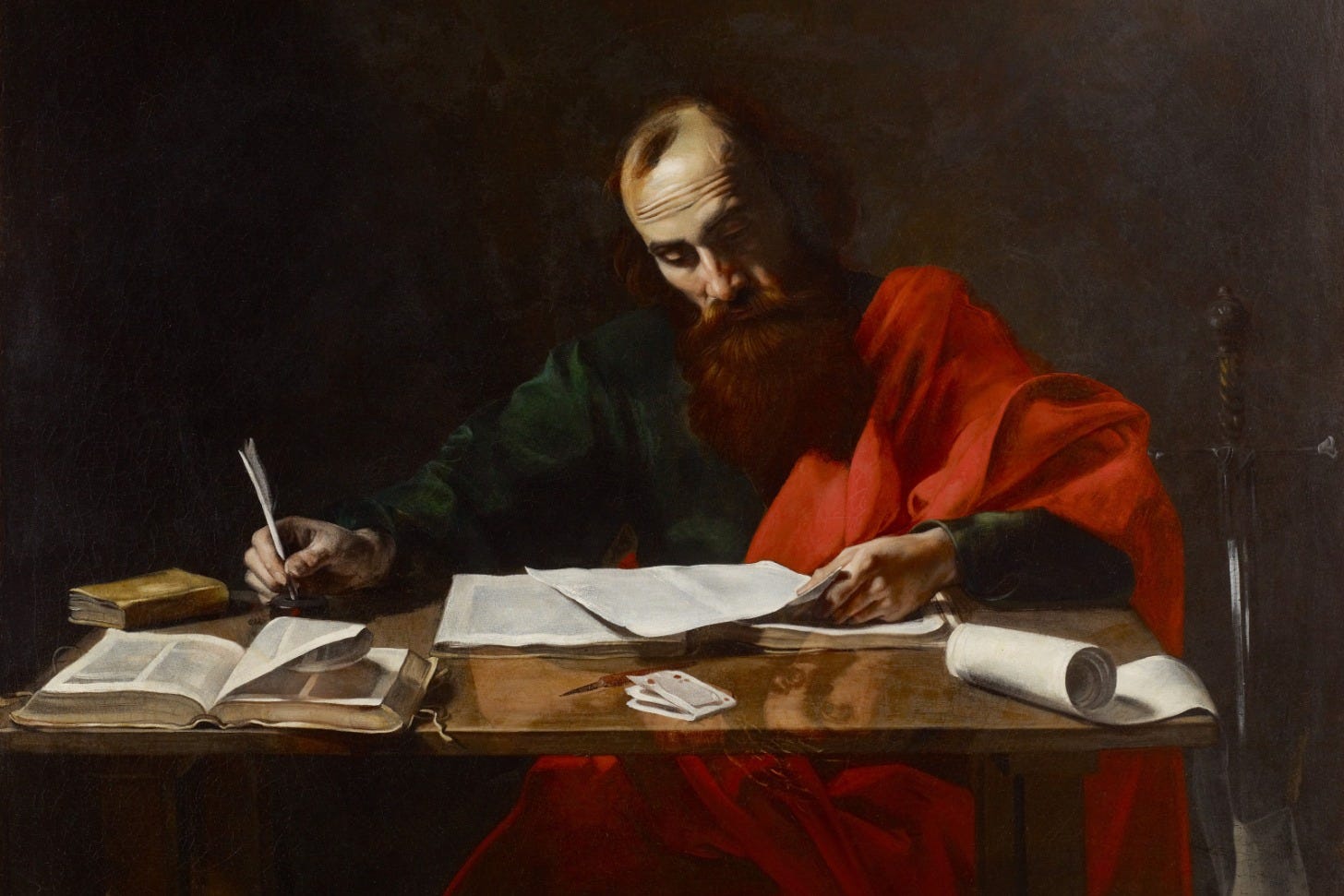
Saint Paul Writing His Epistles | Valentin de Boulogne, ca. 1620 (cropped)
How did letter writing shape the beginning of the Church?
Key Terms for this Lesson
Epistles · Gospels · Parables
The Letters of Paul | ca. 50–65 CE
By the 50s CE, Paul’s churches were scattered from Antioch to Corinth (cf. Sec. 10.1). They were small house-gatherings of Jews and Gentiles, and they had questions: about meals, about marriage, about what to do while they waited for Jesus to return. Paul could only be in one city at a time, and often he was in none of them, but in prison.
So he wrote. Paul’s teaching letters are called epistles (Gr. epistolē, “a message sent”). Thirteen of the New Testament’s 27 books are letters that bear Paul’s name, and among them are some of the oldest writings in the New Testament.
Paul wrote in the shape every Greek letter took: the sender, the receiver, a greeting, a thanksgiving, the body, and a farewell. But he changed the greeting. An ordinary Greek letter opened with chairein, “greetings.” Paul opens with charis, “grace,” and adds “peace” (Gr. eirēnē), the Jewish greeting shalom: “Grace to you and peace from God our Father, and the Lord Jesus Christ” (Romans 1:7).
He usually dictated to a scribe. At the end of Romans, the scribe adds his own line: “I Tertius, who wrote this epistle, salute you in the Lord” (Romans 16:22). In Galatians, Paul takes the pen himself: “Ye see how large a letter I have written unto you with mine own hand” (Galatians 6:11).
The letters were not read in private. They were read aloud to the gathered church, then passed on to the next one:
And when this epistle is read among you, cause that it be read also in the church of the Laodiceans; and that ye likewise read the epistle from Laodicea. Colossians 4:16 (KJV)
Paul wrote because he could not be everywhere at once. A letter, read aloud to a room of believers, carried his voice where he could not go. And because the churches copied and shared them, the letters outlived the rooms they were written for.
The Four Gospels | Good News in Four Portraits
The Greek euangelion means “good news.” The Old English translation of euangelion is gōdspel, our Gospel. Thus, the Gospels are the Christian message of the good news of Jesus Christ: “The beginning of the gospel of Jesus Christ, the Son of God” (Mark 1:1).
The Church received four Gospels, bearing the names of Matthew, Mark, Luke, and John. Each paints its own portrait of one life:
• Matthew frames the story of Jesus in the context of Jewish royalty, opening with his descent from Abraham and David
• Mark is short and direct, moving “straightway” from scene to scene
• Luke tends to emphasize the poor and the women who followed Jesus
• John opens with the Logos, a word at home in Greek philosophy (cf. Sec. 6.5)
Christians copied these books in a new format. Instead of the scroll, they favored the codex, pages bound at the spine, the ancestor of every book you own. The oldest complete New Testament to survive, the Codex Sinaiticus, was copied around 350 CE. Some years later, in 367 CE, the bishop Athanasius (d. 373 CE) wrote the first list of exactly the 27 books of the New Testament.
The Sermon on the Mount | Parables & Teaching
Jesus taught in parables (Gr. parabolē, “a setting beside”), short stories drawn from the life of Galilee that set an everyday thing beside a heavenly one. A sower scatters seed. A shepherd leaves ninety-nine sheep to find one (Luke 15:4). Around the Sea of Galilee, many made their living by fishing, and so “the kingdom of heaven is like unto a net” (Matthew 13:47).
His longest teaching in the Gospels is the Sermon on the Mount (Matthew 5–7). It opens with blessings, “Blessed are the poor in spirit” (Matthew 5:3), and Jesus tells his hearers that he came “not to destroy, but to fulfil” the Law and the Prophets (Matthew 5:17). Then he takes up the oldest law in this course:
Ye have heard that it hath been said, An eye for an eye, and a tooth for a tooth: But I say unto you, That ye resist not evil: but whosoever shall smite thee on thy right cheek, turn to him the other also. Matthew 5:38–39 (KJV)
His hearers knew the line from the Torah, where it keeps a punishment in proportion to the injury (cf. Sec. 2.6), and where the rabbis read it as a payment for the harm done (cf. Sec. 9.6). Jesus asks the one who has been struck to give up even that claim. “For he taught them as one having authority, and not as the scribes” (Matthew 7:29).
Sec 10 • Early Christendom
10.1 History & Politics • Apostles to Constantine
10.2 Literature & Drama • Gospels & Epistles
10.3 Religion • Nicaea & the Creed
10.4 Music • Hymns of the Early Church
10.5 Philosophy • St. Augustine
10.6 Art & Architecture • Catacombs & the Hagia Sophia
Course Page: Humanities I & II