

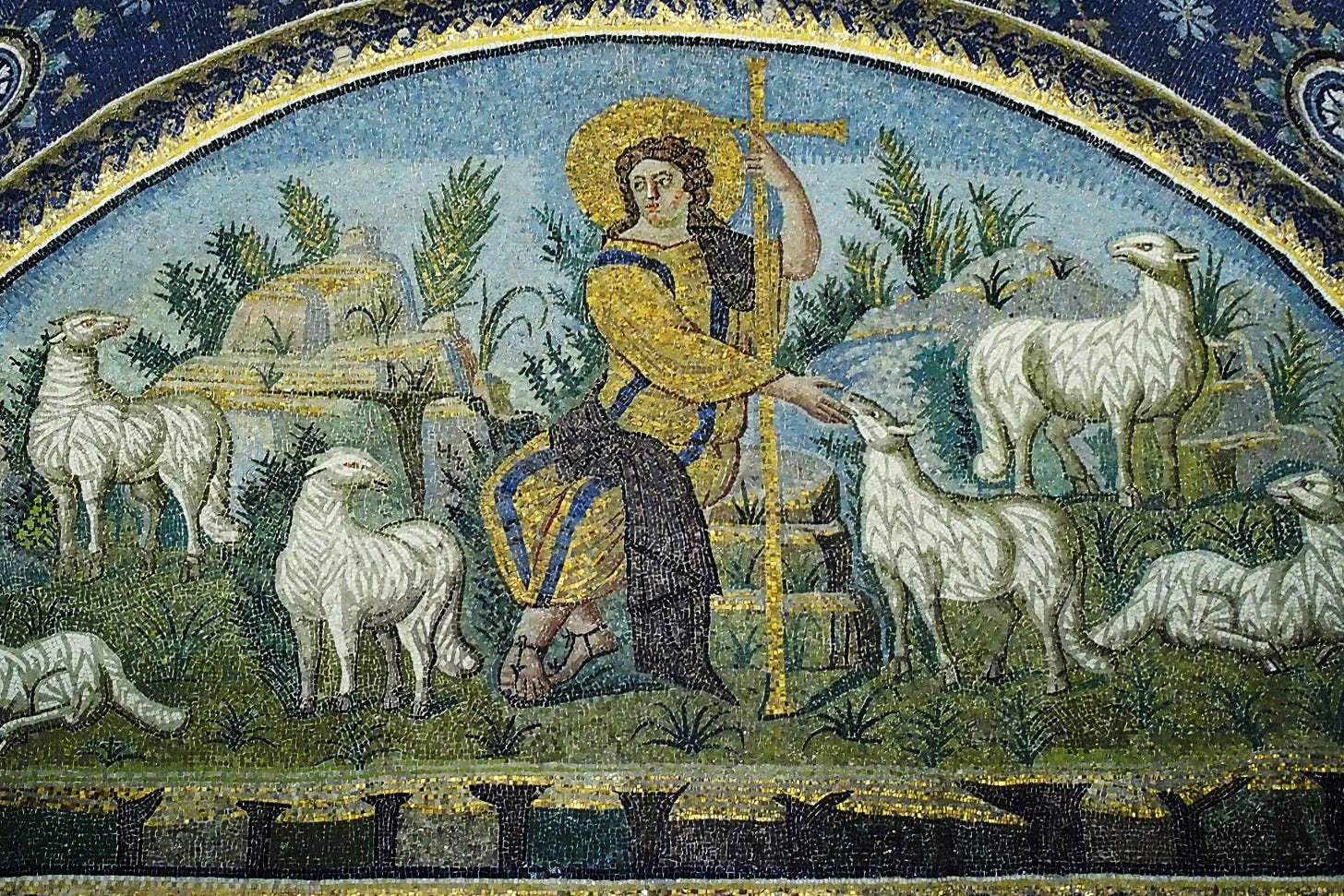
The Good Shepherd | Mausoleum of Galla Placidia, Ravenna, ca. 430 CE (cropped)
Photo Credit: Petar Milošević via Wikimedia Commons
Why did the first Christians paint a shepherd?
Key Terms for this Lesson
Catacombs · Basilica · Hagia Sophia
The Catacombs | ca. 200–400 CE
Roman law kept the dead outside the city walls. So, beyond the walls of Rome, Christians and Jews dug their cemeteries underground, carving miles of narrow galleries into the soft volcanic rock, with the dead laid in shelves along the walls. These are the catacombs. They were burial places, not hideouts, and families gathered there to remember their dead. We find our earliest Christian art in the catacombs. Like the art of many peoples before them, it is funerary art (cf. Sec. 5.6).
We know these are Christian catacombs because of the symbols used to decorate the walls. Inscriptions give the name, the date of death, and a symbol of the person’s faith:
• The anchor | hope: “which hope we have as an anchor of the soul” (Hebrews 6:19)
• The dove and olive leaf | peace, after the flood (Genesis 8:11)
• The Chi-Rho | Christ (cf. Sec. 10.1)
• The fish | Christ, in a word game
The game is Greek. Ichthys is “fish,” and its five letters begin the words Iēsous Christos Theou Yios Sōtēr: “Jesus Christ, God’s Son, Savior.” For the first Christians, the fish said what the cross would later say.
And on the walls and ceilings, again and again, a young shepherd carries a lamb across his shoulders. “I am the good shepherd: the good shepherd giveth his life for the sheep” (John 10:11). The image was old. Greek sculptors had carved men carrying a calf or a ram for centuries. Christians gave it a new meaning, and Jewish Christians knew it from the Psalms: “The LORD is my shepherd” (cf. Sec. 9.4).
Why a shepherd and not a cross? In the catacombs, the dead were laid to rest in hope, and the cross was still Rome’s way of executing criminals. The first Christians painted the hope they held, a shepherd bringing the lost sheep home. The cross became common in Christian art only after Constantine ended crucifixion as a punishment.
The oldest church building yet found tells the same story. At Dura-Europos, a Roman frontier town in Syria, a house was made into a church in the 230s CE. In 256 CE, Roman soldiers buried it inside an earthen rampart against a Persian siege, and so it survived. Above its baptismal font is a shepherd with a sheep across his shoulders.
The Basilica | 313–450 CE
After the Edict of Milan (cf. Sec. 10.1), the church came above ground. For its new churches, Constantine chose not the Roman temple, built as a home for a god’s statue, but the Roman basilica, a long public hall for law courts and business. The basilica was built to hold a crowd. Its long nave led the eye down the rows of columns to the apse, where the bishop sat and the altar stood. Constantine’s Saint Peter’s in Rome (begun ca. 320 CE) took this shape, and many churches in the West still do.
The walls filled with mosaic, small cubes of colored glass and stone set into plaster, some backed with gold leaf. In Ravenna, the Western emperors’ capital from 402 CE, the Good Shepherd of the catacombs reappears in the mausoleum of the empress Galla Placidia (d. 450 CE, see above). Now he is robed in gold and royal purple, and he holds a tall golden cross.
Hagia Sophia | 532–537 CE
In 532 CE, riots in Constantinople burned the city’s great church to the ground. The emperor Justinian (d. 565 CE), with his empress and co-ruler Theodora (d. 548 CE), rebuilt it in under six years. His architects, Anthemius of Tralles and Isidore of Miletus, were mathematicians. Hagia Sophia is Greek for “Holy Wisdom.” It is Justinian’s most famous building project, legendary in its day and still known today for the beauty of its decoration.
Its problem was the Pantheon’s (cf. Sec. 8.4) made harder: how to set a round dome on a square of four great arches. The answer was the pendentive, a curved triangle of masonry that rises from each corner to the dome’s rim. The dome itself, about 100 feet across, sits on a ring of forty windows, so the light seems to come from beneath it. Light symbolizes divine wisdom, in Plato (cf. Sec. 7.6) and in the New Testament. The historian Procopius (d. ca. 565 CE) wrote that the church seemed lit not by the sun outside, but by a light born within it (Buildings 1.1.30). Of the dome, he wrote:
It seems to stand on no solid masonry at all, but to cover the place like a golden sphere hanging from heaven. Buildings (1.1.46, my translation)
For nearly a thousand years, it was the largest church in the world. In 1453, the Ottoman conquest of Constantinople made it a mosque.
Sec 10 • Early Christendom
10.1 History & Politics • Apostles to Constantine
10.2 Literature & Drama • Gospels & Epistles
10.3 Religion • Nicaea & the Creed
10.4 Music • Hymns of the Early Church
10.5 Philosophy • St. Augustine
10.6 Art & Architecture • Catacombs & the Hagia Sophia
Course Page: Humanities I & II
Next Section: Early Islam