

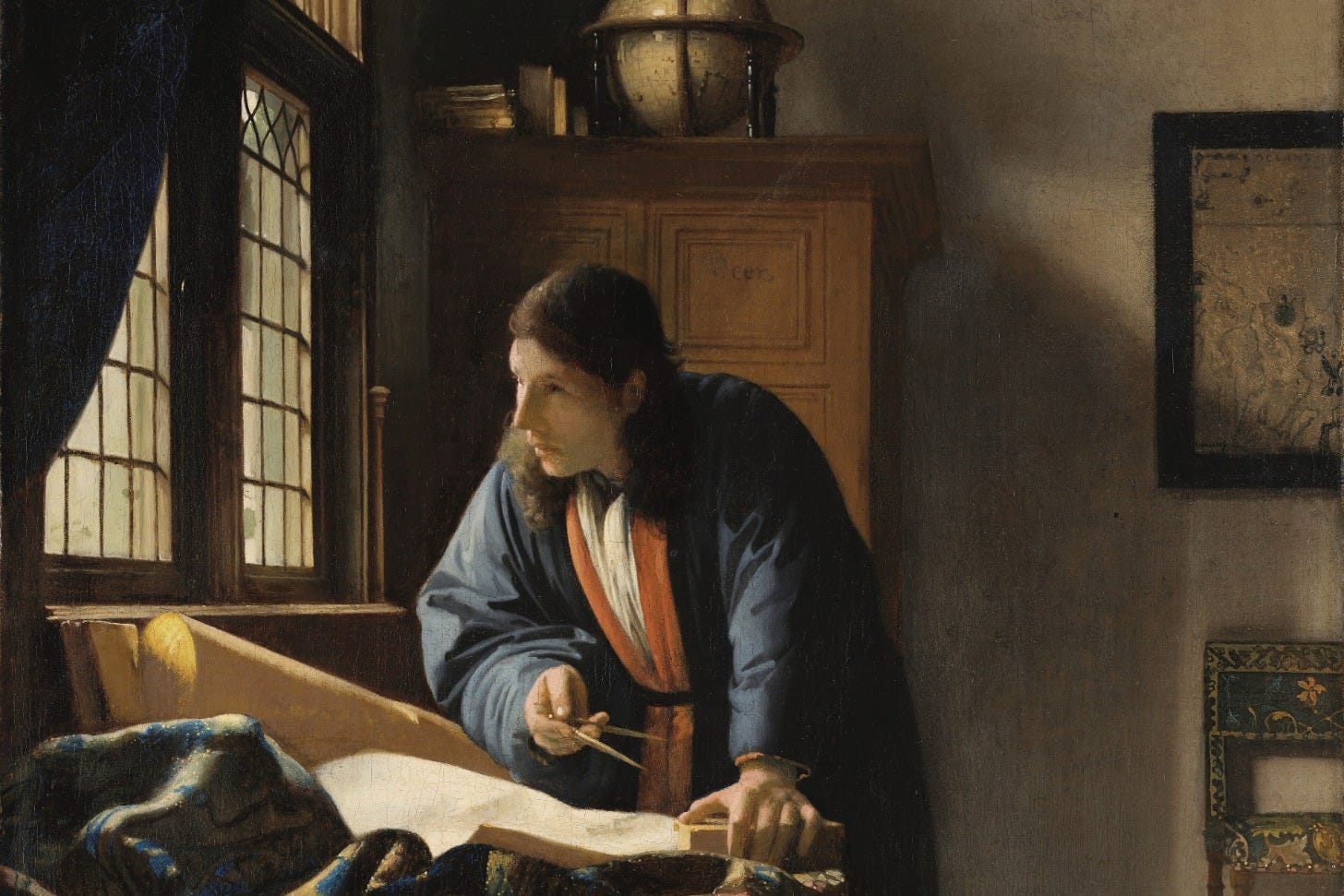
The Geographer | Johannes Vermeer, ca. 1669
Why did Europeans start calling their own age “modern”?
Key Terms for this Lesson
Modernity · Method of Doubt · Cogito Ergo Sum
Modus & Modo | A Word for “Just Now”
The word is older than the age — by about a thousand years.
Its earliest surviving use is in a pope’s letters of the 490s. From the Latin modus (a measure, a manner) came the adverb modo (“just now”), and from modo a new adjective, modernus. For a thousand years, modern meant nothing grander than recent: the modern sermon, the modern bishop, the one you heard last Sunday.
Then something did change. Between the 14th and 16th centuries, profound historical changes occurred throughout Europe that culminated in what we today call the modern age (cf. Humanities I, 15.2). Humanists like Petrarch (d. 1374) and Erasmus (d. 1536) took another look at long-forgotten Greco-Roman texts, marveled at our past achievements, and dared to wonder what humanity might be capable of in a world where we were free to read, believe, and think according to our own personal convictions. To call their own time a rebirth (It. rinascita), they needed a name for the centuries in between — and they found one. In 1469 a Roman bishop and editor, Giovanni Andrea Bussi (d. 1475), later the Vatican’s librarian, wrote of a media tempestas, a “middle season.” The humanists invented the Middle Ages in order to have something to come after. And modern, the word for “just now,” became the word for an age that believed it was starting over. Bruce Mazlish places the birth of the modern age in that Renaissance, when one senses a new interest in man as a creature capable of change, “not merely a fallen Adam seeking salvation” (cf. Mazlish, Makers of Modern Thought).
Modernity represents an historical shift in how people know things, a turn toward evidence you can see, conviction you hold for yourself, and authority you are willing to question. In deep contrast with the classical past, it is a sociocultural shift in history, marked by rationality, individualism, and progress. In the classical past, time was viewed as a big circle. Nothing ever changes. You had the job your father had, and his father, and his father. But in the modern world, there was a new word, progress. In the classical past, reality was explained through metaphor, narrative, and allegory. But in the modern world, there was a new word, discovery. And in the classical past, authority had been invested in holy men. But in the modern world, there was a new focus on the individual to decide for himself what he thought and believed. Modernity has the tendency to ever look forward and ahead of itself.
Methodos | The Way After
Method comes from methodos: meta (after, along) and hodos (a road, a way). A method is a road you can walk a second time and arrive at the same place. In Aristotle’s time, knowledge about the world was gained by deduction from first principles. By the modern age, observation became the standard of scientific knowledge. You have to see it to believe it. The early modern philosophers felt that truth should be derived from reason and individual understanding. Scholasticism, they complained, was lacking in direct observation and scientific parsimony (cf. Humanities I, 13.6).
The man who drew the new road map was a French soldier and mathematician, René Descartes (d. 1650). His Discourse on the Method (1637) was written in French rather than Latin, so that anyone could read it, and it lays down four rules.
The first was never to accept anything for true which I did not clearly know to be such; that is to say, carefully to avoid precipitancy and prejudice, and to comprise nothing more in my judgement than what was presented to my mind so clearly and distinctly as to exclude all ground of doubt. The second, to divide each of the difficulties under examination into as many parts as possible, and as might be necessary for its adequate solution. The third, to conduct my thoughts in such order that, by commencing with objects the simplest and easiest to know, I might ascend by little and little, and, as it were, step by step, to the knowledge of the more complex… And the last, in every case to make enumerations so complete, and reviews so general, that I might be assured that nothing was omitted. Discourse on the Method, Part II (trans. John Veitch)
Doubt everything. Break it into parts. Climb from the simplest. Check your work.
Of What Can We Be Certain? | Descartes
For a thousand years, the Medieval Church’s favorite question was “What is truth?” Pontius Pilate famously posed it to Jesus at his trial (John 18:38), and the schools answered it from authority. It was René Descartes who finally set Europe on a course toward a new world of modern philosophy. He did this by reframing an age-old question. Instead of asking, “What is truth?” he asked, “Of what can we be certain?”
This is a fundamentally different question and the first question of the modern age.
Ironically, Descartes used the concept of doubt to discover undoubtable knowledge. In his search for philosophical certainty, doubt would lead the way! This is his Method of Doubt: set aside everything that can possibly be doubted, and see what is left. First, Descartes doubted the reliability of the senses. Second, he doubted the reality of the physical world. Next, he doubted even mathematics. Perhaps an evil spirit has convinced us that 2+2=4, but actually 2+2=5? Descartes may doubt sensory perception. Descartes may doubt the physical world. Descartes may even doubt mathematical principles. But in all of this, what can he never doubt? He cannot doubt that he is doubting.
Or, as the famous axiom states, Cogito Ergo Sum. “I think, therefore I am.” It is not true because a holy man said it. It is true because it is logically obvious.
Descartes therefore stands at a swinging door. Behind him lay the tradition and authority of the medieval Church. Ahead of him was the great project of modernity. As a penitent French Catholic, the road ahead would not be easy.
Modernus only ever meant recent. The moderns gave it a direction. A modern is someone who believes the road runs forward, and that he can find it by himself. Whether that belief was earned, and what it cost, is the question of the next 89 lessons.
Sec 1 • Defining the Modern
1.1 Philosophy • Modus & Modo: Method & the Way
1.2 History & Politics • Four Ages & the Promise of Progress
1.3 Literature & Drama • The First Information Age
1.4 Art & Architecture • Leonardo, Michelangelo, & the High Renaissance
1.5 Music • Petrucci & the First Printed Music
1.6 Religion • Faith, Reason, & the Individual
Course Page: Humanities I & II