

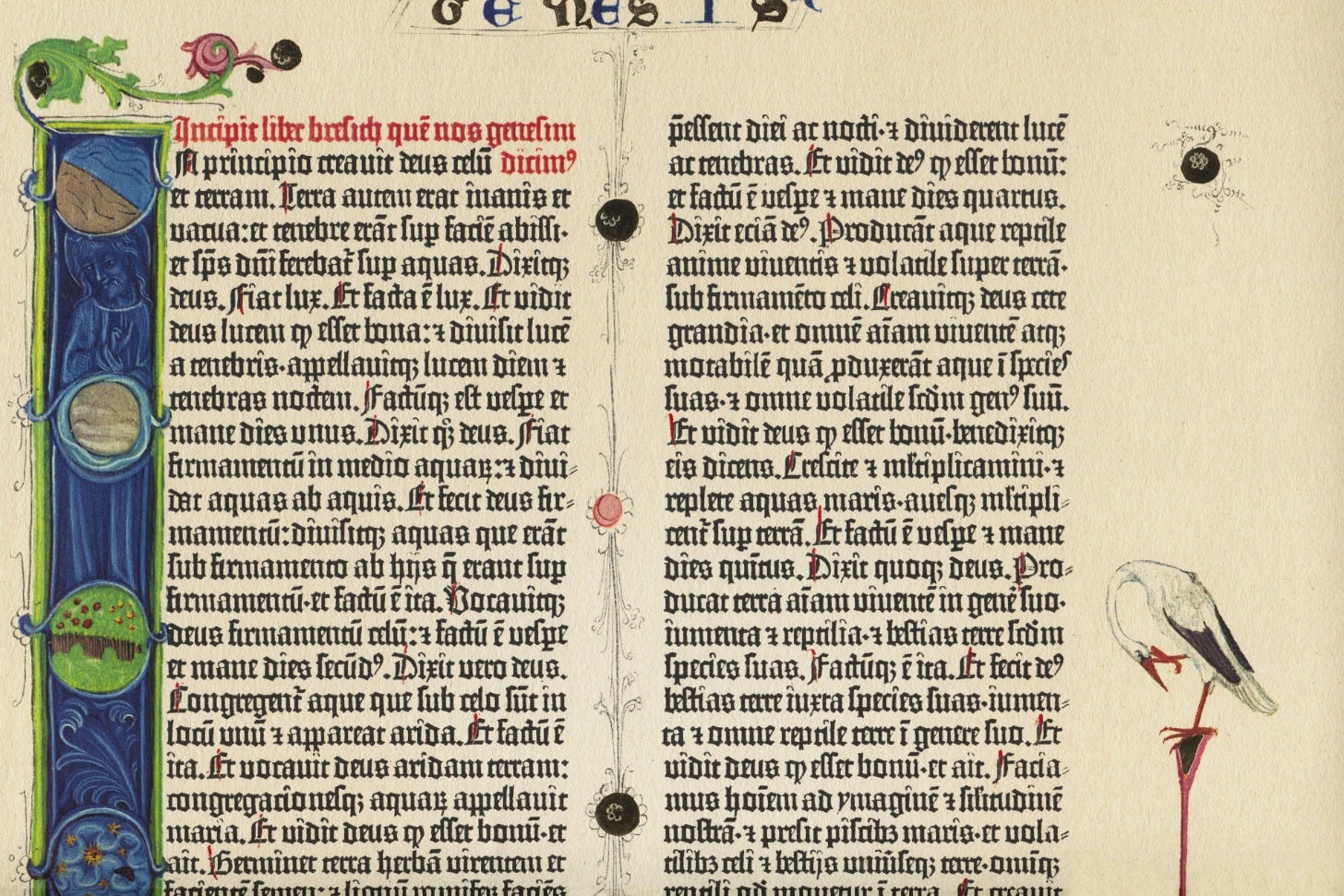
Gutenberg Bible | Mainz, ca. 1455 (detail)
What happens to a civilization when books become cheap?
Key Terms for this Lesson
Printing Press · Movable Type · Incunabula
Before the Press | The Scriptorium
In an age when almost no one could read, the people who could were overwhelmingly monks (cf. Humanities I, 12.3). In the scriptorium (the monastery’s writing room) monks did the most consequential thing anyone in early medieval Europe did with a pen. They copied books.
Around 700 the monks of Wearmouth-Jarrow, in northern England, copied a single Latin Bible, the Codex Amiatinus, on more than 1,000 leaves. It took the skins of some 500 cattle, and it weighs over 75 pounds. Most Latin classics that reached the modern world survived because a monk, somewhere, copied them out by hand and a monastery kept them on a shelf.
So the problem was never that medieval Europe had no books — it had thousands. The problem was arithmetic. Before the press, books were all written by hand and therefore prohibitively expensive. A Bible took a scribe the better part of a year, and a university student rented his textbooks a few leaves at a time. Most Christian Europeans only ever saw one book in their lives, and it was chained to a lectern.
Mainz, ca. 1450 | Punch, Matrix, & Mould
A German goldsmith was about to build a machine that could print a book faster than any monastery of scribes.
We have little information on Johannes Gutenberg (d. 1468) of Mainz: no portrait, no date of birth. And he did not invent printing. Woodblock printing pre-existed movable-type printing by centuries, and Bi Sheng had made clay type in China in the 1040s. What Gutenberg assembled, around 1450, was a system. He cut each letter in reverse on a steel punch, struck the punch into soft copper to make a matrix, and set the matrix in a hand-held mould that cast a lead-alloy letter in seconds. He could cast the same letter hundreds of times, and every copy was identical. That is movable type: metal letters set into lines, locked into a frame, inked, pressed onto paper, then broken apart and set again. The press originated with wine presses, so the press itself was not new at all. The ink was new, an oil-based varnish with a high metal content, not the ink used for manuscripts. The typeface was not new either: a block letter designed to mimic the popular handwriting of religious manuscripts. The printshop became the first proto-assembly line.
The paper had come a long way too. Paper appears in Europe at the end of the 11th century via the Islamic world (cf. Humanities I, 11.3), Chinese by invention, through Muslim Spain, before Italy’s first mills opened at Fabriano in the 1270s. Gutenberg’s Bible is a Chinese material, an Arab trade route, and a German goldsmith’s alloy, pressed together in a wine press.
His great Bible came off the press around 1455, in perhaps 180 copies (49 survive): 1,286 pages in two volumes, 42 lines to the column — hence its other name, the B42. It was finished the year his investor, Johann Fust, sued him for the debt and took the workshop. By one estimate the Bible sold for about 30 florins, roughly three years of a clerk’s wages, so it was no bargain. But the next one cost the same as the first, and the one after that. The scribe’s book got more expensive the better it was. The printer’s book got cheaper the more he made.
The First Information Age | 1455–1517
By 1500 there were presses in some 250 European towns, and they had printed, by the usual count, more than 27,000 editions. Historians call these first printed books incunabula, from the Latin for “cradle” (in cunabulis, “in swaddling clothes”): books from the cradle years of the printing press, before 1501. The capital of the trade was Venice, where the press was made more accessible by Aldus Manutius (d. 1515), an Italian humanist. Aldus is responsible for several features of text that we are familiar with today, including the semicolon, the modern comma, a slanted typeface called italics, and, from 1501, pocket-sized books that Aldus felt would make texts more portable (cf. Sec. 1.5).
In Rabelais’s Gargantua and Pantagruel, written inside that boom, the old giant writes to his son at the university in Paris:
Now is it that the minds of men are qualified with all manner of discipline, and the old sciences revived which for many ages were extinct… Printing likewise is now in use, so elegant and so correct that better cannot be imagined, although it was found out but in my time by divine inspiration, as by a diabolical suggestion on the other side was the invention of ordnance. All the world is full of knowing men, of most learned schoolmasters, and vast libraries. Pantagruel, ch. VIII (trans. Thomas Urquhart)
Printing from God, cannon from the devil, and both new in one lifetime. Rabelais is joking, and he is not. The two machines that defined the modern world arrived together.
Going forward, the printing press meant that texts no longer passed only through the hands of the clergy who copied and read them aloud. A literate townsman could now own a book, read it himself, and reach his own conclusions. Once ordinary people could read the sources for themselves, the question was only a matter of time: who has the authority to say what the text means? In 1517 the press would answer it. Within months of Luther’s Ninety-Five Theses, the prints had carried an academic quarrel across Germany (cf. Sec. 2.2). Early works by reformers that were duplicated in bulk could not be destroyed as easily. Pamphlets and letters received wider distribution because they were cheaper to reproduce. With the printing press, reformers could spread their message quickly and broadly, and within a century, the Christian world would have changed forever.
So here is what happens when books become cheap. Readers multiply. Then questions do.
Sec 1 • Defining the Modern
1.1 Philosophy • Modus & Modo: Method & the Way
1.2 History & Politics • Four Ages & the Promise of Progress
1.3 Literature & Drama • The First Information Age
1.4 Art & Architecture • Leonardo, Michelangelo, & the High Renaissance
1.5 Music • Petrucci & the First Printed Music
1.6 Religion • Faith, Reason, & the Individual
Course Page: Humanities I & II