

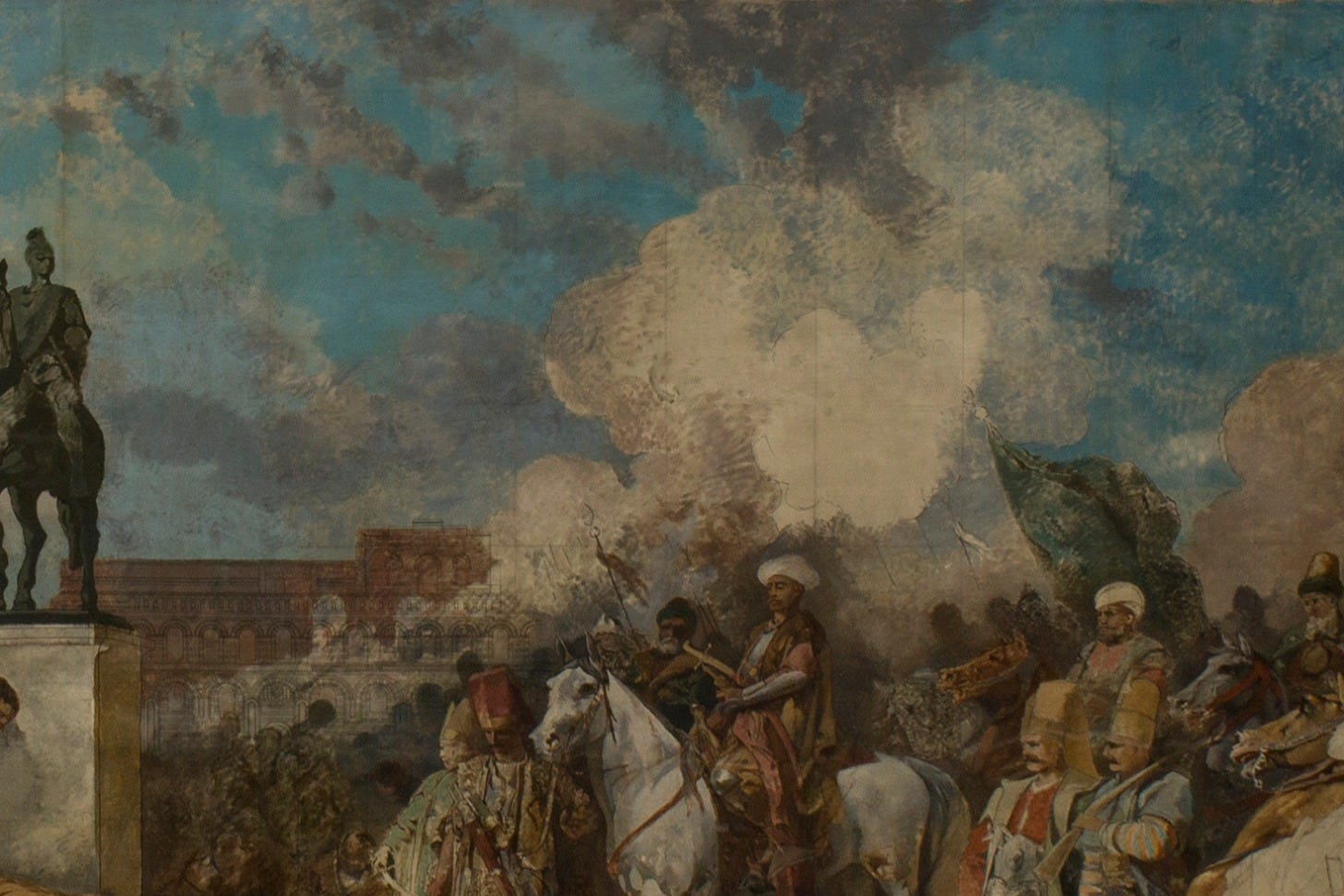
Entry of Sultan Mehmed II into Constantinople | Stanisław Chlebowski, 1870s (detail)
Why did Europe stop believing its golden age was behind it?
Key Terms for this Lesson
Cyclical Time · Golden Age · Progress
The Ages of Decline | Hesiod to Ecclesiastes
For most of human history, the best days were behind us.
The Greek poet Hesiod (fl. ca. 700 BCE) told it first (cf. Humanities I, 1.6), and the Roman poet Ovid (d. 17 CE) told it best. Humanity began in an age of gold and has slid downhill ever since, through silver and bronze, to the age we live in now — the age of iron.
The Golden Age was first founded, which, without any avenger, of its own accord, without laws, practised both faith and rectitude. Punishment, and the fear of it, did not exist… The pine-tree, cut from its native mountains, had not yet descended to the flowing waves, that it might visit a foreign region; and mortals were acquainted with no shores beyond their own… The last Age was of hard iron. Immediately every species of crime burst forth… The sailor now spread his sails to the winds… Then destructive iron came forth, and gold, more destructive than iron; then War came forth, that fights through the means of both. Metamorphoses I (trans. Henry T. Riley)
Ships. Mines. Borders. Trade. What a textbook calls civilization is, for Ovid, the Iron Age. The Golden Age is the age with none of it.
Ecclesiastes knew a cousin of the thought. “The thing that hath been, it is that which shall be… and there is no new thing under the sun” (Ecclesiastes 1:9). The ancient and medieval notion of the world is that the way things are is the way things always were. By and large, people generally assumed life was always the way it is at that moment. People didn’t think of themselves as the product of history. This is cyclical time. Young men in England routinely took their father’s job as their surname, for if your grandfather did it, you did it, and your grandsons would do it too. This is why we have surnames today like Baker, Cooper (barrel maker), Fletcher (arrow maker), Miller, Smith, and Taylor. In a worldview where nothing ever changes, jobs become last names.
In the medieval world, choice was not something people thought of as a good thing. You did not choose your profession. You generally did not choose your wife or husband. You did not choose where you lived. You did not choose your religion. 500 years ago, most Europeans would never leave the town of their birth or the job chosen for them as children. They could not read a Bible, had never voted — or eaten a potato.
The Turn | 1453–1517
With the rise of banks, shipping, printing, and capitalism in the 1400s and 1500s, everything changed.
In 1453 the Ottoman sultan Mehmed II (d. 1481) takes Constantinople, and Greek scholars carry their manuscripts west to Italy (cf. Humanities I, 15.2). Constantinople, the Christian capital, was now an Islamic Ottoman city. Islamic Spain was about to become a united Christian kingdom. And by the end of the century the whole of Europe would set its sights not east, as it had in the medieval period, but west, on the New World. The Islamic world would not. Why? What led to Europe’s meteoric rise? In a word: modernity.
• 1453 | Constantinople falls to the Ottomans
• ca. 1454 | Gutenberg prints at Mainz
• 1492 | Columbus reaches the Caribbean
• 1517 | Luther’s Ninety-Five Theses
The whole idea of a merchant class arose in Italy, where in the 1300s it did not much matter what land you owned, who your father was, or what religion you followed. What mattered was how good you were at making a deal. Individual merchants would sit together on a bench and strike a deal, often borrowing money at interest, and the Italian word for that bench was banca (cf. Humanities I, 15.1). What did this new merchant class love to invest in above all else? Ships. When the Ottomans took Constantinople, Christian traders no longer had a land route east, so European leaders started sending out ships. It’s no coincidence that Columbus found America in 1492. Within one lifetime, Ovid’s pine-tree had descended to the waves and his metal had come out of the ground. Wealth had become status. It still is today.
Four Ages of the Modern | 1454–1980s
The modern world is completely the opposite of the ancient one. Part of that is because people in the modern age thought of themselves as historical beings. Wealthy families sent their children to Italy to study Latin and Greek and to see the old Colosseum and statues. Suddenly people were aware of a context for their existence. So, if we are historical beings, modern thinkers realized, then we can learn from our past mistakes to improve our present and our future. This leads to perhaps modernity’s greatest promise. It’s one that we will see in Hegel, in American politics, and in capitalism: every day in every way things are getting better. This promise is the promise of modernity, and its name is progress. Wealth is no longer perceived as an inheritance but rather an act of individual effort, and a golden age became something you built, not something you had lost.
Ovid’s four ages ran downhill. This course tells the story of four ages that were meant to run up. The first is the Rebirth (1454–1603), Module I: print, the High Renaissance, and a Reformation that handed the individual believer a Bible. The second is Early Modern Philosophy (1604–1775), Module II: the new science, the social contract, and the Enlightenment. The third is Nationalism & Industry (1776–1913), Module III: two revolutions, the factory, the empire, and the first serious doubts. The fourth is the End of Modernity (1914–1980s), Module IV: the trenches, the camps, the bomb, and a generation that asked whether progress had been a story Europe told itself.
Each age kept the promise in a new form, and each paid for it in a new coin. A modern is a person who believes the golden age is ahead. Module I watches Europe come to believe it. Whether the belief survives the 20th century is Module IV’s question.
Sec 1 • Defining the Modern
1.1 Philosophy • Modus & Modo: Method & the Way
1.2 History & Politics • Four Ages & the Promise of Progress
1.3 Literature & Drama • The First Information Age
1.4 Art & Architecture • Leonardo, Michelangelo, & the High Renaissance
1.5 Music • Petrucci & the First Printed Music
1.6 Religion • Faith, Reason, & the Individual
Course Page: Humanities I & II