

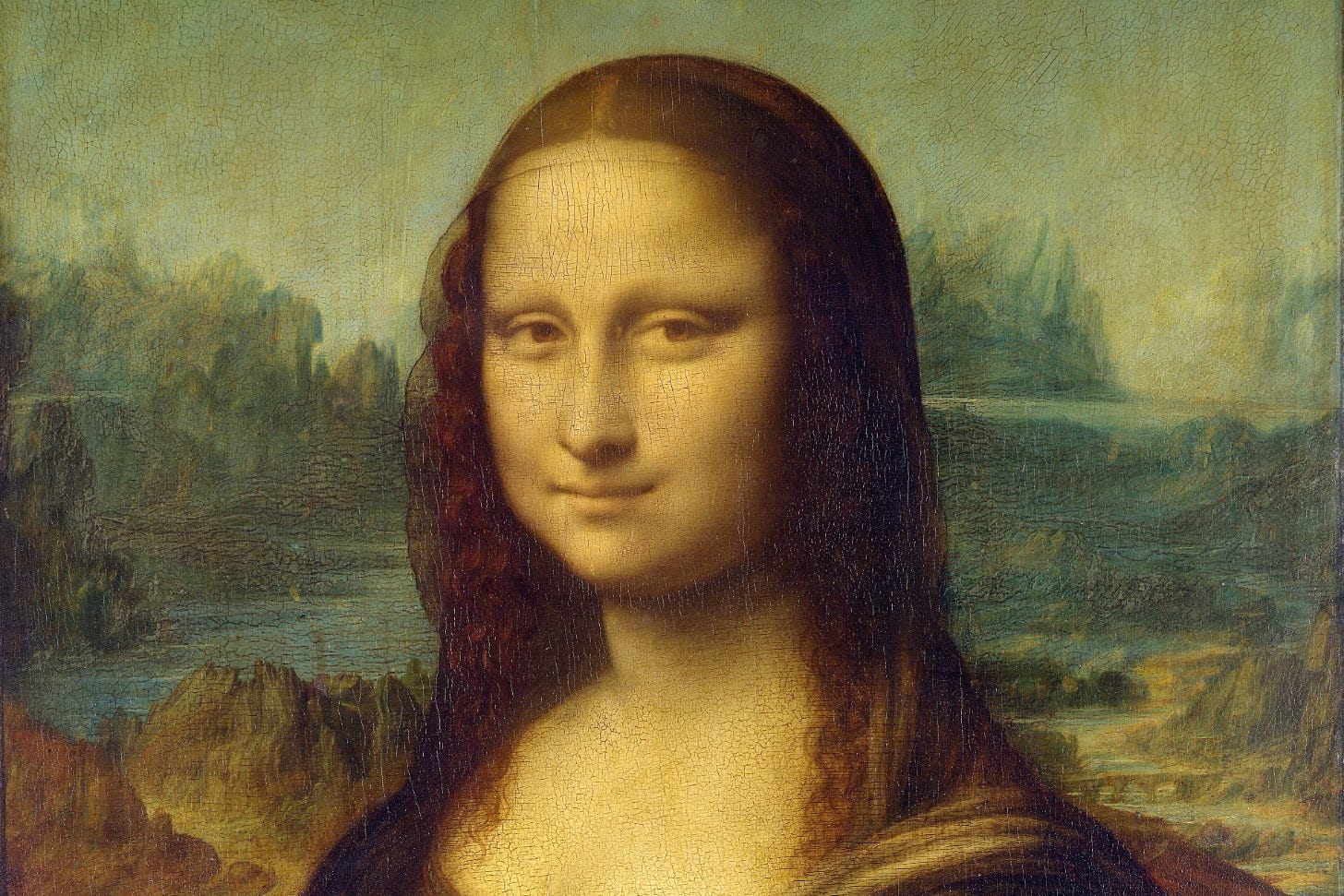
Mona Lisa | Leonardo da Vinci, ca. 1503–1519 (detail)
Why did Leonardo apply for a job as a weapons engineer?
Key Terms for this Lesson
Chiaroscuro · Terribilità · Greek Cross
The Letter | Milan, ca. 1482
Around 1482, a thirty-year-old Florentine wrote to the ruler of Milan asking for work. He listed ten things he could do. Painting came last.
Most illustrious Lord, Having now sufficiently considered the specimens of all those who proclaim themselves skilled contrivers of instruments of war… I shall endeavour… to explain myself to your Excellency showing your Lordship my secrets… 1) I have a sort of extremely light and strong bridges, adapted to be most easily carried, and with them you may pursue, and at any time flee from the enemy… 4) Again I have kinds of mortars; most convenient and easy to carry; and with these can fling small stones almost resembling a storm… 10) In time of peace I believe I can give perfect satisfaction and to the equal of any other in architecture and the composition of buildings public and private; and in guiding water from one place to another. Item: I can carry out sculpture in marble, bronze or clay, and also in painting whatever may be done, and as well as any other, be he whom he may. Leonardo da Vinci, draft letter to Ludovico Sforza (trans. Jean Paul Richter)
The writer was Leonardo da Vinci (d. 1519), and the draft survives, in a copyist’s clean hand rather than Leonardo’s mirror script. We met him in Humanities I (cf. Humanities I, 15.3) as the painter of the Last Supper. In 1482 the court of Milan was not hiring painters. Ludovico Sforza (d. 1508) ruled a duchy between France and Venice, and a court bought what it needed: bridges, mortars, and a man who could drain a moat. Leonardo put the bronze horse of Ludovico’s father in the postscript and his painting in the last line, and, in time, he got the job.
What he painted there is the reason we know his name — not the bridges. The Madonna of the Rocks (begun 1483) sets Mary at the apex of a pyramid, the two infants at its base, and lights the whole from one side so that faces emerge from darkness. That handling of light against shadow is chiaroscuro (It. chiaro, light, and oscuro, dark), and it is how a flat panel began to breathe. In medieval art, the narrative was more important than anatomical correctness, and human proportion was illustrated according to one’s importance, rather than to imply realistic size or perspective (cf. Humanities I, 14.5). The Italian Renaissance is characterized by its realism and quiet dignity. Paintings during this time used almost invisible brushwork, and sculptures were crafted in contrapposto, which is a relaxed, natural position.
Rome | Julius II & the Warrior Pope’s Court
Few men had more power in the 1500s than the popes. Pope Sixtus IV (d. 1484) was a great patron of the arts, commissioning Florentine artists like Botticelli to fresco the walls of the Sistine Chapel, which was named in his honor. Pope Julius II (d. 1513) was Sixtus IV’s nephew and was known as il papa terribile, “the awesome pope,” whose temper was as legendary as his influence. In 1503, Julius II ascended to power after two failed attempts and much bribery. This is traditionally called the beginning of the High Renaissance. He took the name Julius in honor of Julius Caesar and determined it was his duty to restore Rome to its full glory, and for ten years Rome hired everyone.
He gave Bramante (d. 1514) the commission to tear down Constantine’s basilica and build a new St. Peter’s (1506). He brought Raphael (d. 1520), aged twenty-five, from Florence to paint his private library (1508), where The School of Athens (cf. Humanities I, 15.3) faces the Disputà across one room: the philosophers on one wall, the theologians on the other. At the court of Julius II, philosophy served theology, and beauty was a gift of God even when it came from pagan hands.
It was he who summoned Michelangelo Buonarroti (d. 1564), or simply Michelangelo, to Rome, and ordered the sculptor to paint his uncle’s ceiling. The Sistine vault is about 5,800 square feet, and from 1508 to 1512 he painted more than 300 figures on it, standing on scaffolding of his own design. The program is Hebrew Bible from end to end. Nine panels of Genesis run down the spine, from the Creation to Noah. Seven prophets and five sibyls sit beneath them, the pagan prophetesses given the same thrones as Isaiah and Jeremiah. Julius had wanted twelve apostles. Michelangelo gave him the story that came before them.
The word his contemporaries used for Michelangelo’s work was terribilità, an awe-inspiring force, the quality that makes his seated Moses (1513–1515), carved for Julius’s own tomb, look as though he is about to stand. Moses sits in a Roman church, San Pietro in Vincoli, and Julius lies elsewhere.
The Dome | St. Peter’s, 1506–1590
Bramante drew his new basilica as a Greek cross, four equal arms under a central dome. After his death the builders turned it into a Latin cross with a long nave for processions. Then, in 1547, Julius’s successors handed the job to a seventy-one-year-old Michelangelo, who took it without pay (for the love of God, as Vasari records) and turned the plan back into a Greek cross. He designed the dome and died in 1564 with the drum finished and the dome unbuilt. Giacomo della Porta (d. 1602) closed it in 1590, and Carlo Maderno added the nave in 1606–1615. The greatest church in Christendom was built under a dozen architects over 160 years, and the plan changed shape three times.
Why did Leonardo apply for a job as a weapons engineer? Because in 1482 that was the job. By 1547 the greatest sculptor alive was hired to build the greatest church, on his own terms. Modernity is about individuality, and we see this in the arts. We don’t often talk about specific medieval artists. That’s because in the medieval world, artisans were responsible for producing works of art and music for the king and for the Church. This changed during the Italian Renaissance, when art virtuosos became celebrities. In an era when individuals started to stand out from the crowd, suddenly everyone wanted a painting by Leonardo da Vinci, or a sculpture by Michelangelo. The modern world is where individuality and celebrity begin. The High Renaissance (cf. Humanities I, 15.3) lasted barely a generation, from about 1495 to the Sack of Rome in 1527. Its three names were an engineer who painted, a sculptor who built, and a painter who died at thirty-seven — Raphael, in 1520.
Sec 1 • Defining the Modern
1.1 Philosophy • Modus & Modo: Method & the Way
1.2 History & Politics • Four Ages & the Promise of Progress
1.3 Literature & Drama • The First Information Age
1.4 Art & Architecture • Leonardo, Michelangelo, & the High Renaissance
1.5 Music • Petrucci & the First Printed Music
1.6 Religion • Faith, Reason, & the Individual
Course Page: Humanities I & II