

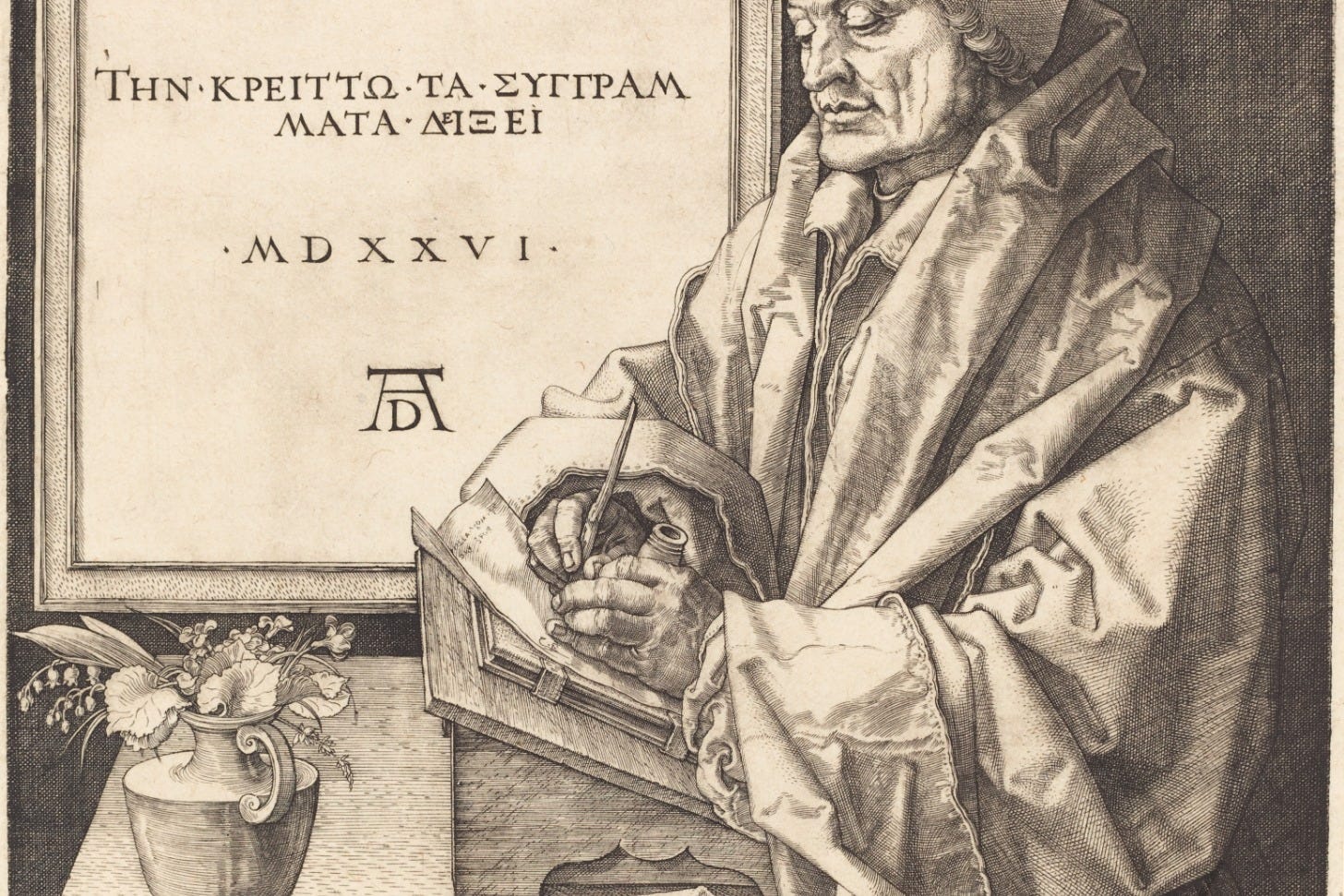
Erasmus of Rotterdam | Albrecht Dürer, 1526 (detail)
Why did Erasmus print the New Testament in Greek?
Key Terms for this Lesson
Ad Fontes · Novum Instrumentum · Private Belief
Basel, 1516 | Novum Instrumentum
In March 1516, at Johann Froben’s press in Basel, a Dutch priest published the New Testament in a language almost no one in Western Europe could read.
Erasmus (d. 1536), a Dutch Renaissance humanist and a devout Catholic, called it the Novum Instrumentum, “the new instrument,” a parallel translation of the New Testament in Greek and Latin. In the left column of each page stood the Greek of the apostles, printed for the first time. In the right column stood a new Latin translation, Erasmus’s own, set beside the Greek so that a reader could check one against the other. It presented the New Testament as a text which dated back beyond the Latin Vulgate and claimed therefore to be potentially more authentic. At the back were his notes, explaining where Jerome’s Vulgate (cf. Humanities I, 10.2), the Latin Bible of the Western Church for 1,100 years, had rendered a word in a way the Greek did not support. Where the Vulgate’s Jesus says do penance, the Greek says change your mind (metanoeite, Matthew 4:17). Erasmus said so, in print, in a book dedicated to Pope Leo X. He was not attacking the Church. He was doing what the humanists always did: ad fontes, “to the sources” (cf. Humanities I, 15.2).
He also said why. In the preface he called the Paraclesis (“exhortation”), the most famous scholar in Europe explained whom he wanted reading it:
I wish that all women read the Gospel, and read the letters of Paul. And would that these were translated into every tongue of every people, so that they could be read and known not only by Scots and Irishmen but by Turks and Saracens too… Would that the farmer sang something of them at the plow, that the weaver hummed something of them at his loom, that the traveler lightened the weariness of the road with stories of this kind. Paraclesis (my translation)
The scholar who printed the Greek wanted it in the hands of the plowman. The Greek was for the translators. The translators were for everyone else.
Faith & Reason | Erasmus and Luther
The first translator to use it was Martin Luther (d. 1546). Luther used Erasmus’s Novum Instrumentum as the Greek text for his German translation of the Bible instead of the Latin Vulgate (1522), and it put the apostles into the language of the marketplace (cf. Sec. 2.2). Early on, Luther found common purpose with Erasmus insofar as both were hoping to reform the Catholic Church, but the two ultimately disagreed on matters of doctrine as well as critical technique. Luther found Erasmus too pedantic and lukewarm, while Erasmus found Luther’s polemics too excessive. Their quarrel is the hinge of this lesson.
For humanists like Erasmus, man was a speculative creature, whose reason might eventually pave the way toward truth. In 1524 Erasmus published On Free Will (De libero arbitrio), and in its sequel, the Hyperaspistes, he insists one of the results of original sin was an affliction of “weakness, not malice; for the perversity we see in some is not from nature, but from the habit of sinning.” In contrast, Luther and the nascent Protestants understood fallen man to be a totally depraved creature incapable of discerning anything on his own. In 1525 Luther answered with On the Bondage of the Will (De servo arbitrio), and he conceded nothing. Where Erasmus wanted a Christian trained by reading, Luther wanted a Christian seized by faith. Erasmus died in 1536 in Protestant Basel, still a member of the Roman church — and the city buried him in its Minster.
What the quarrel did is more important than who won it. At the core of Luther’s teaching were sola fide (Lt. “by faith alone”), that a person is saved by faith and not by works or purchased merit, and sola scriptura (Lt. “by scripture alone”), that scripture is the final rule of Christian truth. Both claims handed the individual believer, Bible in hand, an authority the medieval church had reserved to itself. Once Luther initiated the idea that Christians should look to the Bible for themselves, with no intermediary, the notion of interpretation became central to individual Christians in a way it had never been before, and Erasmus’s Greek was the tool. A great portion of the King James Bible of 1611 can be traced back to Tyndale’s English of 1526, and therefore to the labors of the humanist Erasmus and his Novum Instrumentum.
The Individual | From Public to Private Belief
For medieval Europe, religion was universal: to the medieval mind there was only one religion in the world, the “catholic” (Gr. universal) Church, and any other choice (Gr. hairesis) was a heresy. Religion was also public: there was no practical division between church and state. And religion was an enforced obligation: conformity to Church doctrine was mandated by law. In the Middle Ages, religious life in Europe was this: universal, public, and obligatory.
Contrast this with the modern worldview. Religion came to be understood as a matter of private belief, something a person holds rather than something a town attends. The state no longer required you to participate in Christianity as a matter of governance. Rather, faith became a matter of personal choice in the West. 500 years ago, religion literally meant the opposite of what it does today. Religion went from being a universal, public, and obligatory practice led by the state to a local, private, and voluntary belief system that one feels in the heart (cf. Sec. 2.5).
In ancient and medieval times, authority was invested in God, holy men like priests and bishops, and in tradition. If you had a question, it was these authorities who would answer. Modernity promoted the idea that authority is invested not in outside figures, but in ourselves. It is up to the individual to determine what is right, what is wrong, and what is true. Our notion of privacy also stems from this modern value of individualism. That shift did not finish in Erasmus’s lifetime — it has not finished in ours. But it began on his page. And in the century’s last quarter, in the tower of his château near Bordeaux, Michel de Montaigne (d. 1592) had a motto struck on a medal (1576) with a pair of scales: Que sais-je?, “What do I know?” It is the individual’s question, and Descartes will inherit it (cf. Sec. 1.1).
Why did Erasmus print the New Testament in Greek? So that the plowman could check the priest. He meant it as a reform of the Church he never left. He lived to see it become the reason the Church split. Both are true, and the next section is the story of the second.
Sec 1 • Defining the Modern
1.1 Philosophy • Modus & Modo: Method & the Way
1.2 History & Politics • Four Ages & the Promise of Progress
1.3 Literature & Drama • The First Information Age
1.4 Art & Architecture • Leonardo, Michelangelo, & the High Renaissance
1.5 Music • Petrucci & the First Printed Music
1.6 Religion • Faith, Reason, & the Individual
Course Page: Humanities I & II
Next Section: The Reformation