

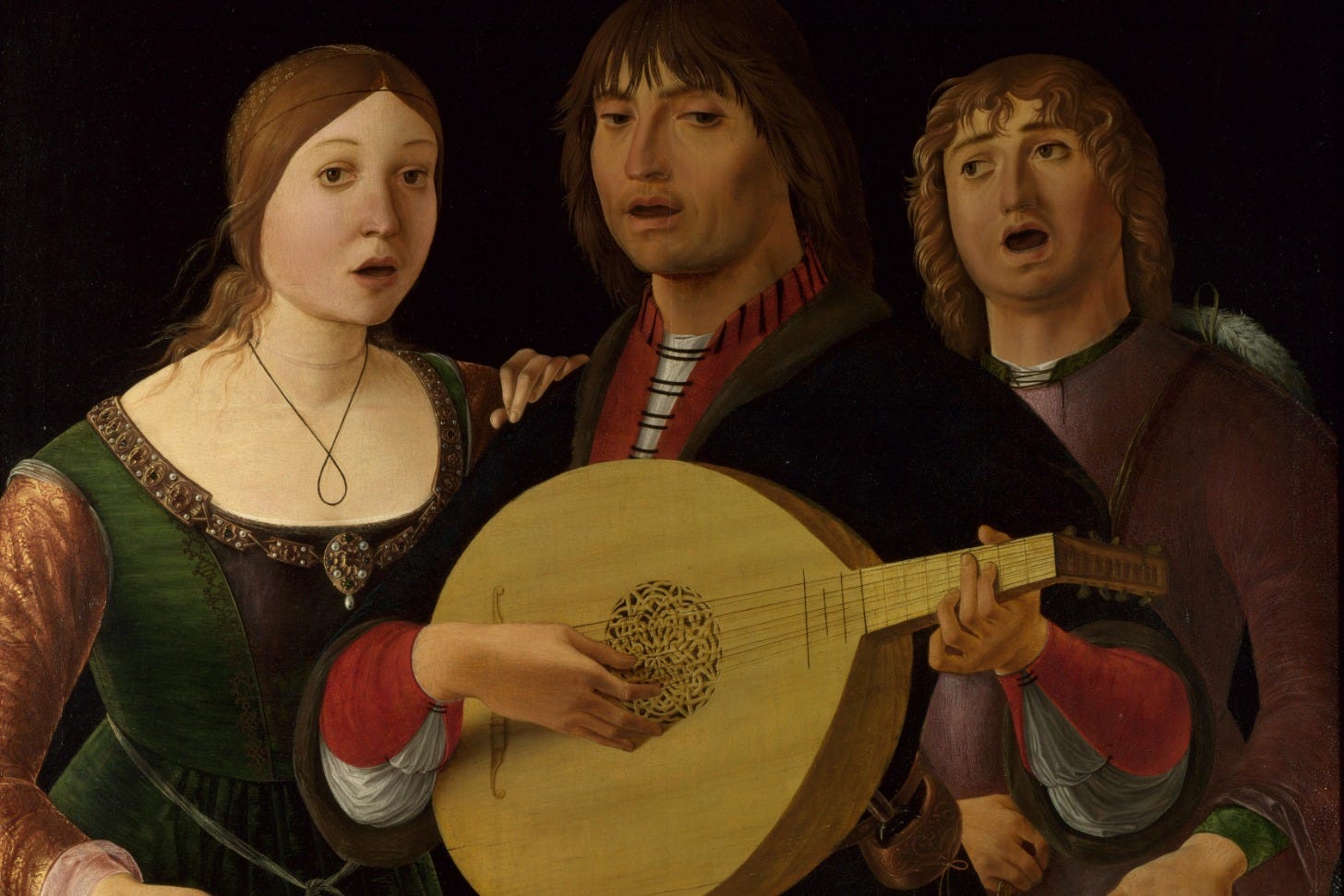
A Concert | Lorenzo Costa, ca. 1488–1490 (detail)
Why did Venice grant one printer a monopoly on music?
Key Terms for this Lesson
Printing Privilege · Odhecaton · Triple Impression
Venice, 25 May 1498 | The Privilege
On 25 May 1498 the government of the Republic of Venice granted a thirty-one-year-old from the Papal States the sole right, for twenty years, to print “figured music” (canto figurato) and music in the tablature of the organ and lute. His name was Ottaviano Petrucci (d. 1539), from Fossombrone in the hills behind Urbino. No one else in the Republic could print a polyphonic note until 1518.
A grant like this was called a printing privilege, and Venice had invented the form. In 1474 the Senate had passed the first patent law in the world, promising ten years’ exclusive use to anyone who built “a new and ingenious device” in the city, and the Republic extended the same bargain to printers. The privilege is the ancestor of the patent and the copyright. It was not a gift. It was a price, paid in advance, for something no one had yet managed to do.
Because the hard part was never printing music. Chant had been printed with movable type since the 1470s (a Roman missal of 1476 has the notes). The hard part was polyphony (cf. Humanities I, 15.4): three or four independent voices, each with its own rhythm, written in a notation of hollow and filled note-heads on a five-line staff that had to line up exactly. Every printer who tried had produced a mess. Venice, the capital of the book trade (cf. Sec. 1.3), bet twenty years of monopoly that Petrucci could.
The Odhecaton | 15 May 1501
Three years later he delivered. His first book was the Harmonice Musices Odhecaton A, “One Hundred Songs of Harmonic Music,” dated by its dedication to 15 May 1501. The Odhecaton holds 96 pieces for three and four voices by the masters of the Franco-Flemish school: Josquin (d. 1521), Isaac, Obrecht, Ockeghem. The parts were printed facing one another across the open page, so that singers could stand around one small book. It is the first book of polyphony printed from movable type, and it sold well enough to be reprinted twice, in 1503 and 1504, and followed by Canti B and Canti C.
How did he do it? By running every sheet through the press three times, for the staves, the words, and the notes. This is triple impression, and its result is beautiful. The notes sit on the lines as if drawn there, the ink is a fine black, and the fit (what printers call the register) is perfect. It was also slow and expensive, which is why a Parisian printer, Pierre Attaingnant, replaced it in 1528 with type that carried a note and its bit of staff together, in one pass. Petrucci’s method lasted a generation. His idea lasted forever.
The next year, 1502, he printed the first book of motets, Motetti A, and on its first page he set a textless canon whose parts carry a Latin inscription from the Psalms.
Mercy and truth are met together; righteousness and peace have kissed each other. Psalm 85:10 (Misericordia et veritas obviaverunt sibi; iustitia et pax osculatae sunt)
The second piece in that book is Josquin’s Ave Maria… virgo serena, the motet Humanities I read closely (cf. Humanities I, 15.4). A Venetian press is where the sound of the papal chapel became something you could buy.
Music for Sale | Josquin’s Name
Music is perhaps the best example of modern individuality (cf. Sec. 1.4). The number of known composers increases sharply as music moves into the Renaissance. Prior to the Renaissance, we knew comparatively few composers and often, only by reputation. We know composers like Guillaume Dufay (d. 1474), who lived in the 1400s and was one of the first to integrate the secular and the sacred when he used a familiar folk tune in the Catholic Mass. In 1502 Petrucci issued the Misse Josquin, a volume given over to one living composer’s masses. Josquin, who blended polyphony with lyricism, had sung in the papal chapel from 1489 to about 1495. He was the most famous musician in Europe, and publishers learned that his name sold music. So many pieces circulated under it that a German editor complained in 1540 that Josquin was putting out more works dead than he had alive.
That is the answer to our Central Problem — patronage. The patrons of the Renaissance, the Medici above all, sponsored artists, musicians, and sculptors, anyone who they believed would add to the prestige of their territory, and by acquiring works of art and the artists who produced them, they asserted themselves and their lands as better than those of the surrounding city-states. The Signoria granted a monopoly because polyphony had been the property of chapels and courts, and Petrucci proposed to make it merchandise. Before 1501, to sing a Josquin motet you needed a scribe, a patron, or a place in a choir. After 1501, you needed a part-book and three friends. By the time the monopoly lapsed, the Costa painting above was ordinary life: three people, one book, reading. In 1568 a Venetian press would print a book of madrigals by Maddalena Casulana, the first woman to publish her own music.
A detail to carry forward — the textbook says music was first printed in 1516. It was 1501, and chant books earlier still. Print reached music before it reached Luther, and the chorale (cf. Sec. 2.3) will be sung from printed sheets.
Sec 1 • Defining the Modern
1.1 Philosophy • Modus & Modo: Method & the Way
1.2 History & Politics • Four Ages & the Promise of Progress
1.3 Literature & Drama • The First Information Age
1.4 Art & Architecture • Leonardo, Michelangelo, & the High Renaissance
1.5 Music • Petrucci & the First Printed Music
1.6 Religion • Faith, Reason, & the Individual
Course Page: Humanities I & II