

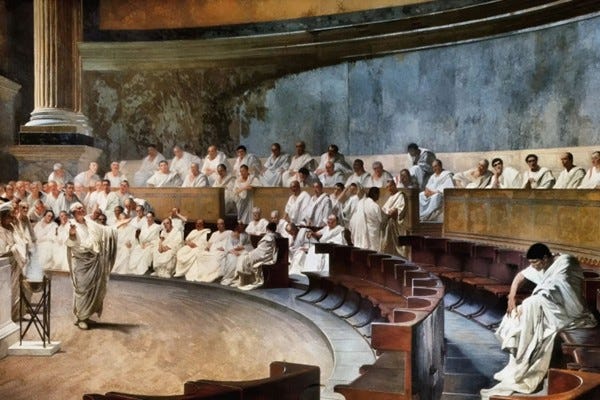
Cicero Denounces Catiline | Cesare Maccari, 1882–88
Why study what people made, when AI can make it now?
Key Terms for this Lesson
Humanities · Humanitas · Sapere Aude
Why study the Humanities?
Well, that’s a silly question. Because you already live in the humanities. The song in your earbuds, the flag over the courthouse, the way your grandmother tells a story. None of it fell from the sky. Every bit of it was made by people who had a reason, and the reasons go back thousands of years.
The humanities are the study of what human beings have made
in order to say who they are.
Humanities is not the study of nature (that’s science), nor is it a form of technical study (technical comes from techné in Greek, meaning a craft). Learning the violin is a techné. Running a cash register is also techné. While techné is a kind of knowledge, promising us methods and facts, the study of culture offers us a road to wisdom (another kind of knowledge) about humanity through the tools of analysis and evaluation. In this Humanities course, we’ll put the same 6 questions to every civilization from the first cities of Iraq to the studios of Florence. By the end, you will be able to walk into a museum, a cathedral, or a courtroom and read the room.
If it helps, think of this as learning to read a second time.
Humanitas | The Word & Its Travels
The word “humanities” has a famous early champion. In 62 BCE, the Roman senator Cicero (d. 43 BCE) stood up in court to defend a Greek poet named Archias, whose citizenship was in dispute. His defense rested on the poet’s education, the studia humanitatis (lit. the studies of humanity), and what those studies had done for Rome:
…these studies are the food of youth, the delight of old age; the ornament of prosperity, the refuge and comfort of adversity; a delight at home, and no hindrance abroad; they are companions by night, and in travel, and in the country.
Cicero, Pro Archia 16 (trans. C. D. Yonge)
The verdict of that case is lost, but the speech survived. In 1333, Petrarch (d. 1374) found a forgotten copy, and by the late 1400s the teachers of its curriculum (grammar, rhetoric, poetry, history, and moral philosophy) were nicknamed the humanists.
That curriculum is the ancestor of this Humanities course.
The Latin underneath is humanitas — the quality of being human. The Roman writer Aulus Gellius (d. ca. 180 CE) complained in his Attic Nights that people used it to mean simple kindness (Gr. philanthrōpia), when its proper sense was education (Gr. paideia). English kept both. We call a person humane and a course of study the humanities.
Sapere Aude | AI & the Courage to Think
Your phone probably has a generative AI that can write an essay about Gilgamesh, paint a ziggurat in the style of Monet, and compose a hymn in the manner of Bach before you finish reading this paragraph.
The machine can produce the humanities because we produced them first. Every sentence it writes is built from sentences human beings wrote, over 5,000 years, for reasons the machine does not have. At present, artificial intelligence does not possess consciousness, self-awareness, or moral understanding. It does not suffer, care, or deliberate about the good. So it cannot tell you why Gilgamesh wanders the earth after his friend dies (Sec. 2.5).
An AI system that simulates conversation or empathy does not thereby possess it. Confusing simulation with possession is a common philosophical error.
The deeper worry is older than computers. In 1784, the Prussian philosopher Immanuel Kant (d. 1804) was posed a question. What is enlightenment?
Enlightenment, Kant wrote, is our exit from self-incurred immaturity (Ger. Unmündigkeit, lit. not yet of age), the inability to use one’s own understanding without someone else’s guidance. The cause is not a lack of intelligence. It is a lack of courage. Kant then urges his readers: Sapere Aude! Dare to know!
It is so convenient to be immature. If I have a book that understands for me, … a doctor who judges my diet for me, and so on, then I need not trouble myself at all. I have no need to think, so long as I can pay. Others will readily take over the tiresome business for me. Kant, What Is Enlightenment? (1784)
Now read that again with a chatbot in mind.
The cost can be measured. In one study in 2025, 15 of the 18 students who wrote an essay with ChatGPT could not correctly quote a single sentence from it afterward. The students who wrote on their own nearly all could. Automation does not merely replace human labor. It replaces human judgment.
The task is therefore not to eliminate this technology, but to impose principled limits on its use. Artificial intelligence should extend human agency without replacing moral responsibility.
Over the next 15 sections, we will spend time with the people who invented cities, alphabets, law, tragedy, the arch, and polyphony. Somewhere around Sec. 8 or 9 you may start to notice something no chatbot will notice on your behalf:
These people were talking to you.
Sapere aude.
Sec 1 • In the Beginning
1.1 Why the Humanities Matter
1.2 How to Read a Civilization
1.3 Before Writing
1.4 A Revolution in Food
1.5 What is Civilization?
1.6 The Bronze & Iron Ages
Course Page: Humanities I & II