

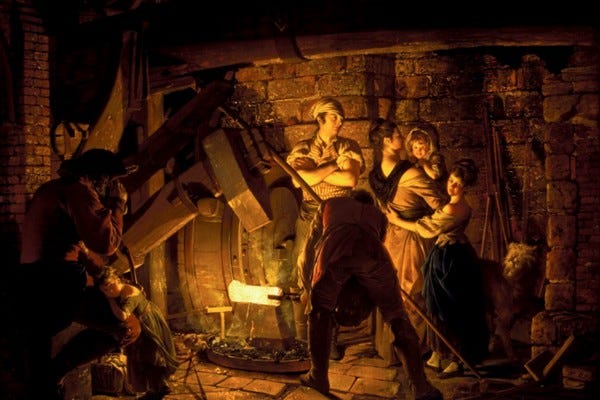
An Iron Forge | Joseph Wright of Derby, 1772 (cropped)
What role does metalworking have in the development of civilization?
Key Terms for this Lesson
Bronze Age · Iron Age · Smelting
Stone, Bronze, & Iron | The Three Ages
Stone, then bronze, then iron. The names sound ancient, but they were worked out around 1820 and published in 1836 by a museum curator in Copenhagen, Christian Jürgensen Thomsen (d. 1865), who sorted his collection by the material each tool was made of. His three-age system stuck.
The Greeks had ages of metal of their own. Around 700 BCE, the poet Hesiod described the generations of humankind as metals, each harder and sadder than the last:
…Zeus the Father made a third generation of mortal men, a brazen race… Their armour was of bronze, and their houses of bronze, and of bronze were their implements: there was no black iron. … For now truly is a race of iron, and men never rest from labour and sorrow by day, and from perishing by night…
Hesiod, Works and Days 143–178 (trans. Hugh G. Evelyn-White)
Hesiod’s ages measure virtue, not technology. The Roman poet Lucretius (d. ca. 55 BCE) came closer to Thomsen: first hands and stones, then bronze, then iron (De Rerum Natura 5.1283–1287).
• ca. 3300 BCE | Bronze is first cast in the Near East
• ca. 1323 BCE | Tutankhamun is buried with a dagger of meteoric iron
• ca. 1200 BCE | The Late Bronze Age collapse begins
• ca. 1200 BCE | Iron working spreads from Anatolia
The Bronze Age | ca. 3300–1200 BCE
The Bronze Age is the era when tools and weapons of bronze replaced those of stone.
During the Paleolithic Age, most people had only simple personal weapons made of rocks, shells, sticks, and bones (chipped stone points and spears). In the Neolithic Age, this upgraded to axes and sickles of ground and polished stone. Eventually, it was discovered that some of the materials found in the ground could be melted out of rock in a hot enough fire. This is smelting, heating ore until the metal inside runs free. When Ötzi the Iceman died in the Alps around 3300 BCE, he was carrying an axe of nearly pure copper. Copper came first, in a short prelude archaeologists call the Copper Age. Hikers found him, axe and all, in 1991.
Iron and copper were plentiful, but tin was not. However, copper and tin, if heated together in a fire as hot as a pottery kiln, would melt and form bronze, an alloy of roughly 9 parts copper to 1 part tin. It was much harder than copper alone, far less brittle than stone, and could be shaped into almost anything. After about 3000 BCE, the army that had bronze weapons and sufficient numbers was generally the army that won.
The tin had to come from far away (some of it from as far as Afghanistan). So the Bronze Age was also an age of long-distance trade. Bronze Age warriors skipped over the vast (but un-meltable) iron deposits in favor of the copper mines and the rare tin routes. The art of working iron, which no ordinary fire could melt, would be the greatest technological jump in a thousand years.
It was only a matter of time.
The Iron Age | From ca. 1200 BCE
The Iron Age is the era when iron replaced bronze as the working metal of daily life and war.
Iron, oddly, was known long before the Iron Age. It fell from the sky. When the boy-king Tutankhamun (d. ca. 1323 BCE) was buried in Egypt, he wore a dagger forged from a meteorite. Archaeologists found it in his tomb in 1925, and in 2016 its metal was confirmed to come from space. By some accounts, iron was worth more than gold.
Previously, the hottest fires made were the 2,000° F pottery ovens that could melt copper but not iron (iron melts at about 2,800° F). The breakthrough was the bloomery — a furnace of charcoal driven by bellows. It never melted the iron at all. It heated the ore until the iron separated into a glowing, spongy lump (the bloom), which smiths then hammered, reheated, and hammered again.
Then, around 1200 BCE, the great Bronze Age kingdoms of the eastern Mediterranean fell within a few decades of one another. Scholars name several causes (drought, famine, earthquakes, raiders called the Sea Peoples), and the tin routes collapsed with them. Iron, found almost everywhere, filled the gap. Now iron weapons and tools could be quickly, plentifully, and cheaply produced. The technique spread throughout Asia, Europe, and North Africa as iron blades and tools spread through entire armies.
Many of the great traditions also took shape across these centuries, most of them sung long before they were written. The Vedas of India, the Iliad of Greece, and the Yi Jing of China all date from between about 1500 and 700 BCE (Secs. 4–6).
Sec 1 • In the Beginning
1.1 Why the Humanities Matter
1.2 How to Read a Civilization
1.3 Before Writing
1.4 A Revolution in Food
1.5 What is Civilization?
1.6 The Bronze & Iron Ages
Course Page: Humanities I & II
Next Section: Ancient Mesopotamia