

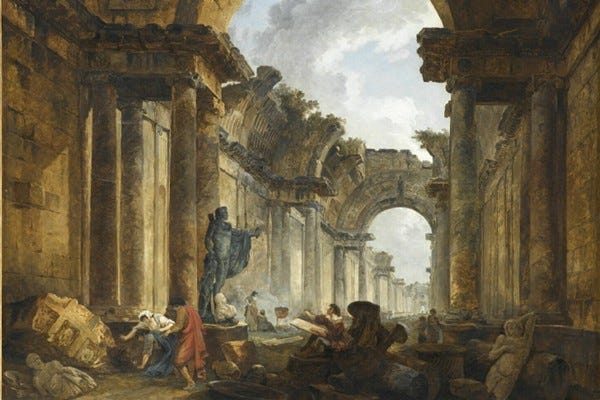
Imaginary View of the Grande Galerie of the Louvre in Ruins | Hubert Robert, 1796
How do you learn from the past?
Key Terms for this Lesson
Culture · Primary Source · BCE & CE
An Introduction to this Series
This is a survey of the humanities of the ancient and medieval world: the art, architecture, literature, music, religion, and philosophy of the civilizations of the ancient and medieval world. No foreknowledge of any civilization or any of their languages is required. Assigned readings come from Culture & Values (Ch. 1 for this section). This course is made of 15 sections divided into 4 modules. Each section’s theme will be divided into 6 lessons (e.g., Sec. 2.1 through 2.6).
The four modules of this course are:
• I. Early Civilizations
• II. The Greco-Roman Traditions
• III. The Abrahamic Traditions
• IV. The Rise of Europe
After Section 1, we begin in Mesopotamia around 3500 BCE and end in Florence around 1500 CE. That’s 5,000 years in 15 weeks!
Culture & the Six Questions
This is not a World History course.
A history course asks what happened: who won the war, which king fell, where the border moved. Those facts matter here. But this course then asks a second question. What did a people make out of what happened to them, and why?
Culture is social information that is transmitted from one generation to the next.
Think of it as everything from how people cook their food to the stories they tell around the campfire. A war is history. The Iliad, sung about that war for centuries before anyone wrote it down, is culture.
For this series, we will ask 6 basic questions of each civilization:
• History & Politics | Where and how did folks feed, defend, and govern themselves?
• Religion | What did they hold sacred, and what did their tradition ask of them?
• Literature & Drama | What stories did they tell, and how did they last?
• Art & Architecture | What did they build, carve, and paint, and for whom?
• Music | How did they sound together, and for what occasions?
• Philosophy | How did they think and teach how a person ought to live?
You will see these six questions answered in every civilization we study. They are the course’s standard model, and an excellent template for your own notes.
Every section after this one opens with History & Politics. After that, the order follows each civilization’s own story. In India the hymns of the Vedas were sung for centuries before anyone wrote them down, so Music comes early (Sec. 4.2). In the Renaissance, Religion comes last, because the Gutenberg Bible (ca. 1455) sets the stage (Sec. 15.6) for the Reformation that opens Humanities II.
Every lesson also opens with a Central Problem: one line naming the thing that people needed to solve. Sec. 3.1, for example, opens on “Who answers when the river does not rise?” Hold the problem in mind as you read.
Evidence, Dates, & Religion
The best evidence for a civilization is a primary source — a text or object made by the people we are studying (a law code, a hymn, a temple, a painted pot). A secondary source is what later scholars say about them.
The Greek general Thucydides (d. ca. 400 BCE) wrote his history of the Peloponnesian War, a war he had fought in, and he said plainly why he bothered:
…if it be judged useful by those inquirers who desire an exact knowledge of the past as an aid to the interpretation of the future, which in the course of human things must resemble if it does not reflect it, I shall be content. In fine, I have written my work, not as an essay which is to win the applause of the moment, but as a possession for all time. Thucydides, History of the Peloponnesian War 1.22 (trans. Richard Crawley)
Scholars generally use BCE (before the common era) in the place of BC (before Christ) and CE (common era) in the place of AD (Anno Domini: Latin for In the Year of Our Lord) when denoting years. It is a sign of respect between Christian and non-Christian scholars. In this way, we retain the historical facts without pushing a particular agenda in a public inquiry open to all faiths. That being said, the “CE” is generally dropped after the beginning of the medieval period (ca. 500s).
The numbers themselves do not change: 2026 CE is 2026 AD.
Every section carries a lesson on religion, and one rule governs all of them: We are here to study religion, not to practice or prosecute religion. The material is far more interesting than any verdict I could render on it.
Sec 1 • In the Beginning
1.1 Why the Humanities Matter
1.2 How to Read a Civilization
1.3 Before Writing
1.4 A Revolution in Food
1.5 What is Civilization?
1.6 The Bronze & Iron Ages
Course Page: Humanities I & II