

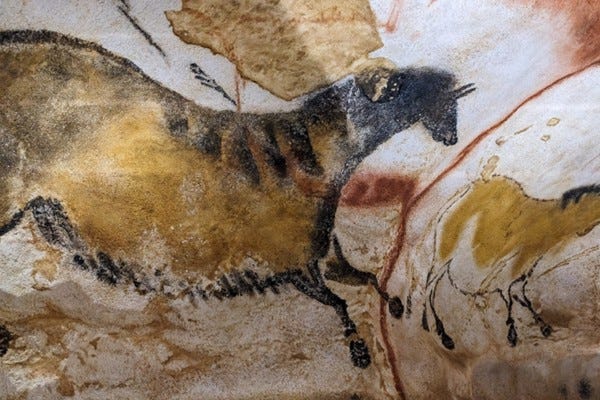
Aurochs & Horses | Lascaux, France, ca. 15,000 BCE
Photo Credit: Eline13Viki+ via Wikimedia Commons, CC0
Why did people paint animals deep in caves where no one lived?
Key Terms for this Lesson
Prehistory · Paleolithic · Sacred
Prehistory | Before 3200 BCE
In September 1940, as the story usually goes, four teenagers in southwestern France went looking for a dog named Robot and found a hole in the hillside instead. They squeezed through it with a lamp. What they found on the walls is now called Lascaux.
Bulls, horses, stags, and bison. Some 600 paintings and nearly 1,500 engravings, the largest bull about 17 feet long. All of it made about 17,000 years ago, in the dark.
Historians call this earliest period of humanity prehistory because it comes before recorded history (before there was a written record of events). Everything in this lesson was made by people who could not write. Even though there are no “prehistoric texts,” we can still look to the record of archaeological evidence for clues to their stories. A single tool or ornament can reveal much about the priorities and customs of its original community, even when no written language exists to explain its purpose.
The longest stage of prehistory is the Paleolithic. Greek for Old (Paleo) Stone (Lithos). The Paleolithic Age (i.e., Old Stone Age) ends around 10,000 BCE. That’s twelve thousand years before today, which means even the end of the Paleolithic is six times older than Christianity! Prehistory itself ends with writing. By archaeologists’ dating:
• ca. 38,000 BCE | The Lion Man is carved in Germany
• ca. 32,000 BCE | The burials at Sungir in Russia
• ca. 28,000 BCE | The Venus of Willendorf is carved in Austria
• ca. 15,000 BCE | The cave of Lascaux is painted
• ca. 3200 BCE | Writing appears in Sumer (Sec. 1.5)
Lascaux & the Painted Cave
Paleolithic people lived near cave mouths and under rock overhangs, where there was daylight and a way out. The paintings are not there. They are deep inside, in passages that had to be lit with stone lamps burning animal fat (archaeologists have recovered more than a hundred of them at Lascaux). In one gallery, sockets cut into the rock held a wooden scaffold so the painters could reach the ceiling. The colors came from the earth itself — red and yellow ochre (iron-rich clay), and black from charcoal and manganese.
So why do it? Scholars have offered three main answers. Some read the paintings as hunting magic, a way of calling the herds. Others see the work of ritual specialists who went into the dark on purpose, to meet the animals there. Still others read the walls as a record of seasons and migrations.
Here’s the wrinkle: the bones left behind at Lascaux are mostly reindeer. It’s what the painters actually ate. Yet among hundreds of animals on the walls, there is only one reindeer. Hunting magic alone does not explain that. The cave itself closed to the public in 1963, because visitors’ breath was damaging the paintings. Today’s tourists walk through a full-size copy.
The Sacred | Figures & Graves
In early cultures, certain items were reserved for use in places like graves, social gathering places, or the homes of leaders. These objects were understood to be significant in ways that went beyond their practical usefulness. They were considered sacred (from the Latin sacer, dedicated to the gods and set apart from ordinary use).
The oldest of them is a creature no one had ever seen. The Lion Man stands about 12 inches tall, a man’s upright body with a lion’s head, carved from a mammoth tusk with stone tools and found in hundreds of broken pieces in a German cave in 1939, on the eve of a war that would delay its reassembly for decades. By one estimate, it took more than 300 hours to carve with stone tools. Nothing in nature looks like it.
The Venus of Willendorf (sometimes rendered “Lady of Willendorf”) is another. She is a small limestone figure of a woman, just 4 inches tall, found in Austria in 1908. Her face is hidden beneath rows of carved bands (braids, perhaps, or a woven cap), and she still carries traces of red ochre. Scholars have long read her as a figure of fertility and abundance. She fits in the palm of a hand.
The Paleolithic Age is also when we see the earliest indications of ceremonial burial. Bodies were placed in dugout graves, often with tools, weapons, ochre, and jewelry. At Sungir, east of modern Moscow, one man was buried with nearly 3,000 beads of mammoth ivory sewn into his clothing. Archaeologists estimate that each bead took about an hour to make. That is nearly 3,000 hours of work, placed in the ground with one man.
A cave painted where no one lived. A figure small enough to carry. A grave filled with beads. Long before anyone could write the word, the people of the Paleolithic were already setting things apart.
Sec 1 • In the Beginning
1.1 Why the Humanities Matter
1.2 How to Read a Civilization
1.3 Before Writing
1.4 A Revolution in Food
1.5 What is Civilization?
1.6 The Bronze & Iron Ages
Course Page: Humanities I & II