

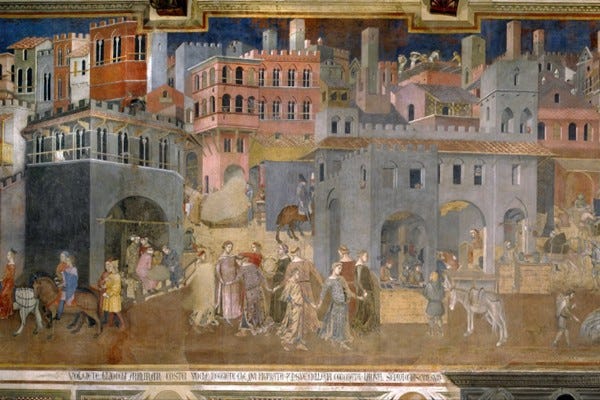
Effects of Good Government in the City | Ambrogio Lorenzetti, 1338–39 (cropped)
What do we need to live together?
Key Terms for this Lesson
Civilization · City-State · Social Stratification
Civis | The Citizen & the City
Let’s take a look at what is meant by “civilization.” The word is of Latin origin, from civis, the citizen. From civis, we get the following modern words:
• Civic | as in Civic Center, where performances happen in a city
• Civil | as in civil suit, a legal proceeding where one citizen sues another
• Citizen | an official member of an ancient city (or modern state)
• Civilian | a citizen who is not officially engaged in a city’s defense
• City | a permanent settlement of citizens
Several cities make a civilization. Put simply, a civilization is a people who have learned to live together in cities, and who have built everything that kind of life requires.
The Greeks had their own word for the city, the polis (hence politics). Its great theorist, the philosopher Aristotle (d. 322 BCE), tutor to Alexander the Great (d. 323 BCE), argued that the city is natural to human beings:
Hence it is evident that the state is a creation of nature, and that man is by nature a political animal. … But he who is unable to live in society, or who has no need because he is sufficient for himself, must be either a beast or a god: he is no part of a state. Aristotle, Politics 1.2 (trans. Benjamin Jowett)
The Six Attributes
So what does a city need? One common textbook model recognizes a civilization by 6 attributes (not to be confused with the 6 questions of Sec. 1.2):
• Urban Life | In archaeology, urban means a dense settlement of permanent structures (e.g., temples, buildings, large monuments). Its people no longer roam as nomadic groups did before them.
• Government | Leaders who control, to one degree or another, what is done in the community. Generally, one leader holds much more power than the rest of the settlement.
• Class Distinctions | People have specialized jobs, just as we do today (hunter, weaver, weapon smith), and some members possess more wealth than others.
• Tools & Trade | Tools and skills lead to production and trade, sometimes with people in distant places.
• Writing | A shared, recordable language. Early writing often developed as a record-keeping tool for traders and tax collectors. It may be the single most important invention in human history.
• Religion | A shared system of ceremonial practices and beliefs, centered on the city’s gods, temples, and rulers.
The third attribute has a name of its own. Social stratification is the division of a society into ranks by wealth, occupation, or status. And the first cities were usually city-states — self-governing cities that ruled the farmland around them.
It’s important to remember that the word “civilized” is not meant to be a value judgment. It’s a descriptive term. When we say a culture is civilized, it means that the evidence shows that its citizens possessed all or at least most of the social qualities listed above, particularly the first two.
Example | Two Towns
Let’s take two famous sites and test them.
Çatalhöyük, in Anatolia (~Turkey), was home to several thousand people around 7000 BCE. Its mudbrick houses were packed wall to wall, with no streets at all. Residents walked across the rooftops and climbed down ladders into their homes. They buried their dead beneath the floors. Yet the houses are nearly all the same size, and some archaeologists read Çatalhöyük as one of the most equal communities ever excavated. There is no palace, no temple district, and no writing. By the six attributes, Çatalhöyük is a remarkable town, but not yet a civilization.
Uruk, one of the first cities of Sumer in Mesopotamia (~Iraq), held tens of thousands of people by about 2900 BCE. It had monumental temples, full-time craftsmen, a ruler, and a city wall nearly 6 miles around. Around 3200 BCE, its scribes pressed some of the world’s earliest writing into clay, and most of those tablets are records of grain, livestock, and workers’ rations. One of the first texts they copied again and again was a list of about 140 job titles, ranked from the highest official down. Its most famous object, the Warka Vase, shows ranked rows of people carrying offerings up to the goddess Inanna. Uruk has all six, and so does every civilization in this course.
Its walls, said to be built by its king Gilgamesh, open the world’s oldest epic (Sec. 2.5).
Sec 1 • In the Beginning
1.1 Why the Humanities Matter
1.2 How to Read a Civilization
1.3 Before Writing
1.4 A Revolution in Food
1.5 What is Civilization?
1.6 The Bronze & Iron Ages
Course Page: Humanities I & II