

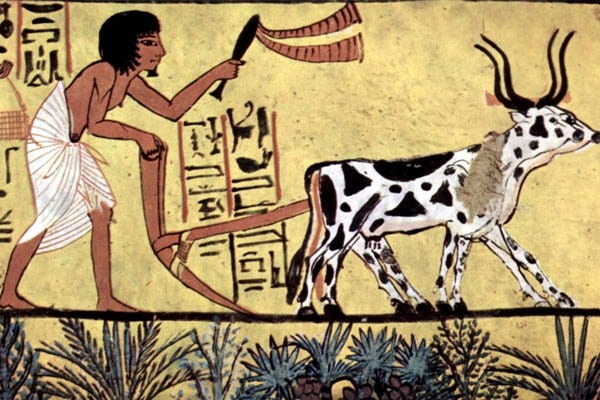
Plowing with Oxen | Tomb of Sennedjem, Egypt, ca. 1250 BCE
How do you feed more mouths than with hunting alone?
Key Terms for this Section
Neolithic · Agricultural Revolution · Domestication
The Neolithic | 10,000-3300 BCE
All from wild grass!
During the Agricultural Revolution in the Fertile Crescent, grasses were planted and harvested, and then the seeds from the best crops were replanted. Over many generations, this selective breeding process led to the edible grains that still fill our grocery stores. Lentils, peas, chickpeas, and flax (for linen and oil) were tamed from wild plants the same way. Likewise, in Asia, the cultivation of wild grasses led to rice, while in the Americas a scraggly wild grass called teosinte became corn. The grinding down of these grains produces flour. Most of the bread you have ever eaten begins here.
Neolithic. Greek for New (Neo) Stone (Lithos). The Neolithic Age (ie. New Stone Age) lasted from approximately 10,000 to 3300 BCE, when bronze arrives (Sec. 1.6). Farming on a large scale began at this time, and this explosion in farming scale and technique is now known as the Agricultural Revolution.
Its arithmetic is simple. A band of hunters and gatherers needs a great deal of land to feed a few dozen people, and it has to keep moving to do it. A field of wheat feeds far more people from far less ground, and it stays put. Nearly everything in the rest of this course grows out of that change.
• ca. 10,000 BCE | Farming begins in the Fertile Crescent
• ca. 8500 BCE | Wild aurochs are bred into cattle
• ca. 7000 BCE | Maize is farmed in Mexico, rice in China
• ca. 4000 BCE | The ox-drawn plow appears in Mesopotamia
Domestication | The First Partners
Domestication is the slow work of breeding wild plants and animals until they depend on us, and we on them.
Animals have been a part of the human story from the very beginning. The first animals to be domesticated were wolves. Through selective temperament breeding, early man in Eurasia slowly bred dangerous wolves into loyal dogs thousands of years before the invention of writing. Dogs provided security at night, cleaned animal scraps from the ground (which kept other animals and disease-carrying bugs away from the camp), and were loyal hunting companions. So, an early man with a dog was generally better off than the man without one.
The farmers of the Neolithic followed with a whole barnyard:
• Sheep | from the wild mouflon, with its huge horns
• Pigs | from the wild boar
• Cattle | from the aurochs, the great wild bull painted at Lascaux (Sec. 1.3), now extinct
• Donkeys | from the African wild ass
Both the cow and the donkey enabled Neolithic communities to farm and build on an unprecedented scale. An ox can pull a plow through ground no human arm could break.
Granaries, Water, & Walls
The large farmlands of the Agricultural Revolution required lots of water, and natural rainfall wasn’t always sufficient to cover the needs of the grain fields. So Neolithic farmers invented a way to bring river water to the plants called irrigation. Rodents, snakes, and other vermin soon became a constant threat to the storehouses of grain (called granaries). To combat the rodent problem, Neolithic settlers domesticated small wildcats into the now common house cat. The cat became so respected in agricultural Egypt that the death of an Egyptian family’s cat was often mourned like a member of the household.
Greek historian Herodotus (d. 425 BCE) recorded the custom after he was in Egypt:
…in whatever houses a cat has died by a natural death, all those who dwell in this house shave their eyebrows only… Herodotus, Histories 2.66 (trans. G. C. Macaulay)
A granary also changes what a village is. Stored grain is a surplus — food beyond what anyone needs today. A surplus means not everyone has to farm. Some can make pots, weave cloth, keep the stores, or settle disputes over the water. That division of labor is the seed of the city (Sec. 1.5).
It is also a target. With the rise of Neolithic settlements came the first organized military battles between settlements. After all, why spend a year growing crops when you can take someone else’s in a day? But competing settlements didn’t take this lying down. In fact, the competition for better weapons helped drive an explosion of technology now known as the Bronze Age (Sec. 1.6).
Sec 1 • In the Beginning
1.1 Why the Humanities Matter
1.2 How to Read a Civilization
1.3 Before Writing
1.4 A Revolution in Food
1.5 What is Civilization?
1.6 The Bronze & Iron Ages