

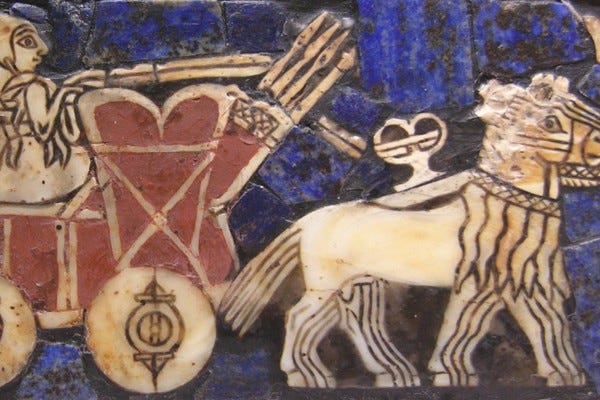
The Standard of Ur, War Side | Royal Cemetery of Ur, ca. 2500 BCE (detail)
Why did civilization begin here, and not Norway, Mexico, or Australia?
Key Terms for this Section
Fertile Crescent · Cuneiform · Akkadian Empire
The Fertile Crescent | Land, Rivers, & Animals
We’ll begin our study of ancient civilizations with Mesopotamia (~Iraq). The name is Greek: mesos, middle, and potamos, river. The land between the rivers. The rivers are the Tigris and the Euphrates, and they run from the mountains of Turkey to the Persian Gulf through the Fertile Crescent, an arc of farmable land that curves from the Gulf up through Iraq and Syria to the Mediterranean.
So why did Western civilization begin in Mesopotamia and not somewhere else? Why do we trace it to what is basically modern Iraq instead of, say, Norway, Mexico, or Australia? Well, here are five ways ancient Mesopotamia stood out from the rest of the world.
• Best Land | A mild climate, freshwater rivers, and abundant farmland. Ancient Mesopotamia looked a lot more like Iowa back in the day.
• Best Geography | A land bridge between Africa, Europe, and Asia, so people travelling from all directions passed through, sharing ideas, techniques, and technology.
• Best Rivers | The spring floods laid down fresh silt every year, and river mud baked into brick. What the land lacked (stone, timber, and metal) the rivers carried in by boat, from as far away as Afghanistan.
• Best Crops | Many founder crops, like barley, wheat, and peas, grew here naturally.
• Best Animals | Cows, goats, sheep, and pigs are all native to this region, useful for food, milk, and clothing.
If every animal could be tamed, civilization would have sprung up in many more places. But domestication (cf. Sec. 1.4) can only occur if five very specific things happen: the animals must have a diet that is flexible and cheap, mature quickly, breed in captivity, have an easy-going temperament, and follow a leader. Only four river valleys had them: the Tigris and Euphrates, the Nile, the Yellow and Yangtze, and the Indus. Northern Europeans domesticated reindeer, but you can’t teach a reindeer to plow. Mesoamerica domesticated the turkey, and the Andes the llama, but llamas can’t plow either. And Australia… Well, they have kangaroos, but trying to get a kangaroo to plow just isn’t going to be a good day for anybody (least of all the kangaroo).
Only ancient China, India, and Egypt could ever really compete.
Sumer & Akkad | City-States & the First Empire
• ca. 3500 BCE | The Sumerian city-states rise (Uruk, Ur, Lagash)
• ca. 3200 BCE | Cuneiform writing appears at Uruk (cf. Sec. 1.5)
• ca. 2334 BCE | Sargon of Akkad unites the river valley
• ca. 1792 BCE | Hammurabi takes the throne of Babylon
• 612 BCE | Nineveh falls, and Assyria with it
Mesopotamia was organized into regional city-states (cf. Sec. 1.5) controlled by priest-kings, rulers who stood for the city before its god. The Sumerian word for king was lugal, literally “big man.” Writing at this time developed as a political tool of the priest-kings. Simply put, those with the power to read and write held great sway over those who couldn’t — this remains true today.
The Sumerians developed a system of writing called cuneiform (Latin cuneus, a wedge, for the marks a reed leaves in soft clay, later baked hard). Writing had several political advantages. It let the Sumerians catalog their stored food, plan for the future, collect taxes, and trade. Finally, writing encouraged the development of laws.
Around 2334 BCE, a Semitic king named Sargon of Akkad (d. ca. 2279 BCE) took over the entire region. His Akkadian Empire is often called the first empire in history: one ruler over many cities. The term Semitic refers to anyone who speaks a Semitic language. Hebrew and Arabic are the best known today, and the word Semite comes from Shem, Noah‘s son in the Hebrew Bible.
Babylon & Assyria | ca. 1750–331 BCE
In the 1700s BCE the region was unified again, under Babylon. Its most famous king, Hammurabi (d. ca. 1750 BCE), had his laws cut into stone, and the stone opens with the king’s job description:
…to bring about the rule of righteousness in the land, to destroy the wicked and the evil-doers; so that the strong should not harm the weak…
Code of Hammurabi, Prologue (trans. L. W. King)
The laws themselves wait for Sec. 2.6.
The peak of Mesopotamian power came in the Iron Age (cf. Sec. 1.6), between 1000 and 612 BCE, when the Assyrians were in charge. They built huge palaces at Nineveh (~Mosul), their gates guarded by winged bulls with human heads (the lamassu). But the fall of Nineveh in 612 BCE to the Medes and Babylonians marked the end of Assyria, and in 539 BCE the Persian king Cyrus (d. 530 BCE) took Babylon with little resistance. Two centuries later, Persia itself was conquered by the Greek Alexander the Great (d. 323 BCE), who entered Babylon in 331 BCE (Sec. 7).
By then, the cities between the rivers were already 3,000 years old.
Sec 2 • Ancient Mesopotamia
2.1 History & Politics • Between the Rivers
2.2 Religion • Temple & Priest-King
2.3 Art & Architecture • The Ziggurat of Ur
2.4 Music • The Lyres of Ur
2.5 Literature & Drama • Gilgamesh & the Enuma Elish
2.6 Philosophy • An Eye for an Eye