

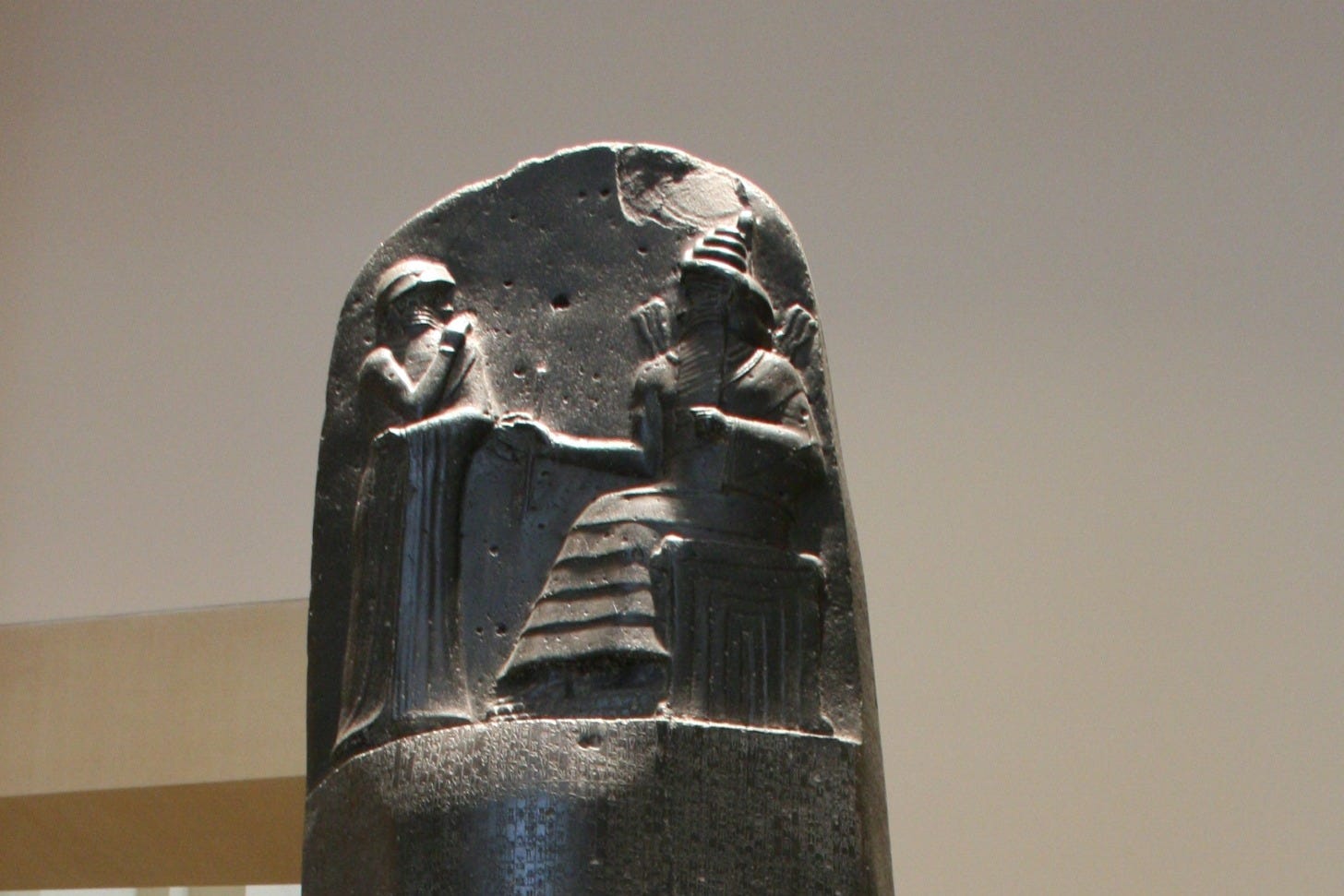
The Stele of Hammurabi | Babylon, ca. 1750 BCE, now in the Louvre
Photo Credit: Rlunaro via Wikimedia Commons
How do you keep the strong from harming the weak?
Key Terms for this Lesson
Code of Hammurabi · Lex Talionis · Base-60
The Code | 282 Laws on a Stone
The massive region of Mesopotamia was unified in the 1700s BCE under Babylon (cf. Sec. 2.1). Its most famous king, Hammurabi (d. ca. 1750 BCE), was responsible for one of the earliest attempts at achieving social justice through the law. His laws put aside the whims of the crowd or a cruel leader in favor of fairness and justice. An older code survives from Ur, but Hammurabi’s is the one the world remembers. The Code of Hammurabi was carved on a stele, a ceremonial, human-sized flat stone, with an image of Hammurabi at the top receiving the symbols of his authority from the sun god Shamash, the god of justice.
Hammurabi’s 282 laws address contracts, liabilities, and familial relationships, such as the ones between husbands, wives, and other family members. Every law takes the same shape: if a man does this, then this follows. Three classes appear in them (the free man, the commoner, and the slave), and the penalty depends on who you are. Reading 1.5 in the textbook prints a selection.
The laws show us that women actually had a lot of autonomy for that time and age. If a woman wanted to leave her husband, the leaders would conduct interviews to make sure she had been a good and faithful wife, and if she had been, she could not only leave her husband and return to her father’s house, but she could take her dowry with her (Law 142). It also assured that the dowry a woman brought with her to a marriage would pass to her children at her death, not return to her husband or father (Law 162).
An Eye for an Eye | Lex Talionis
The laws everyone knows are the ones about injury:
If a man put out the eye of another man, his eye shall be put out. … If he break another man’s bone, his bone shall be broken. … If a man knock out the teeth of his equal, his teeth shall be knocked out. Code of Hammurabi, Laws 196, 197, 200 (trans. L. W. King)
This is lex talionis, Latin for “the law of retaliation.” To a modern reader it sounds like cruelty. To Hammurabi it was a limit. Before written law, a man who lost an eye might take a life for it, and his victim’s family might take two. An eye for an eye says the punishment may equal the injury and may not exceed it. It is a ceiling on vengeance, not a license for it. The same principle governs the famous builder’s law: if a builder’s house falls and kills its owner, the builder dies (Law 229).
The measure is also unequal. The eye of a commoner was worth a fine (Law 198), and the eye of a slave half his price (Law 199). Equal for equal applied only between equals. Still, Hammurabi’s prologue makes the king’s job keeping the strong from harming the weak (cf. Sec. 2.1), and the laws do protect widows, orphans, and the injured. The code’s idea of justice is not equality but proportion: each according to his station, and no one beyond his measure.
The same principle appears in the Torah, in the same words: “Eye for eye, tooth for tooth, hand for hand, foot for foot” (Exodus 21:24, cf. Sec. 9.6), and Jesus will quote the line in the Sermon on the Mount (Matthew 5:38, cf. Sec. 10.2). Every court that weighs a punishment against a crime is still working Hammurabi’s problem.
Wisdom & Number | Shuruppak & Base-60
Mesopotamia’s philosophy also came in a father’s voice. The Instructions of Shuruppak (ca. 2600 BCE) is the oldest wisdom literature in the world: a father’s advice to his son. Do not steal. Do not vouch for another man’s debt. Do not buy a donkey that brays. Do not plant a field beside a road. It is the same shape the Bible’s Proverbs will take 2,000 years later (cf. Sec. 9.6): not a system, but a list of what a wise man does.
And the Mesopotamians counted in a way we still use. Their number system was base-60 (sexagesimal), because 60 divides evenly by 2, 3, 4, 5, 6, 10, 12, 15, 20, and 30. That is why an hour has 60 minutes, a minute 60 seconds, and a circle 360 degrees. The priests who tracked the stars (cf. Sec. 2.2) used it to predict eclipses, and a Babylonian tablet from about 1800 BCE lists right-triangle number sets more than a thousand years before Pythagoras (Sec. 6.5).
Ancient Mesopotamia didn’t have the unifying elements, like the Pharaoh, that ancient Egypt had. However, the Sumerian and Semitic people are really the first in this region to show examples of the qualities of a bona fide civilization. Next, we look to their neighbors to the south, Egypt (Sec. 3).
Sec 2 • Ancient Mesopotamia
2.1 History & Politics • Between the Rivers
2.2 Sacred Life • Temple & Priest-King
2.3 Art & Architecture • The Ziggurat of Ur
2.4 Music • The Lyres of Ur
2.5 Literature & Drama • Gilgamesh & the Enuma Elish
2.6 Wisdom • An Eye for an Eye
Course Page: Humanities I & II
Next Section: Ancient Egypt