

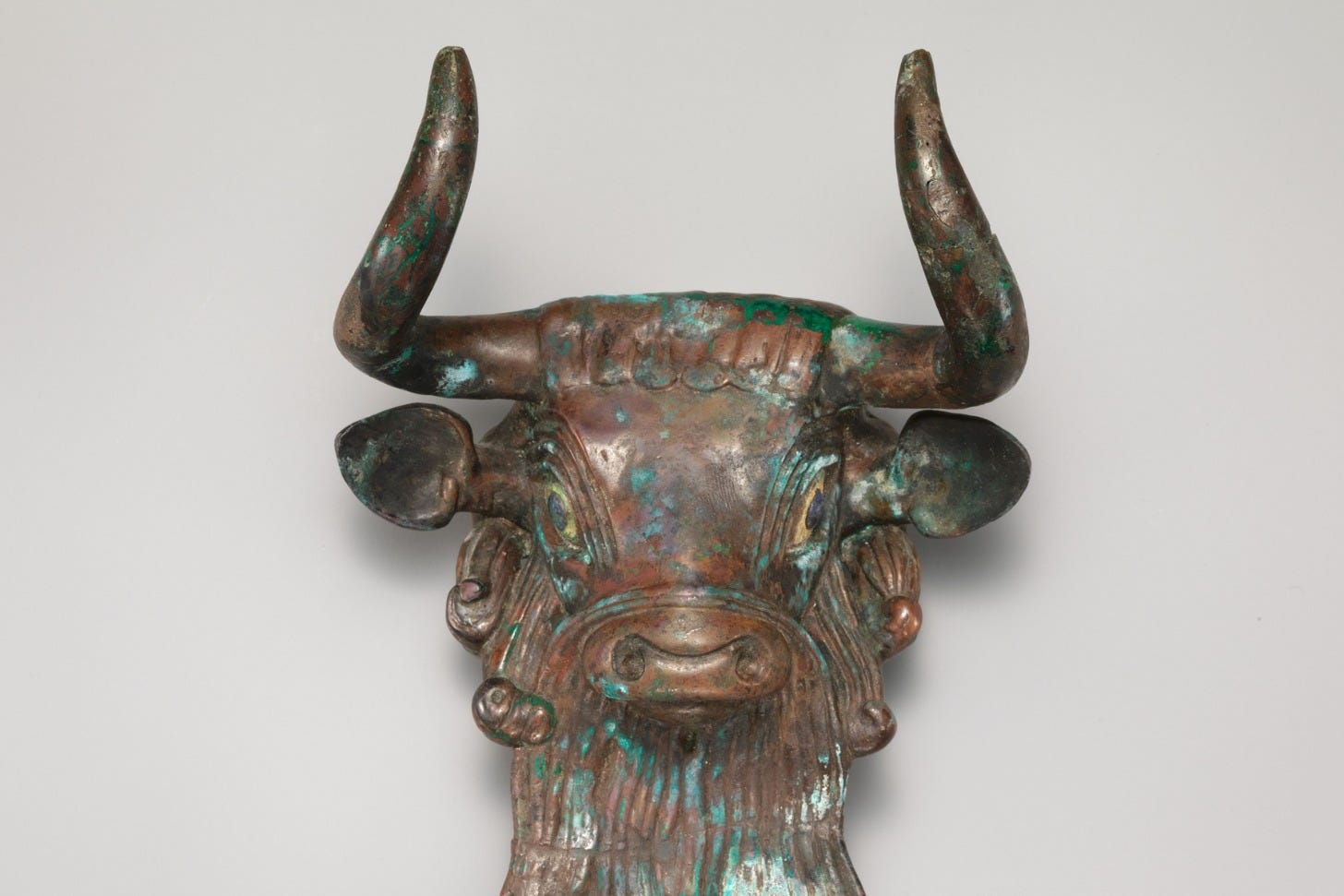
Bull’s Head Ornament for a Lyre | Sumer, ca. 2600–2350 BCE (detail)
Photo Credit: The Metropolitan Museum of Art via Wikimedia Commons, CC0
Why bury a lyre with a king?
Key Terms for this Lesson
Lyres of Ur · Hurrian Hymn · Royal Cemetery of Ur
The Royal Cemetery | Woolley’s Dig, 1922–1934
Between 1922 and 1934, a British archaeologist named Leonard Woolley (d. 1960) dug up about 1,850 graves at Ur, and 16 of them were different from the rest. He called them the Royal Cemetery of Ur (ca. 2500 BCE). In these tombs the kings and queens of Ur were buried with their gold, their jewelry, their chariots, and their households. In the largest, which Woolley named the Great Death Pit, 74 attendants (68 of them women) had been put to death and laid in rows beside the tomb, dressed in their finest, and beside the women lay the lyres.
A lyre is a stringed instrument with two arms rising from a sound box and a crossbar between them, plucked like a small harp. Its wood had rotted to nothing in 4,500 years. Woolley noticed the hollows the wood left in the soil, poured plaster into them, and lifted out the shapes of the instruments with their gold and shell inlay still in place. Several lyres and harps came out of the cemetery, the Lyres of Ur. One, the Queen’s Lyre, is in London. One, the Golden Lyre, stayed in Baghdad and was smashed when the Iraq Museum was looted in 2003. And one, the Great Lyre, from a tomb Woolley called the King’s Grave, went to Philadelphia.
The Great Lyre | A Bull with a Beard of Lapis
The Great Lyre’s sound box ends in a bull’s head of gold with a beard of lapis lazuli, the blue stone from Afghanistan (cf. Sec. 2.3). The bull is not decoration. In Sumerian poetry the bull’s bellow is the sound of the instrument itself, and the moon god of Ur, Nanna, was praised as a young bull. The lyre was built to sound like the god of the city.
Below the head, a panel of shell inlay shows four scenes, and the animals in them are behaving like people. A scorpion-man stands guard. A dog carries a table of meat. A lion carries a jar. And a donkey plays a bull-headed lyre while a jackal shakes a rattle and a bear steadies the frame. It is a banquet, and the band is playing. The same scene, with human players, fills the top row of the Standard of Ur‘s peace side (Sec. 2.3): the king and his court feast and listen while a musician plucks a lyre and a singer stands beside him.
So why bury a lyre with a king? We don’t know for certain, and the Sumerians left no explanation. The best reading of the evidence is the simplest: the king’s banquet was meant to go on. The gods’ afterlife was a house of dust (Sec. 2.2), and a king of Ur took his court, his table, and his music down into it with him. The lyres were found with the women who had played them.
Hymns & Notation | The Oldest Written Music
Music in Mesopotamia was first of all temple work. Priests and priestesses sang hymns to the city’s god every day, and a special class of singers chanted laments when a temple was destroyed. One of these, the Lament for Ur (ca. 2000 BCE), mourns the sack of the city by the Elamites: the god has abandoned his house, and the singer begs him to come home. Sargon‘s daughter Enheduanna (d. ca. 2250 BCE) wrote hymns to be sung in the temples of Ur and Uruk (Sec. 2.5).
The Mesopotamians also wrote music down. A clay tablet from Ur (ca. 1800 BCE) names seven tunings for a nine-stringed lyre, a scale system a thousand years older than Pythagoras (Sec. 6.5). And from the port city of Ugarit (~Syria), around 1400 BCE, comes the Hurrian Hymn to the moon goddess Nikkal: the oldest substantially complete piece of written music in the world. Its words are in Hurrian, its musical terms in Akkadian, and scholars still disagree about how the notation should be read, so every modern performance of it is a reconstruction.
Babylon’s music was also the music its captives were made to play. After Nebuchadnezzar II destroyed Jerusalem in 586 BCE (cf. Sec. 9.1), the exiles remembered the demand:
By the rivers of Babylon, there we sat down, yea, we wept, when we remembered Zion. We hanged our harps upon the willows in the midst thereof. For there they that carried us away captive required of us a song… How shall we sing the LORD’s song in a strange land? Psalm 137:1–4 (KJV, cf. Sec. 9.4)
The harps of Ur and the harps on the willows are the same instrument, two thousand years apart.
Sec 2 • Ancient Mesopotamia
2.1 History & Politics • Between the Rivers
2.2 Sacred Life • Temple & Priest-King
2.3 Art & Architecture • The Ziggurat of Ur
2.4 Music • The Lyres of Ur
2.5 Literature & Drama • Gilgamesh & the Enuma Elish
2.6 Wisdom • An Eye for an Eye
Course Page: Humanities I & II