

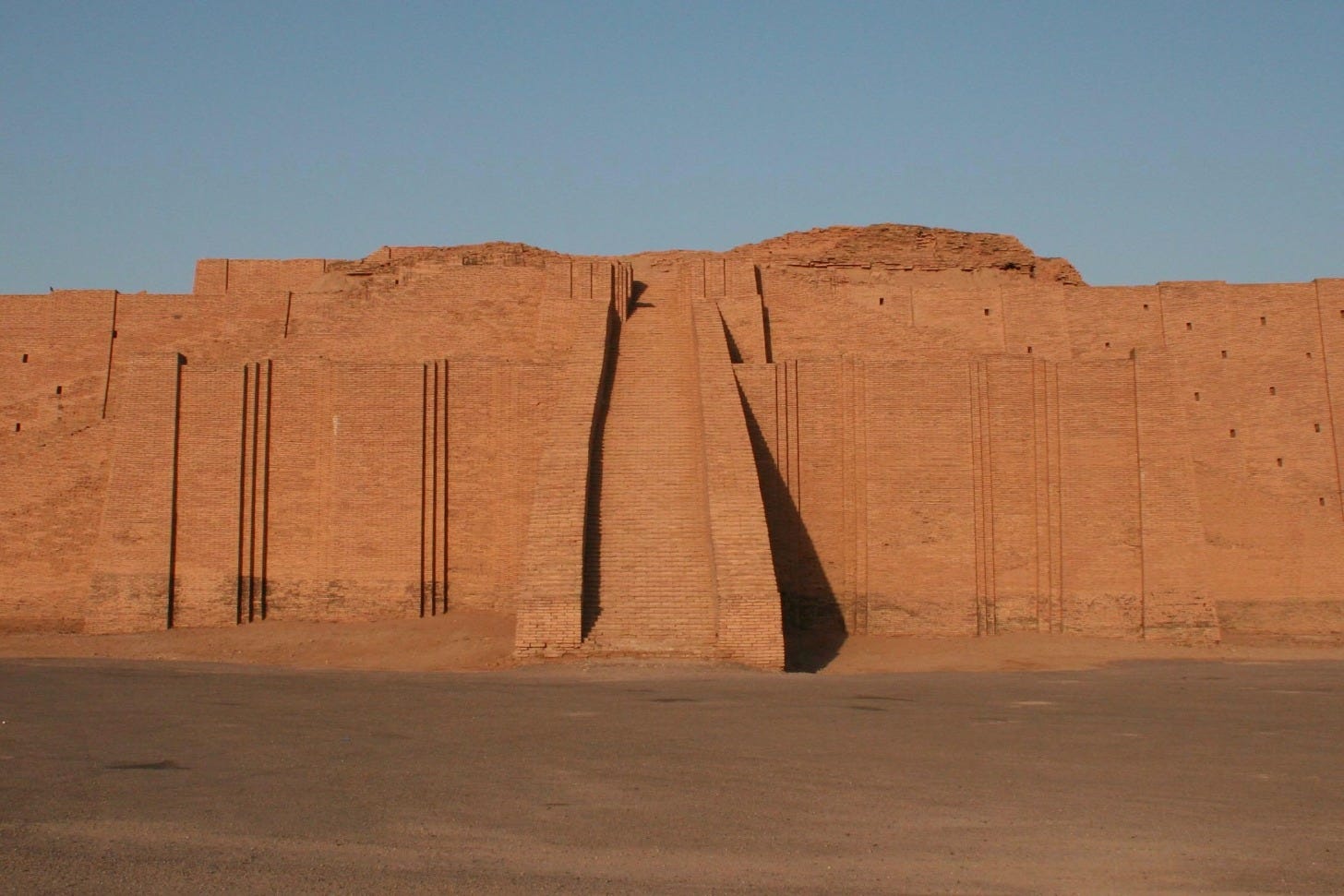
The Ziggurat of Ur | Ur (Iraq), ca. 2100 BCE (restored)
Photo Credit: Tla2006 via Wikimedia Commons, Public domain
How does a civilization build a mountain?
Key Terms for this Lesson
Ziggurat · Stele · Lady of Warka
Ziggurat | The Mountain House
Southern Mesopotamia is a flat plain of river mud. There is no stone to quarry, no mountain to climb, and no forest to cut, which is a problem when your gods live on mountaintops. So the Mesopotamians built their own. A ziggurat (from the Akkadian zaqāru, “to build high”) is a massive stepped platform, somewhat pyramid-like in shape, built for ceremonial purposes. The stairs of the ziggurat lead to a shrine at the top, the god’s own house, raised above the city (cf. Sec. 2.2). The most famous is at Ur, built around 2100 BCE by the Sumerian king Ur-Nammu (d. ca. 2094 BCE) for the moon god Nanna, the same Ur from the story of Abraham in the Bible.
How do you build a mountain out of mud? Brick. The core of the Ziggurat of Ur is millions of sun-dried mudbricks, and its skin is a layer of baked brick about 8 feet thick, set in bitumen, natural tar. Its base measures about 210 by 150 feet. Every few courses, the king’s name is stamped into the bricks. The mountain is signed.
The Bible remembers this construction exactly, in its story of Babylon’s tower:
And they said one to another, Go to, let us make brick, and burn them thoroughly. And they had brick for stone, and slime had they for morter. And they said, Go to, let us build us a city and a tower, whose top may reach unto heaven… Genesis 11:3–4 (KJV)
Brick for stone, and tar for mortar. That is a ziggurat, and the great one at Babylon, the Etemenanki, was called “the House of the Foundation of Heaven and Earth.”
Stele & Standard | Kings in Stone
What stone Mesopotamia had was imported, so it was reserved for the king. A stele is a ceremonial, human-sized flat stone, set upright and carved with words or pictures. One of the surviving pieces of art of the Akkadian period is the Victory Stele of Naram-Sin, created about 4,300 years ago. It shows the king, Sargon‘s grandson Naram-Sin (d. ca. 2218 BCE), wearing a horned crown, the crown of a god, climbing a mountain and standing on the bodies of his enemies beneath symbols of the gods. He is drawn twice the size of his soldiers. Rather than speculating on failure to achieve eternal life, like Gilgamesh (Sec. 2.5), the Akkadian kings rise up to meet the gods and be honored by them.
The Stele of Hammurabi (ca. 1750 BCE) is the same idea in a lawyer’s hands: a 7-foot pillar of black basalt, with the king at the top receiving the measuring rod and ring of kingship from the seated sun god Shamash, and 282 laws cut below (Sec. 2.6). Both steles were carried off to Susa (~Iran) as war loot around 1150 BCE, where French archaeologists dug them up around 1900. Today they stand in the Louvre.
Older than either is the Standard of Ur (ca. 2500 BCE), a wooden box inlaid with shell, red limestone, and lapis lazuli carried 1,500 miles from Afghanistan. One side shows war (chariots, prisoners, the king), the other peace (a banquet, with a musician playing a lyre, Sec. 2.4), each in three rows read from the bottom up. No one knows what it was for. Its discoverer guessed at a banner on a pole, and the name stuck.
Warka & the Ishtar Gate | Marble & Glazed Brick
The Lady of Warka is a marble carving of a woman’s face created around 5,000 years ago at Uruk (Arabic Warka). No records exist of who the statue is based on. Archaeologists aren’t sure if it is a carving of a human being or a goddess, but because it is carved in marble, they believe it could be the Sumerian goddess of love and war, Inanna. Marble isn’t a common resource in this region of the world, so they find it very unlikely that a carving of an everyday person would have been made in such a rare piece of rock. It is among the first lifelike human faces in art. (Stolen from the Iraq Museum in 2003, it was recovered the same year.)
Twenty-five centuries later, the kings of Babylon solved the stone problem another way. The Ishtar Gate (ca. 575 BCE), built by Nebuchadnezzar II (d. 562 BCE), is mudbrick again, but glazed a deep blue and set with golden bulls and dragons in relief (lions lined the road to it), and was rebuilt in Berlin’s Pergamon Museum. The Assyrians to the north, who had stone, carved it: the lion hunts of Ashurbanipal (ca. 645 BCE), now in London, are the finest animal sculpture of the ancient world. As for the Hanging Gardens of Babylon, no Babylonian text mentions them. They are a legend told by later Greek writers, and the only one of the Seven Wonders whose location is unknown.
Sec 2 • Ancient Mesopotamia
2.1 History & Politics • Between the Rivers
2.2 Sacred Life • Temple & Priest-King
2.3 Art & Architecture • The Ziggurat of Ur
2.4 Music • The Lyres of Ur
2.5 Literature & Drama • Gilgamesh & the Enuma Elish
2.6 Wisdom • An Eye for an Eye
Course Page: Humanities I & II