

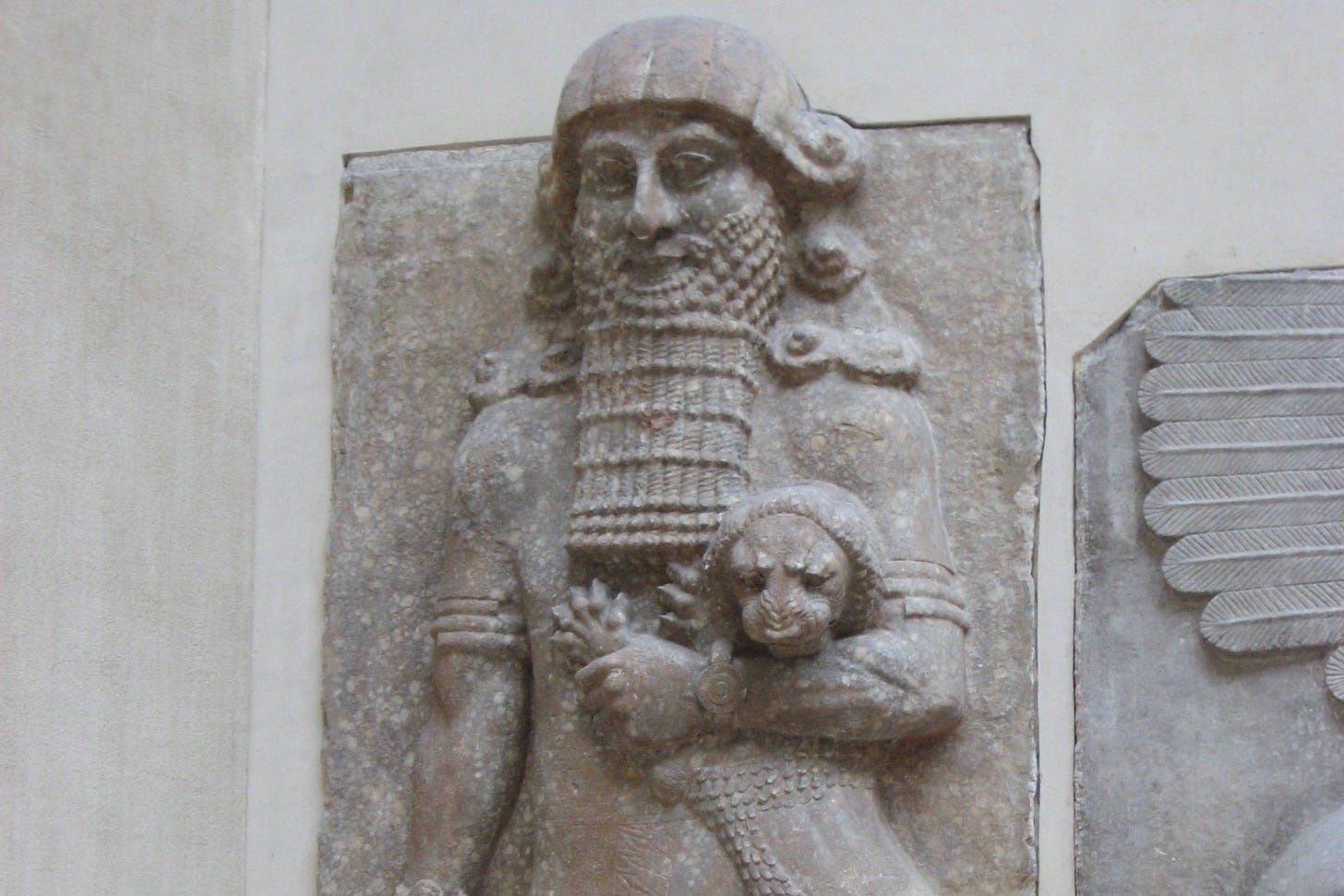
Hero Mastering a Lion | Palace of Sargon II, Khorsabad (Iraq), ca. 710 BCE (detail)
Photo Credit: Jastrow via Wikimedia Commons
What does a king do when his friend dies?
Key Terms for this Lesson
Epic of Gilgamesh · Enuma Elish · Enheduanna
Gilgamesh | The King Who Could Not Keep His Friend
The Epic of Gilgamesh is one of the oldest works of literature ever found. Archaeologists believe Gilgamesh was a real person who ruled from the city of Uruk around 2700 BCE (cf. Sec. 1.5), and legends about him became the poem. The Sumerians told his stories first. Around 1200 BCE a Babylonian scholar gathered them into one Akkadian poem on 12 clay tablets, and that is the version we read. Most of it was lost for more than 2,000 years, until a British Museum assistant named George Smith (d. 1876) read the flood tablet in 1872 and announced it to a stunned London.
In brief, the first half of the story is Gilgamesh meeting and befriending a wild man named Enkidu, a man of the steppe made by the gods to be his equal. They have adventures together: they kill the forest giant Humbaba and the Bull of Heaven. For that, the gods decree that Enkidu must die, and he sickens and dies in his friend’s arms. The rest of the story is about Gilgamesh coping with death by attempting to gain immortality and questioning the meaning of life.
Gilgamish bitterly wept for his comrade, (for) Enkidu, ranging
Over the desert: ‘I, too—shall I not die like Enkidu also?
Sorrow hath enter’d my heart; I fear death as I range o’er the desert…’ Epic of Gilgamesh, Tablet IX (trans. R. Campbell Thompson, 1928)
He crosses the waters of death to find Utnapishtim, the one man the gods made immortal, who tells him how he survived a great flood sent to punish humankind: one virtuous man is warned, builds a boat, and saves his family and the animals. You probably know this story. In Gilgamesh the survivor is Utnapishtim. In Genesis the survivor is Noah (cf. Sec. 9.1). Utnapishtim then gives Gilgamesh a plant that restores youth, and a snake steals it while he bathes. In the end, Gilgamesh concludes immortality belongs to the gods, fails to achieve his goals, and returns home, where the poem ends as it began, with the king looking at the walls of Uruk. So in all, it’s a rather pessimistic work. This is rather sophisticated, because it asks some of the big questions about human existence (Readings 1.1–1.4 in the textbook).
Enheduanna | The First Author
By the usual reckoning, the first author in history whose name we know is a woman. Enheduanna (d. ca. 2250 BCE) was the daughter of Sargon of Akkad (Sec. 2.1), installed by her father as high priestess of the moon god Nanna at Ur. She wrote hymns to the temples of Sumer and to the goddess Inanna, and she signed them. One, The Exaltation of Inanna, tells how a rebel drove her from her temple and how she prayed her way back. A carved disk from Ur, now in Philadelphia, shows her in her priestess’s robe, overseeing an offering poured at an altar, and her name is cut on the back. Every named author since, from Homer to the present, stands in a line that begins with her.
Enuma Elish | The Drama of the New Year
The second great poem of Mesopotamia is Babylon’s story of creation, the Enuma Elish (Akkadian for its first words, “When on high”). In it, the young god Marduk, patron of Babylon, kills the sea-monster Tiamat, the mother of the gods, and makes the world from her body: half of her becomes the sky, half the earth. Then humans are made from the blood of a defeated god, to do the gods’ work for them. In return for the victory, the gods build Marduk his temple at Babylon and name him king of the gods. The poem is Babylon’s claim to rule.
It is also, for a few days each spring, a play. At the Babylonian New Year festival, the Akitu, eleven days at the start of the year, the whole Enuma Elish was recited aloud before the statue of Marduk. Then, on the fifth day, the high priest took the king’s crown, scepter, and ring, struck him across the face, and made him kneel and swear that he had not sinned against the city. He struck him again, and if the king’s tears flowed, Marduk was pleased, and the year would go well. The crown was handed back. That is as close as Mesopotamia came to theater: a script, a stage, a cast, and an audience, once a year, with the king in the leading role.
Here the Hebrew Bible and the river valley meet again, and the difference is worth seeing. The book of Genesis also has creation emerging from a watery void. But there is one massive difference between the earlier Mesopotamian narrative and the later Hebrew one. Where the Mesopotamian gods quarrel, scheme, and war among themselves, Genesis presents one God acting alone, with divine moral purpose.
Sec 2 • Ancient Mesopotamia
2.1 History & Politics • Between the Rivers
2.2 Sacred Life • Temple & Priest-King
2.3 Art & Architecture • The Ziggurat of Ur
2.4 Music • The Lyres of Ur
2.5 Literature & Drama • Gilgamesh & the Enuma Elish
2.6 Wisdom • An Eye for an Eye
Course Page: Humanities I & II