

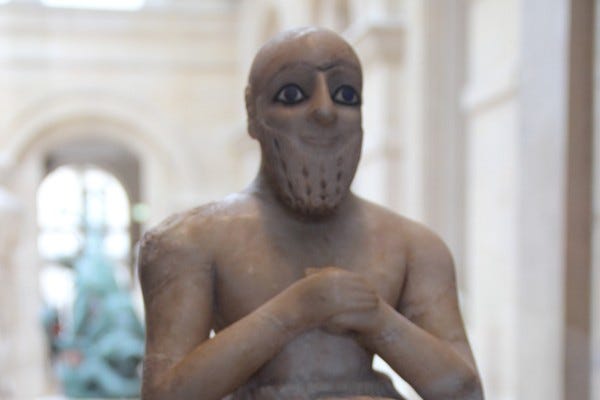
Statue of Ebih-Il | Mari (Syria), ca. 2400 BCE (detail)
Photo Credit: Gary Todd via Wikimedia Commons, CC0
Why did every Sumerian city belong to a god?
Key Terms for this Lesson
Priest-King · Polytheism · Inanna
Holy Days | The Gods of Sumer
Temples were built to provide a ceremonial interface between humanity and the gods of Mesopotamian tradition. Life in the city focused on the temple, where citizens worshipped a god or gods who protected the city. Early stories about the gods’ plans made life seem less chaotic and less based on chance. What we think of as “religion” today was simply an embedded part of everyday life and events. In other words, everything was “sacred” and done with sacredness in mind (cf. Sec. 1.3). There was no such category as “secular,” like we have now in the modern world.
For the Mesopotamians, the gods revealed themselves in the natural world: the sky, the sun, the moon, and in storms, floods, and droughts. Religious holidays and festivals were often timed with the seasons. In fact, the word “holiday” comes from the words “holy day.” Each power of nature had a name, and each of the great gods had a home city that was his or hers. The people of a city held festivals to honor their god and wore the god’s symbols in battle, just as sports teams today rally around their mascots:
• Anu | the sky, father of the gods, at Uruk
• Enlil | the wind and storm, king of the gods, at Nippur
• Enki | fresh water and wisdom, at Eridu
• Nanna | the moon, at Ur
• Utu (Shamash) | the sun and justice, at Sippar
Beside them stood Inanna, the Sumerian goddess of love and war, whom the Semitic peoples called Ishtar. Her partner, the shepherd Dumuzi (Tammuz), spends half of every year in the underworld, and his death was mourned each summer, when the fields burned brown. This is polytheism: many gods, each with a province of the world, a city, and a house.
The Temple | The House of the God
The Sumerian word for temple was simply é, “house.” Enlil’s temple at Nippur was the É-kur, “Mountain House.” Inanna’s at Uruk was the É-anna, “House of Heaven.” Every Sumerian city was understood to be the estate of its god, and the temple was the big house on that estate: it owned fields, herds, and workshops, paid its workers in rations of barley, and kept the accounts. The earliest writing we have is the temple’s bookkeeping (cf. Sec. 1.5). The temple was the city’s storehouse, bank, and employer, and the god’s statue inside it was dressed and fed twice a day.
A citizen who could afford it did not stand in the temple himself. He commissioned a statue to stand there for him. Dozens survive, with huge inlaid eyes and hands clasped at the chest, like the superintendent Ebih-Il of Mari above. The eyes are the point: the statue keeps watch before the god forever, so that its owner’s prayer is never interrupted.
The priests also read the will of the gods in the world itself. Before any great decision, a sheep’s liver was inspected for marks, and night after night the stars were tracked. Divination was the priest’s science, and the Babylonian star records became the beginning of astronomy (Sec. 2.6).
The Priest-King | Steward of the God
As mentioned in Sec. 2.1, the Mesopotamian priest-kings used writing to collect information on their citizens. They also used writing to record their commands so their wishes could be carried out in different cities. Throughout the ancient world, the same group of people generally controlled economic matters and sacred matters. With the power of literacy kept for themselves, the priest-kings amassed enormous wealth around the temple. This temple wealth encouraged the idea that the priest-king was the direct representative of the city’s god, its steward rather than its owner. The Egyptians took this a step further, with their kings (the pharaohs) announcing that they were actually gods themselves (Sec. 3.1)! The idea of the god-king will play out again and again, even much later in ancient Rome under Julius Caesar (d. 44 BCE, cf. Sec. 8.2).
What the gods did not offer was a happy afterlife. The dead went down to one place, a house of dust:
To the land of no return, the land of darkness, … To the house without exit for him who enters therein, … The place where dust is their nourishment, clay their food. They have no light, in darkness they dwell. Descent of Ishtar (trans. Morris Jastrow)
So the Mesopotamians kept faith with the gods for this life: for rain, for harvest, for the city’s walls. That is the world Abraham leaves in Genesis. The great ziggurat of Iraq stands at Ur, the same Ur from the story of Abraham in the Bible (Genesis 11:31, Sec. 9.1), and Mesopotamia has a great flood story of its own, in which one righteous man is warned, builds a boat, and saves his family and the animals (Sec. 2.5). The Bible begins its story between the rivers.
Sec 2 • Ancient Mesopotamia
2.1 History & Politics • Between the Rivers
2.2 Sacred Life • Temple & Priest-King
2.3 Art & Architecture • The Ziggurat of Ur
2.4 Music • The Lyres of Ur
2.5 Literature & Drama • Gilgamesh & the Enuma Elish
2.6 Philosophy • An Eye for an Eye
Course Page: Humanities I & II