

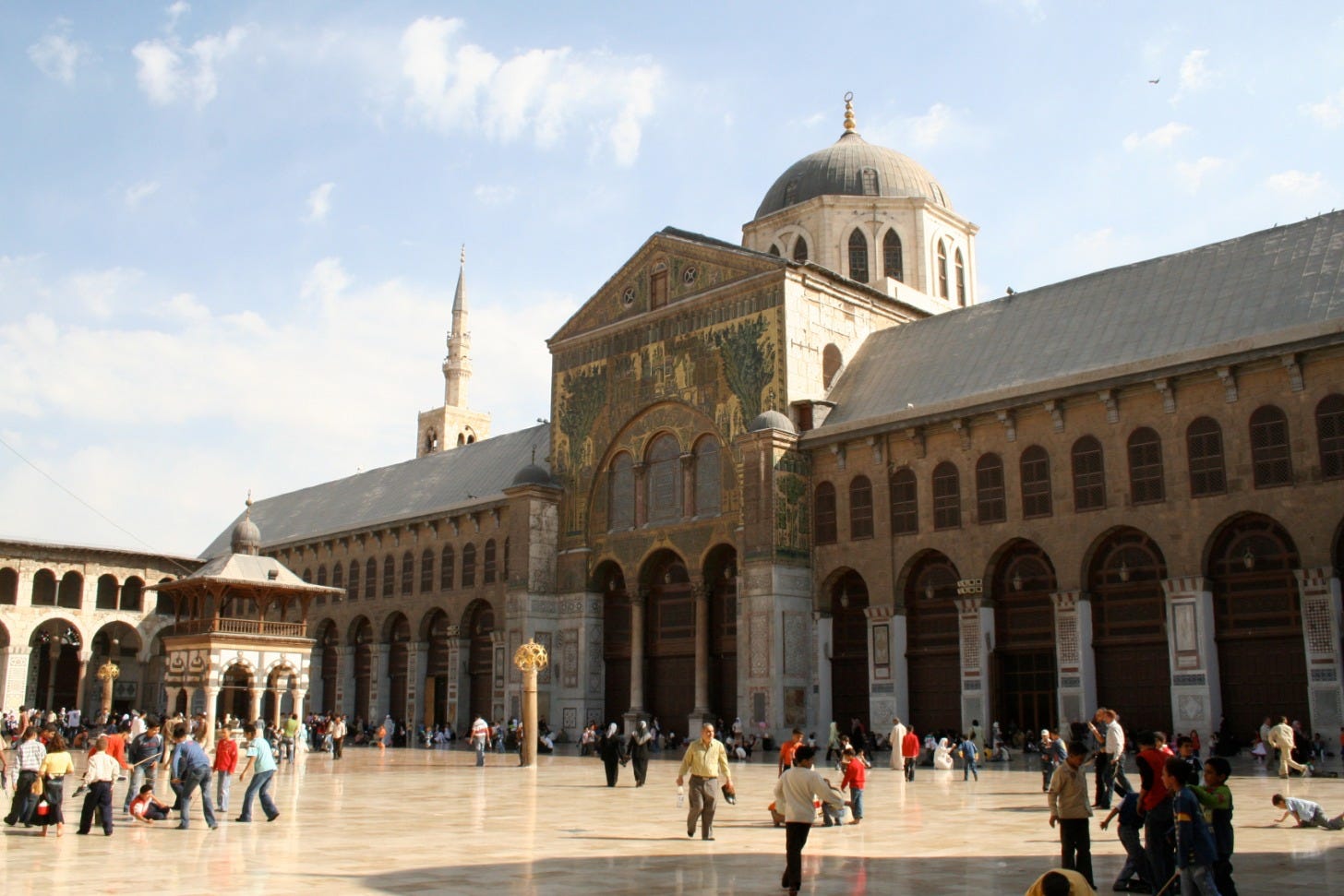
The Umayyad Mosque | Damascus, 715 CE
Photo Credit: Wurzelgnohm via Wikimedia Commons, CC0
Who should lead after Muhammad?
Key Terms for this Lesson
Hijra · Caliphate · Sunni & Shia
Mecca & Medina | 570–632 CE
Arabia in the 500s CE was a world unto itself, wedged between the two superpowers of the age: the Christian Byzantine Empire to the northwest (cf. Sec. 10.1) and a revived Persian Empire to the northeast (cf. Sec. 7.1). At the center of the desert town of Mecca stood a single cube of stone, the Ka’ba, which Arab tradition held had been raised by Abraham (cf. Sec. 9.1) and his son Ishmael. Around it stood some 360 idols, tradition says, a god for every tribe that came to trade. Meccan prosperity ran on those idols, and the tribe that kept the shrine, the Quraysh, grew very wealthy.
Muhammad was born into that tribe around 570 CE and orphaned young. A caravan trader known as al-Amin, “the Trusted One,” he married Khadija (d. 619 CE), a self-made widow who ran her own caravan business. Muslims hold that in 610 CE, in a cave on Mount Hira, the angel Gabriel came to him with a single command: “Recite!” (cf. Sec. 11.2). Muhammad’s message was unsparing: there is only one God, and the rich must answer for how they treat the poor.
Mecca’s leaders answered with ridicule, then pressure, then persecution. In 622 CE the community migrated north to the oasis town of Yathrib, a journey known as the Hijra (Ar. emigration). The Hijra marks Year 1 of the Islamic calendar (1 AH). Yathrib became known as Medina, “the City.”
At Medina, the movement became a community, the Ummah, a new kind of tribe that anyone could join. The Constitution of Medina bound the town’s Muslims, Jews, and others into a pact of mutual defense, each keeping its own faith. In 630 CE, after years of war, Muhammad returned to Mecca with 10,000 followers. A broad amnesty was declared for the whole city, and he cleared the Ka’ba of its idols.
The Rightly Guided | 632–661 CE
Two years later, in 632 CE, the Prophet died at Medina. It fell to Abu Bakr to steady the grieving crowd:
Whoever worshipped Muhammad, Muhammad has died. Whoever worshipped God, God is living and does not die. Sahih al-Bukhari (3668, my translation)
The message survived its Messenger. But who leads, and by what right?
Sunni Muslims hold that Muhammad named no successor and left no procedure for choosing one. Shia Muslims hold that he named Ali. After heated argument in a shura (Ar. consultation), the majority chose Abu Bakr (d. 634 CE), the Prophet’s father-in-law, as Khalifat Rasul Allah, the “Successor to the Messenger of God.” Caliph for short. A caliph is a successor, a deputy. He’s never a prophet, and never a source of revelation. The office, and the empire it came to govern, is the Caliphate.
The other candidate had been Ali (d. 661 CE), Muhammad’s cousin and son-in-law. But Quraysh, as later tradition has Umar explain it, would not see prophethood and the caliphate held by one clan.
Under Umar (d. 644 CE), the Ummah expanded at a rate almost impossible to wrap your head around. Damascus, Jerusalem, Egypt, and Persia fell like dominoes. Uthman (d. 656 CE) set the Qur’an in one written edition (cf. Sec. 11.2) and was killed by rebels. Ali at last took the office, and the Ummah fought its first civil war. The Sunni tradition remembers these four as the Rashidun, the “Rightly Guided” caliphs.
Damascus & Baghdad | 661–762 CE
• 661 CE | Mu’awiya (d. 680 CE) founds the Umayyad Caliphate at Damascus
• 680 CE | Ali’s son Husayn is killed at Karbala, in Iraq
• 750 CE | The Abbasid Revolution takes the caliphate
• 762 CE | Baghdad is founded on the Tigris
In 661 CE, Uthman’s Umayyad kinsman Mu’awiya, the governor of Syria, took the office. The Umayyad Caliphate was the first Islamic dynasty. Not a shura. Not a community of consent. A dynasty, seated in an old Roman city, that would pass from father to son.
At Karbala in 680 CE, the forces of Mu’awiya’s son killed Husayn, the Prophet’s grandson. That grief sealed the division. Sunni Muslims hold that the community was right to choose its leaders by consensus, beginning with Abu Bakr. The name comes from sunna, the Prophet’s custom. Shia Muslims (from Shi’atu Ali, the “Party of Ali”) hold that leadership belonged by right to Ali and the family of the Prophet. Today about 85–90 percent of the world’s Muslims are Sunni. But do not lose sight of the fact that Sunni & Shia are two branches of one religion, and both revere Ali.
In 747 CE, a revolution raised black banners in the Persian east, and by 750 CE the Abbasids, descendants of Muhammad’s uncle al-Abbas, held the caliphate. In 762 CE, the caliph al-Mansur (d. 775 CE) laid out a new capital as a perfect circle, Madinat al-Salam, the “City of Peace.” Baghdad would become, by many estimates, the largest city in the world (cf. Sec. 11.3).
Sec 11 • Early Islam
11.1 History & Politics • The Caliphate
11.2 Literature & Drama • The Qur’an & Hadith
11.3 Philosophy • The House of Wisdom
11.4 Religion • The Five Pillars
11.5 Music • The Call & Qur’anic Recitation
11.6 Art & Architecture • Mosque, Calligraphy, & Arabesque
Course Page: Humanities I & II