

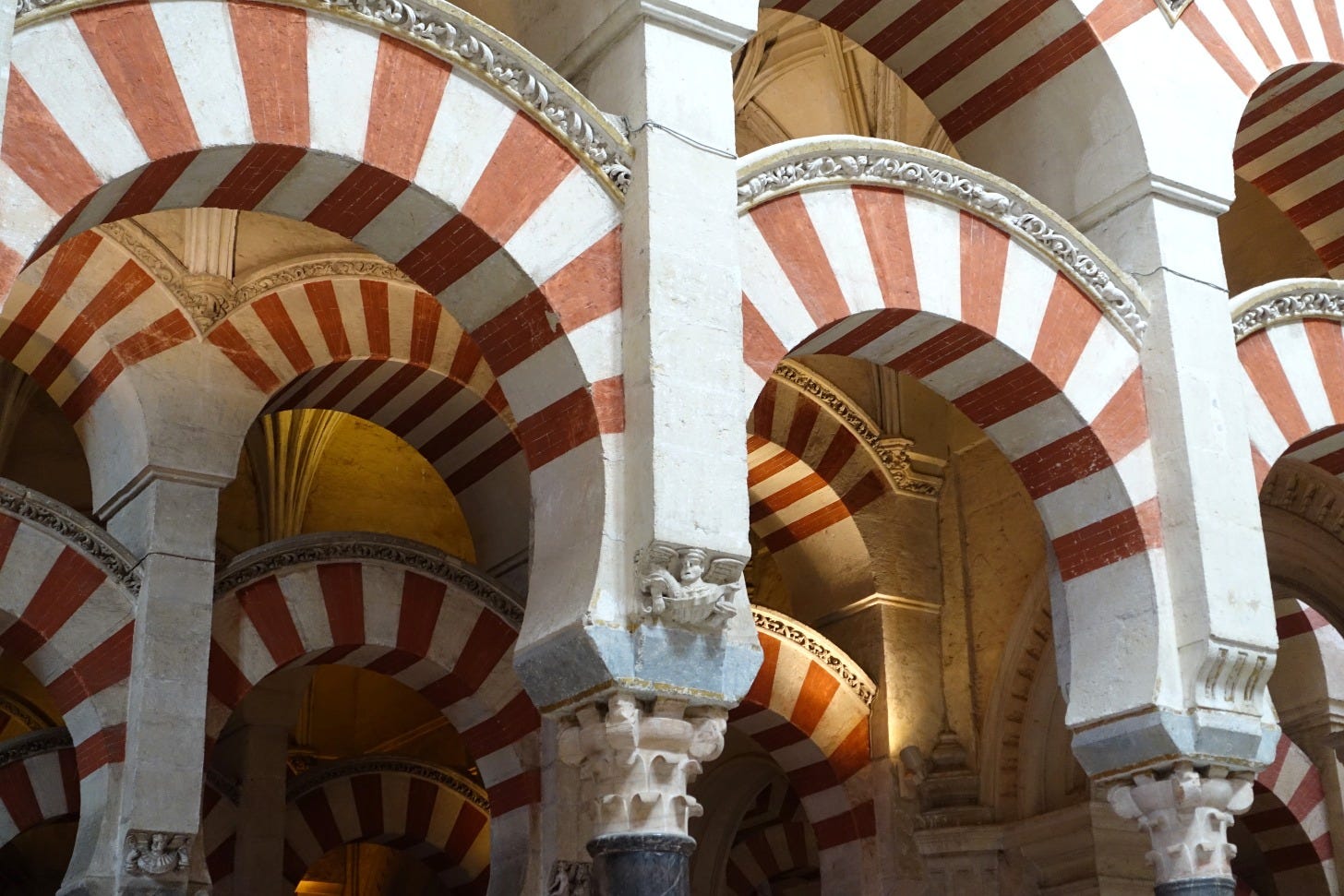
The Great Mosque | Córdoba, 785–987 CE
Photo Credit: Daderot via Wikimedia Commons, CC0
Why did Muslim artists decorate with words instead of pictures?
Key Terms for this Lesson
Mosque · Calligraphy · Arabesque
The Mosque | 622–715 CE
The building where Muslims gather is the mosque (Ar. masjid, “place of prostration”). A mosque is not a church: it holds no altar and no sacrament, only a congregation at prayer. The model for all later mosques was Muhammad’s own house in Medina (cf. Sec. 11.1): a walled courtyard with a roof of palm fronds on palm-trunk columns along one side. The early mosques kept its plan, a courtyard and a hall for prayer.
A mosque’s layout is typically functional and spare. All prayer faces the Ka’ba in Mecca, the direction called the qibla (“wheresoever ye may be, turn your faces… toward it,” 2:144, trans. Pickthall). A niche in the qibla wall, the mihrab, marks that direction. Beside it stands the minbar, the stepped pulpit for the Friday sermon, and outside rises the minaret (cf. Sec. 11.5). Worshippers leave their shoes at the door. There are no pews and no chairs, only carpet, and the congregation prays in rows, shoulder to shoulder.
As the caliphs grew rich, the mosque grew great. In Jerusalem, on the Temple Mount (cf. Sec. 9.3), the caliph Abd al-Malik (d. 705 CE) raised a shrine, the octagonal, golden-domed Dome of the Rock (completed 691–692 CE), the oldest surviving great work of Islamic architecture. In Damascus, his son al-Walid I (d. 715 CE) built the Great Mosque (705–715 CE) on the site of a Christian church, the basilica of St. John the Baptist (cf. Sec. 10.6). The shrine said to hold John’s head still stands inside, since Muslims honor him as the prophet Yahya. Byzantine craftsmen covered the mosque’s walls with gold mosaics of rivers, trees, and palaces. Not one person or animal appears in them.
Calligraphy | Words as Ornament
That absence is the key to Islamic art. In the mosque and on the page of the Qur’an, Muslim art shows no human figures. Some 360 idols, tradition says, had once stood around the Ka’ba, and Muhammad had cleared them out (cf. Sec. 11.1). To keep anything in a house of prayer that might draw worship away from God was, to most Muslim scholars, unthinkable. Book painters in Baghdad, and later in Persia and the Ottoman lands, would show people at court and in stories (as in the header of Sec. 11.3), but never in the place of prayer.
So the artists of the mosque turned to the one thing they held most sacred: God’s word. Calligraphy (Gr. kalli, “beautiful,” and graphia, “writing”) became the highest art of the Islamic world, and the calligrapher the most honored artist. The great early Qur’ans were written in Kufic, a stately, angular script, as in the Blue Qur’an (cf. Sec. 11.2). In 10th-century Baghdad, the vizier Ibn Muqla (d. 940 CE) set the rounded scripts in proportion, measuring every letter by the rhombic dot of the pen. The writing that Mesopotamia and Egypt had pressed and carved for records and rites (cf. Sec. 2.1, 3.5) became, in Islam, the ornament itself.
The verse most loved on a mosque’s walls, and on the glass lamps that once hung in them, is the Qur’an’s own image of light:
Allah is the Light of the heavens and the earth. The similitude of His light is as a niche wherein is a lamp. The lamp is in a glass. The glass is as it were a shining star… Light upon light. The Meaning of the Glorious Koran (24:35, trans. Marmaduke Pickthall)
A niche, a lamp, and a verse about both: the mihrab and the light hung before it carry the Qur’an’s own words. There are no narrative scenes from holy scripture, only the holy scripture itself.
Arabesque | Córdoba, 785–987 CE
Around the words grows pattern. The arabesque is an ornament of interlacing vines and leaves, often set beside geometric stars, that repeats without end, and its makers built it with compass and straightedge, out of the same geometry the House of Wisdom studied (cf. Sec. 11.3). A pattern can be extended in every direction past the edge of the wall.
Far to the west, the most famous Umayyad survivor of the Abbasid revolution, Abd al-Rahman I (d. 788 CE), fled to Spain and began the Great Mosque of Córdoba in 785 CE. His heirs enlarged it three times. Its hall became a forest of some 850 columns, many of them reused Roman shafts, carrying two tiers of arches, horseshoe below and round above, striped in red brick and white stone. Its mihrab, added in the 960s CE, glows with gold mosaic and Kufic verse, laid, tradition says, by a master sent from Constantinople.
Unlike the Hagia Sophia (cf. Sec. 10.6), which became a mosque in 1453, the Córdoba mosque became a cathedral after the city fell to Castile in 1236. Its arches still stand.
Sec 11 • Early Islam
11.1 History & Politics • The Caliphate
11.2 Literature & Drama • The Qur’an & Hadith
11.3 Philosophy • The House of Wisdom
11.4 Religion • The Five Pillars
11.5 Music • The Call & Qur’anic Recitation
11.6 Art & Architecture • Mosque, Calligraphy, & Arabesque
Course Page: Humanities I & II
Next Section: The Holy Roman Empire