

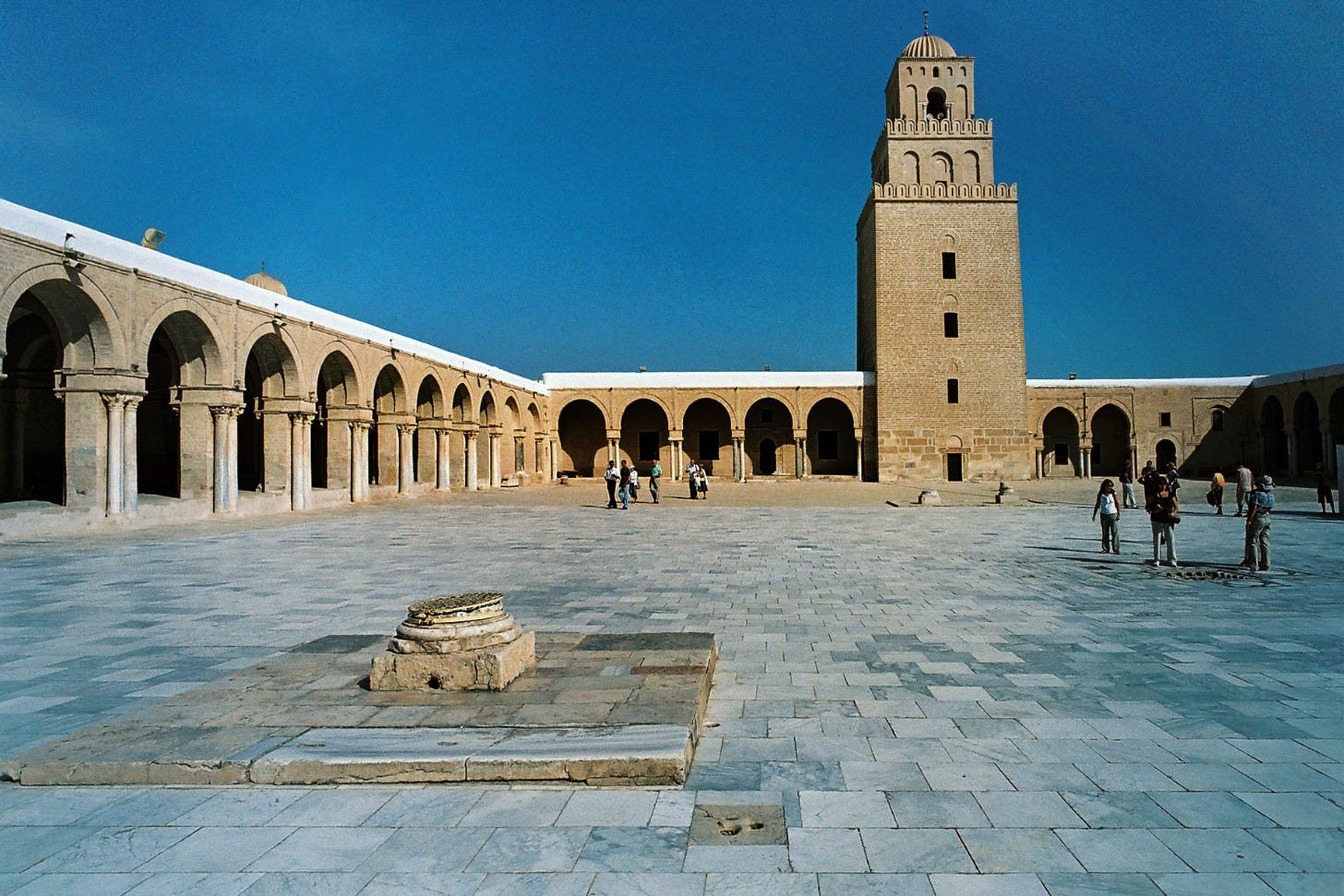
The Minaret of the Great Mosque | Kairouan, Tunisia, ca. 836 CE
Photo Credit: Vince Crawley via Wikimedia Commons
Why did the first call to prayer use a human voice?
Key Terms for this Lesson
Adhan · Muezzin · Tajwid
The Call | Medina, ca. 622 CE
When the first Muslims arrived in Medina (cf. Sec. 11.1), they had a practical problem. Prayer came five times a day (cf. Sec. 11.4), and no one had a clock. How do you gather a city at the same moment? The neighbors had answers already. Eastern Christians struck a wooden clapper to call worshippers, and Jews sounded the shofar, a ram’s horn, on holy days (cf. Sec. 9.6). The Companion Ibn Umar (d. 693 CE) remembered the debate:
When the Muslims came to Medina, they used to gather and estimate the time of the prayer, and no one called for it. One day they talked about this. Some said, ‘Take a clapper, like the clapper of the Christians.’ Others said, ‘No, rather a trumpet, like the horn of the Jews.’ Umar said, ‘Why not send a man to call to the prayer?’ The Messenger of God said, ‘Bilal, get up and call to the prayer.’ Sahih al-Bukhari (604, my translation)
Muslims chose a human voice, and the voice they chose belonged to a freed slave. Bilal ibn Rabah (d. ca. 640 CE), born into slavery in Mecca and of Abyssinian (Ethiopian) descent, had been among the first converts, and Abu Bakr had bought his freedom. Tradition remembers Bilal’s voice as strong and beautiful. He climbed to a rooftop beside the Prophet’s mosque and called the city to prayer.
That call is the adhan, from an Arabic root meaning to hear, and the one who gives it is the muezzin (mu’adhdhin, “the one who calls”). A clapper or a horn can only say now. A voice can say why. The adhan carries the Shahadah itself (cf. Sec. 11.4). In its most common form, translated, it says:
• God is Greater. (x4)
• I testify there is no god but God. (x2)
• I testify Muhammad is the Messenger of God. (x2)
• Come to prayer. (x2) Come to salvation. (x2)
• God is Greater. (x2)
• There is no god but God.
It is easily the most recognizable sound in the Islamic world, and it has marked the hours in Damascus and Cairo for well over a thousand years. In time, the rooftop became a tower, the minaret (cf. Sec. 11.6).
The Recitation | Tajwid
Inside the mosque, the Qur’an is not sung. It is recited (cf. Sec. 11.2). Muslims do not call it music, and yet anyone who hears a trained reciter knows it is not ordinary speech. A saying of the Prophet asks for exactly that: “Beautify the Qur’an with your voices” (Sunan Abi Dawud 1468, my translation).
The art has a name: tajwid, from a root meaning to make excellent. Tajwid is the set of rules for reciting the Qur’an correctly: how each letter is formed in the throat or on the lips, which vowels are drawn out and for how many beats, where the voice hums through the nose, and where a reader may and may not pause. A misplaced pause can change a verse’s meaning. So students learn tajwid from a teacher, by ear, verse by verse, the way the Companions learned it from Muhammad.
Within those rules, a reciter (qari’) has room for art. He may read in a measured, even style for study and prayer, or in a slower, ornamented style for a gathered audience, and many shape their lines in the traditional melodic modes called maqamat. As with the Greek modes (cf. Sec. 6.4), each maqam is felt to carry its own mood: one grave, one tender, one bright. In tajwid, the melody always serves the words. India’s priests, too, kept the Vedas alive by chanting them on fixed pitches (cf. Sec. 4.2).
Voice & Instrument | 622–950 CE
In the mosque, there are no instruments. Like the early church, which sang with voices alone (cf. Sec. 10.4), Muslim worship gives the whole of its music to the human voice. Whether instruments belong in a devout life at all is a question Muslim scholars have debated for centuries, and they still do.
Outside the mosque, the courts of Damascus and Baghdad filled with music. The favorite instrument was the oud, a short-necked, pear-shaped instrument plucked with a quill. Its Arabic name, al-’ud (“the wood”), crossed into Spain and Europe and became our word lute. The musician Ziryab (d. ca. 857 CE), who came from Baghdad to Umayyad Córdoba in 822 CE, is said to have added a fifth string to it.
The philosophers listened, too. Al-Kindi wrote some of the first Arabic treatises on music theory, and al-Farabi (cf. Sec. 11.3) wrote a Great Book of Music on scales, rhythm, and instruments. Even so, the sound that defines the Islamic world is still the one Bilal first sent over Medina: one voice, five times a day, calling a city to stop.
Sec 11 • Early Islam
11.1 History & Politics • The Caliphate
11.2 Literature & Drama • The Qur’an & Hadith
11.3 Philosophy • The House of Wisdom
11.4 Religion • The Five Pillars
11.5 Music • The Call & Qur’anic Recitation
11.6 Art & Architecture • Mosque, Calligraphy, & Arabesque
Course Page: Humanities I & II