

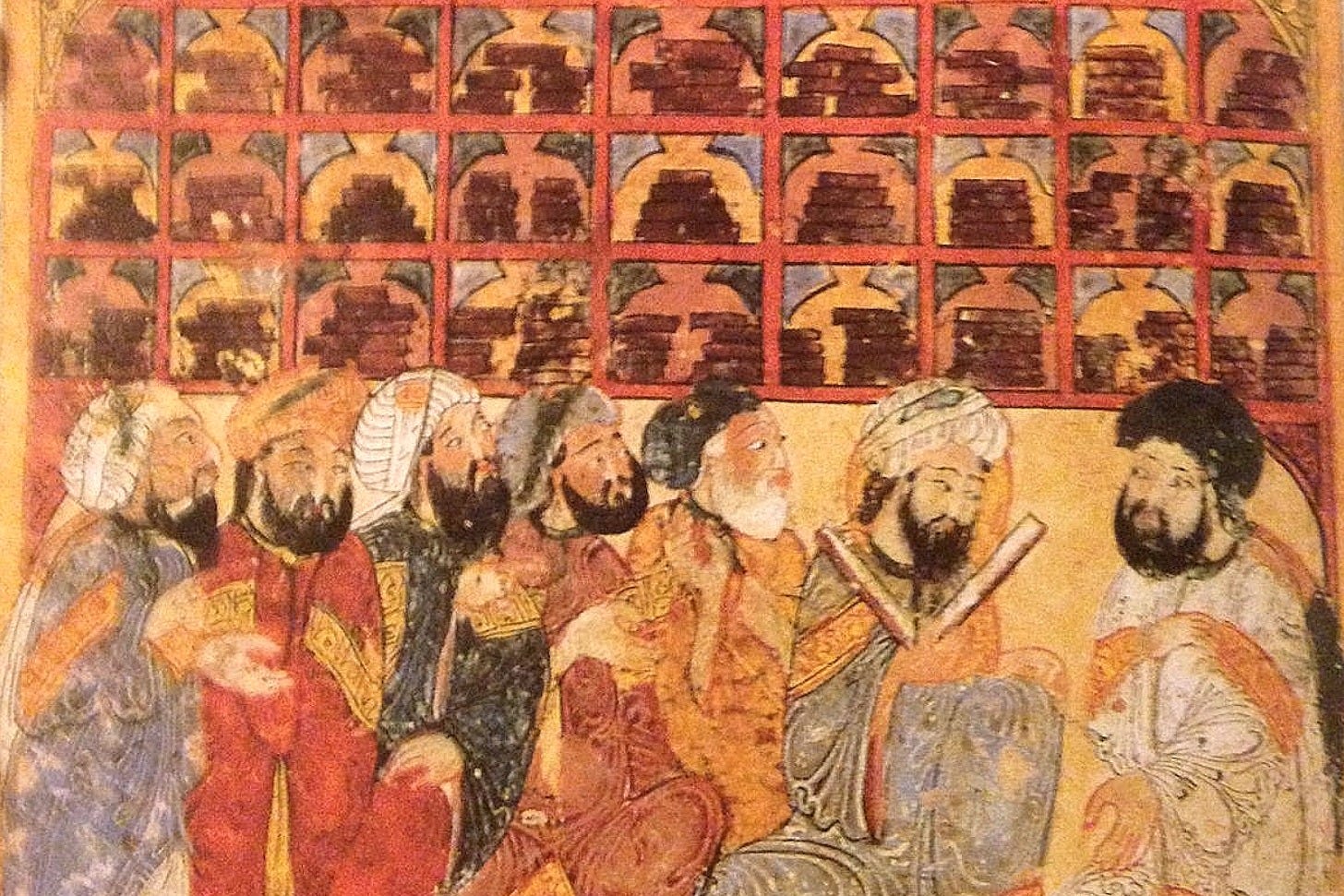
A Library | Yahya al-Wasiti, 1237 (cropped)
Why did a caliph pay to translate Aristotle?
Key Terms for this Lesson
House of Wisdom · Falsafa · Algebra
The Translators | 762–900 CE
At the center of the Abbasid world stood the round city of Baghdad, founded in 762 CE (cf. Sec. 11.1). Its very centrality is why it became one of the greatest repositories of knowledge on the planet: the Oxford of its day, the place to which scholars carried the writings and inventions of distant lands. Did the Hindus have a better number system? Adopt it. Tradition says papermaking reached the caliphate after the Battle of Talas in 751 CE, and a paper mill is reported in Baghdad by the 790s CE.
The Arabs had arrived with a single book, the Qur’an, and an enormous appetite for more. Under the caliph Harun al-Rashid (d. 809 CE) and his son al-Ma’mun (d. 833 CE), that appetite found a home in the caliphal library and research center remembered as the House of Wisdom (Bayt al-Hikma). In al-Ma’mun’s Baghdad, the works of Plato, Aristotle, Euclid, Ptolemy, and the Greek physicians were rendered into Arabic (cf. Sec. 7.6).
Why would a Muslim ruler pay for pagan Greek books? Later writers told two stories. A tenth-century bookseller, Ibn al-Nadim (d. ca. 995 CE), records that al-Ma’mun dreamed of a pale, broad-browed man who said, “I am Aristotle,” and taught him that the good is whatever is good in reason. Another report has the caliph paying a translator the weight of his books in gold. Real or contrived, the stories make a compelling point. To al-Ma’mun’s court, knowledge was a treasure worth its weight in gold, wherever it came from.
The translators themselves were largely Christians. The greatest of them, Hunayn ibn Ishaq (d. 873 CE), was a Christian physician of the Church of the East whose surviving catalog lists over a hundred works of the physician Galen. From its first page, the Golden Age was the work of Christians, Jews, Zoroastrians, and Muslims alike. In the West, few could still read Greek, and much of that learning fell out of circulation for centuries.
Falsafa | 870–1037 CE
The discourse the Greeks called philosophia (“the love of wisdom”) entered Arabic as falsafa, and a philosopher became a faylasuf. Falsafa asked whether the truths of reason and the truths of revelation could live together. Its first great voice, al-Kindi (d. ca. 873 CE), “the Philosopher of the Arabs,” answered yes, since truth is one, whatever its source:
It befits us not to be shy of finding the truth good, or of taking hold of it from wherever it comes, even from peoples remote from us and nations different from us. On First Philosophy (my translation)
A generation later, al-Farabi (d. 950 CE) earned the title “the Second Teacher” (Aristotle being the first), and described an ideal state ruled by a philosopher in the spirit of Plato’s Republic. Muslim readers also met Plotinus, the founder of Neoplatonism (cf. Sec. 10.5), in an Arabic version that circulated under Aristotle’s name.
The summit was reached by the Persian physician Avicenna (Ibn Sina, d. 1037). His Canon of Medicine was required reading for Jewish, Christian, and Muslim medical students for centuries. In philosophy, he drew a famous distinction between the necessary and the contingent. Everything in the world exists only because something else caused it. Only God, Avicenna argued, exists necessarily, by His own nature, and every chain of causes must finally hang on Him. Christian thinkers in Europe would take up his arguments, and those of Averroes (d. 1198), a judge in Córdoba (cf. Sec. 13.6).
Algebra & Zero | ca. 825 CE
Among the scholars of al-Ma’mun’s Baghdad was the mathematician al-Khwarizmi (d. ca. 850 CE). His Compendious Book on Calculation by Completion and Balancing taught how to solve an equation by moving and canceling terms. The Arabic for “completion” is al-jabr, literally “restoration,” the word for setting a broken bone, and so his title gave us algebra. Algebra became the science of solving for the unknown, which in Arabic was simply “the thing.”
A second book of his taught readers to calculate with India’s numerals. Recall that the digits we call “Arabic,” and the zero among them, came from India (cf. Sec. 4.1). They reached Europe through Latin translations of al-Khwarizmi’s book, whose opening words, Dixit Algorizmi (“Thus spoke al-Khwarizmi”), turned his name into our algorithm. The Arabic sifr, “empty,” gave English both cipher and zero.
The sciences ran well beyond mathematics. In Cairo, Ibn al-Haytham (d. ca. 1040) wrote a Book of Optics (ca. 1021 CE) that explained sight as light entering the eye. In Baghdad and his native Rayy, the physician al-Razi (d. ca. 925 CE) wrote one of the earliest clear accounts of the difference between smallpox and measles. Six of our brightest stars still answer to Arabic names: Aldebaran, Altair, Betelgeuse, Rigel, Vega, Deneb. And English still carries the age’s vocabulary: algebra, algorithm, zenith, nadir, cotton, sugar. We remain its inheritors every time we use its vocabulary.
Sec 11 • Early Islam
11.1 History & Politics • The Caliphate
11.2 Literature & Drama • The Qur’an & Hadith
11.3 Philosophy • The House of Wisdom
11.4 Religion • The Five Pillars
11.5 Music • The Call & Qur’anic Recitation
11.6 Art & Architecture • Mosque, Calligraphy, & Arabesque
Course Page: Humanities I & II