

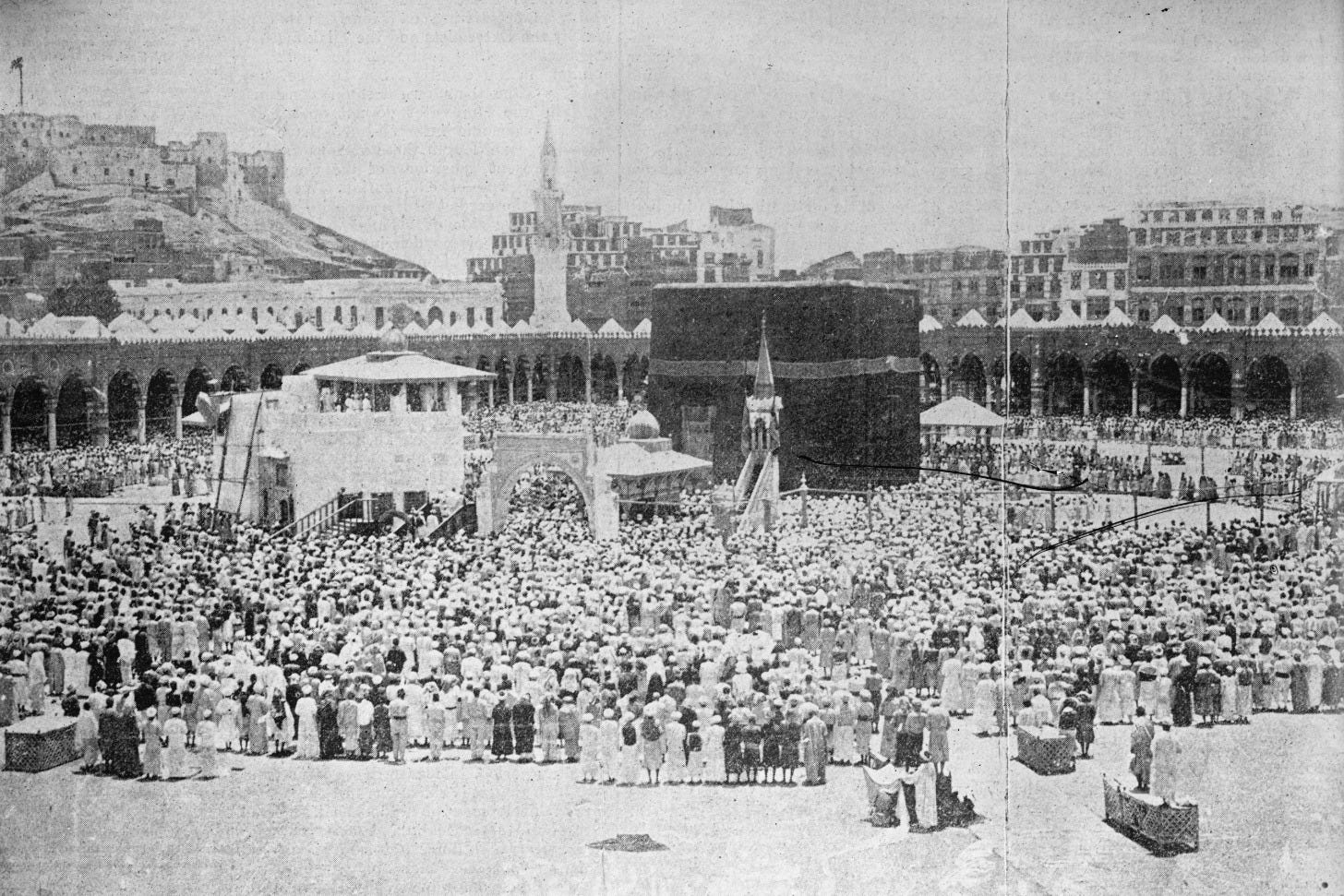
Pilgrims around the Ka’ba | Mecca, ca. 1909–1919 (cropped)
Photo Credit: National Photo Company via Wikimedia Commons
Why do pilgrims at Mecca set aside every sign of rank?
Key Terms for this Lesson
Five Pillars · Shahadah · Hajj
The Shahadah | Right Practice
Every religious tradition is held together by two poles: orthodoxy (Gr. ortho, “right,” and doxa, “belief”) and orthopraxy (Gr. ortho, “right,” and praxis, “practice”). Every tradition has both. No tradition weights them equally. Like Judaism, with its mitzvot (cf. Sec. 9.2), Islam has generally weighted correct practice. A saying of the Prophet names five practices:
Islam is built upon five: bearing witness that there is no god but God and that Muhammad is the Messenger of God, establishing the prayer, giving the zakat, the pilgrimage, and the fast of Ramadan. Sahih al-Bukhari (8, my translation)
With these Five Pillars, a Muslim builds a life.
The first pillar is a sentence, the Shahadah, “testimony.”
لَا إِلٰهَ إِلَّا ٱللّٰهُ مُحَمَّدٌ رَسُولُ ٱللّٰهِ
There is no god but God, and Muhammad is the Messenger of God.
The Shahadah is where Islamic belief and Islamic practice meet, because saying it is the doing of it. Its first clause is the strict monotheism (cf. Sec. 9.2) Muslims call tawhid, literally “to make one.” Whatever one can imagine God to be, the Islamic response is always Allahu Akbar, “God is Greater.” Not great. Greater. Greater than the thought you just had. And this sentence is the door. Say it sincerely, before witnesses, and you are a Muslim: no clergy, no committee, no ceremony.
Zakat, Sawm, & Hajj | The Great Levelers
The next three pillars all have the same job, but from different angles. They level the world in the spirit of Muhammad’s teachings.
Zakat is obligatory almsgiving, the great economic leveler. Each year, a Muslim gives 2.5 percent of the savings he has held for a full year, above a minimum, to those in need. The word means to purify. Zakat is an act of worship, not a tithe, and gifts beyond it are sadaqa, voluntary charity. Zakat is a close kin of the Jewish tzedakah (cf. Sec. 9.6), giving understood not as optional kindness but as an obligation of righteousness.
Sawm is the obligatory fast of Ramadan, the month in which, Muslims hold, the Qur’an was first revealed, the great hunger leveler. From dawn to sunset, Muslims abstain from food and drink. The Qur’an names its own kinship with the older fasts: “Fasting is prescribed for you, even as it was prescribed for those before you” (2:183, trans. Pickthall). And every observant Muslim on earth, prince and poor alike, knows exactly what it feels like to want food and not have it.
The Hajj is the pilgrimage to Mecca, the great class leveler. Once in a lifetime, every Muslim who is able in body and purse is to make it, from the 8th to the 12th or 13th day of the twelfth month. Before entering the sacred precinct of Mecca, every man, of every nation and class and station, puts on the same two plain white cloths, the ihram, and women dress in simple, modest clothing. There are no social classes on Hajj. This was Muhammad’s dream, made visible for one week of the year.
At the center stands the Ka’ba. Pilgrims circle it seven times, then walk seven times between the hills of Safa and Marwa, remembering Hagar’s search for water for her son Ishmael, a story Genesis tells in its own way (Genesis 21:14–19). Afterward, the pilgrim puts his ordinary clothes back on and returns home a hajji. Many keep the white cloth. They will wear it once more as a burial shroud.
Salat | The Tent Pole
Which leaves the fifth pillar: salat, formal prayer, often communal, performed five times daily: at dawn, midday, afternoon, sunset, and night. The name is often traced to a root meaning to bow or bend. It is named for what the body does. The worshipper washes, faces Mecca, stands, bows, then kneels and touches forehead to the floor, and rises again shoulder to shoulder, in ranks, in time.
Five times a day, you stop what you are doing, wash, and put your face on the ground, often in a room full of people doing the same thing at the same moment. There is nothing casual about it and nothing convenient about it.
Salat is called the “tent pole” of Islam, and in a sense it contains all five pillars at once. In prayer, the Shahadah is recited. The five prayers take about 36 minutes out of 24 hours, some 2.5 percent of the day, the zakat proportion in time instead of money. Throughout, the worshipper abstains from food and drink, a sawm in miniature. And every prayer faces the Ka’ba, a brief Hajj, made from anywhere a Muslim may find herself.
At dawn tomorrow, hundreds of millions of people will wash, turn toward the same cube in the same desert valley, and put their foreheads on the ground. Sunni and Shia (cf. Sec. 11.1). The same words, under the same sun, in the same direction.
The Ummah may never agree on who leads.
But in prayer, it all faces the same way.
Sec 11 • Early Islam
11.1 History & Politics • The Caliphate
11.2 Literature & Drama • The Qur’an & Hadith
11.3 Philosophy • The House of Wisdom
11.4 Religion • The Five Pillars
11.5 Music • The Call & Qur’anic Recitation
11.6 Art & Architecture • Mosque, Calligraphy, & Arabesque
Course Page: Humanities I & II