

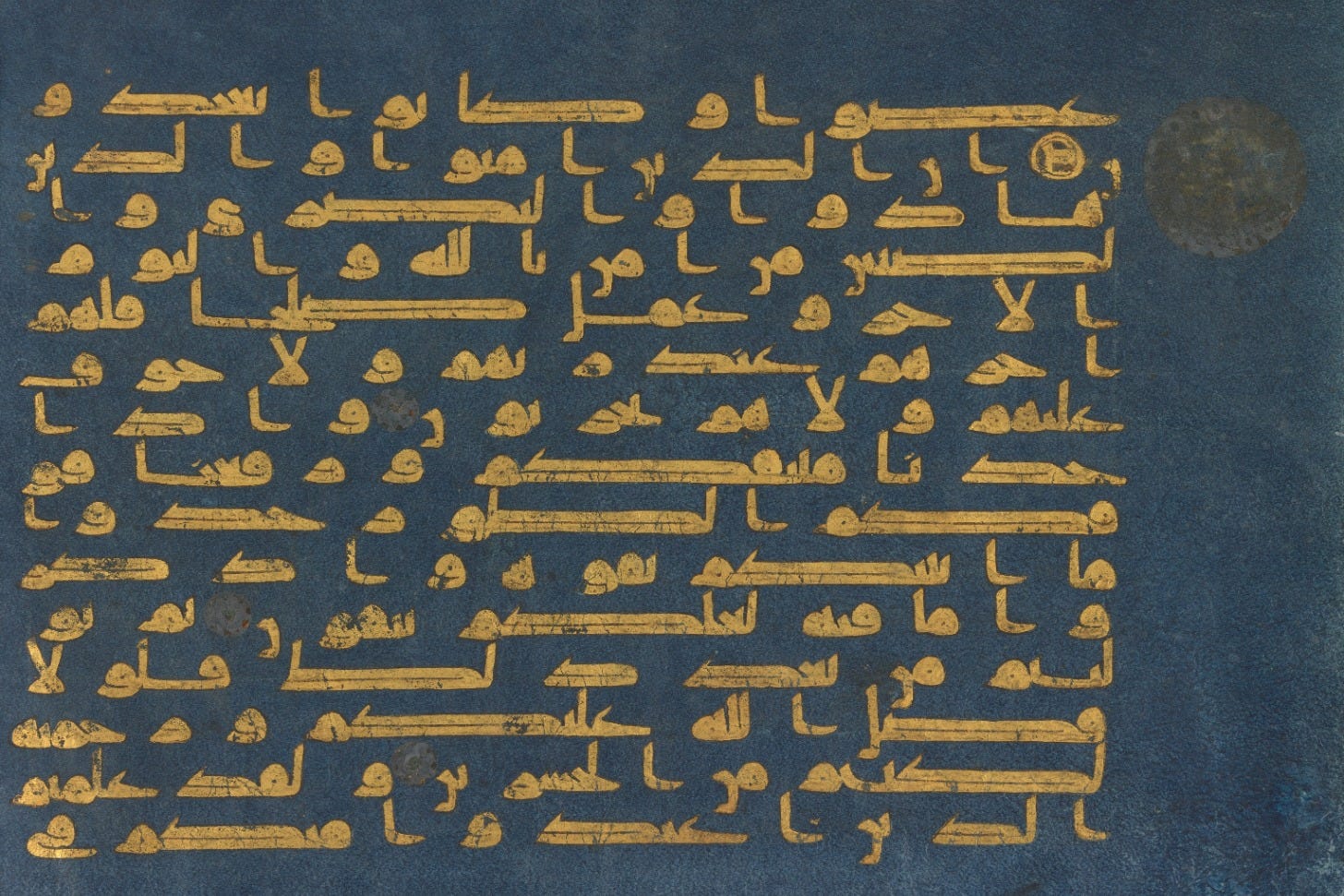
The Blue Qur’an | North Africa, 9th–10th century CE (cropped)
Why would a man travel for a month to hear one saying?
Key Terms for this Lesson
Qur’an · Hadith · Isnad
The Recitation | 610–632 CE
The Arabic word Qur’an does not mean “book.” It means Recitation, from the same root as the first command that, Muslims hold, the angel gave Muhammad in 610 CE, iqra’, “Read!” or “Recite!” (cf. Sec. 11.1). Taken from their etymological bases, the Jewish Torah is a teaching (cf. Sec. 9.5). The Gospels are good news (cf. Sec. 10.2). And the Qur’an is a recitation. Muslims hold that these were its first words:
Read: In the name of thy Lord Who createth, Createth man from a clot. Read: And thy Lord is the Most Bounteous, Who teacheth by the pen, Teacheth man that which he knew not. The Meaning of the Glorious Koran (96:1–5, trans. Marmaduke Pickthall)
The Qur’an was heard before it was ever read as text. Islamic tradition holds that it was “sent down” in installments across 23 years of Muhammad’s ministry. With each installment, Muhammad recited the new verses to his Companions, who memorized them, recited them to others, and wrote some of them on whatever lay to hand: pieces of bone, scraps of leather, the flat ribs of palm leaves.
Muslims hold that the Qur’an’s speaker is God, often in the “We” of Arabic majesty: “Thus We have appointed you a middle nation” (2:143, trans. Pickthall). Like the Bible, it speaks of Adam, Noah, Abraham, Moses, and Jesus, whom it honors as a prophet and calls the Messiah. Mary is the only woman it names, and a whole chapter carries her name.
The Book | ca. 650 CE
At the Prophet’s death, there was no Qur’an between two covers. The revelation survived in the memories of his Companions and on those scattered scraps. Tradition holds that Abu Bakr had a first copy gathered. Around 650 CE, the caliph Uthman set scholars to checking the written verses against the memories of the surviving Companions, and a single authoritative written edition was sent across the empire (cf. Sec. 11.1). Muslims hold that the text Uthman sent out is the one recited by nearly two billion Muslims today.
The Qur’an defies most of our literary expectations. It has little narrative continuity and almost no chronological order. Its 114 chapters, the surahs, run (after the short opening) mostly from longest to shortest, so a reader who starts at the beginning reads the laws of Medina before the thunder of Mecca. Each surah is made of verses called ayas, “signs.”
The Qur’an is also the first book of the Arabic language. Before it, Arabic was the speech of a peninsula, kept alive in poetry recited around fires. After it, Arabic became the liturgical language of an empire. And because Muslims hold that the Arabic is the revelation, any translation is regarded as an interpretation: useful, common, and secondary. In worship, the Qur’an is recited in Arabic from Indonesia to Ohio. A hafiz (“guardian”) has memorized all 114 surahs. There are millions alive today, many of them children.
The Hadith | 632–870 CE
After Muhammad’s death, the Ummah faced a great variety of questions the Qur’an does not answer in detail. So the community looked first to the Companions, and their stories became the beginnings of the Hadith: the reports of the words and deeds of Muhammad not found in the Qur’an. Together they record his Sunnah, his custom (cf. Sec. 11.1). Most Muslims hold that the Hadith clarify the Qur’an and never replace it.
For the better part of two centuries, the Hadith passed largely by word of mouth, and not every report was true. So the practice of looking back on the accounts of eyewitnesses to Muhammad became a research skill in and of itself. Every report came with its isnad, its chain of transmission: A heard it from B, who heard it from C, who heard the Prophet say… Scholars weighed each link. Did these two men ever meet? Was this narrator known to be honest, and was his memory sound? Entire schools of thought will swing on the hinge of a teaching’s credibility via its isnad.
So a chain was worth a journey. The scholar al-Bukhari (d. 870 CE) records that the Companion Jabir ibn Abdullah “traveled a month’s journey to Abdullah ibn Unays for a single hadith” (Sahih al-Bukhari, Book of Knowledge, ch. 19, my translation). To hear a saying from the man who heard it, rather than from a stranger who heard it secondhand, was to shorten the chain by a link.
The greatest collector was al-Bukhari himself. By the tradition’s count, he weighed some 600,000 reports and kept about 7,000 (counting repeats) in his Sahih, “the Sound.” For Sunni Muslims, it is the most trusted book after the Qur’an. Shia Muslims keep their own collections, weighing chains that run through Ali and the family of the Prophet. Like the Talmud beside the Torah (cf. Sec. 9.5), the Hadith became a second, written record of a teaching first carried by memory.
Sec 11 • Early Islam
11.1 History & Politics • The Caliphate
11.2 Literature & Drama • The Qur’an & Hadith
11.3 Philosophy • The House of Wisdom
11.4 Religion • The Five Pillars
11.5 Music • The Call & Qur’anic Recitation
11.6 Art & Architecture • Mosque, Calligraphy, & Arabesque
Course Page: Humanities I & II