

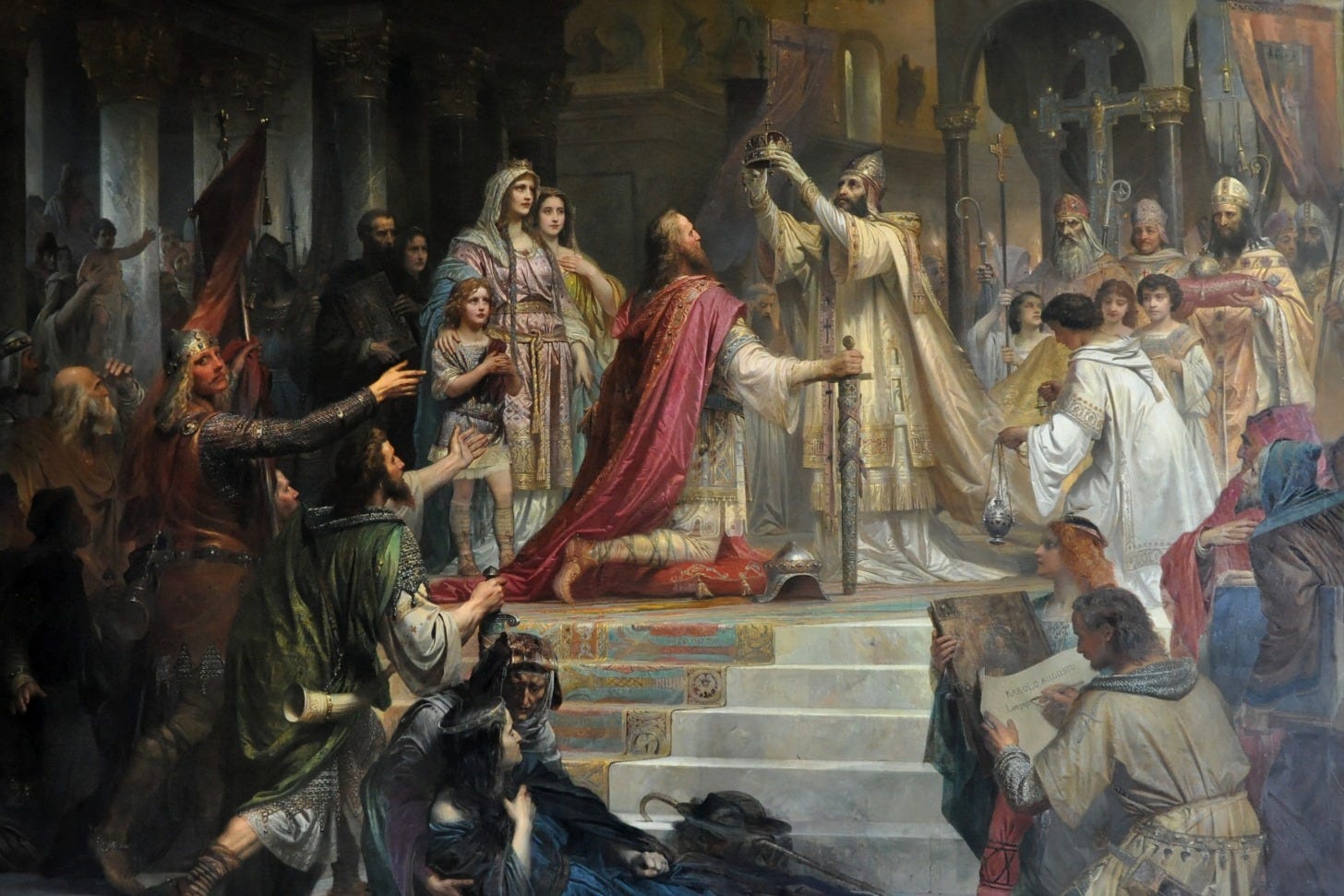
The Coronation of Charlemagne | Friedrich Kaulbach, 1861
Why did a pope crown Charlemagne emperor of the Romans?
Key Terms for this Lesson
Holy Roman Empire · Missi Dominici · Feudalism
Rome to the Franks | 476–800 CE
• 476 CE | The last emperor in the West, Romulus Augustulus, is deposed
• 732 CE | Charles Martel turns back an Umayyad army near Tours
• 800 CE | Charlemagne is crowned emperor in Rome
• 843 CE | The Treaty of Verdun divides Charlemagne’s empire among his grandsons
• 962 CE | Otto I is crowned emperor in Rome
In 476 CE, a Germanic general deposed the last emperor in the West, a boy named Romulus Augustulus. Rome’s empire did not end that day. It moved east. Constantinople kept the Roman name, the Roman law, and the Roman throne (cf. Sec. 10.1), while the old western provinces broke into kingdoms ruled by Germanic peoples: Goths, Lombards, Burgundians, and Franks.
The Franks held Gaul (~France). Their king Clovis (d. 511 CE) was baptized into the Latin Church around 500 CE, and the Franks would become the popes’ chief allies in the West. Clovis’ heirs let their power pass to their chief ministers. One of these ministers, Charles Martel (d. 741 CE), “the Hammer,” defeated an Umayyad army from Spain near Tours in 732 CE (cf. Sec. 11.1). His son Pepin the Short (d. 768 CE) took the crown in 751 CE with the pope’s blessing. In 754 CE, Pope Stephen II crossed the Alps to ask for his help, and Pepin defended Rome against the Lombards.
Pepin’s son Charles is Charlemagne, Charles the Great (Lt. Carolus Magnus), and his name gives his dynasty its name, Carolingian. His wars almost doubled the Frankish kingdom. By 800 CE, Charlemagne’s empire included most of Western Europe: France, Germany, the Low Countries, and much of Italy.
The Coronation | 800 CE
Charlemagne received a papal coronation in Saint Peter’s Basilica in Rome on Christmas Day, 800 CE, by Pope Leo III (d. 816 CE). He was the first emperor in the West in more than three centuries.
Why? Leo needed a protector. In 799 CE his enemies in Rome had attacked him in the street, and he fled across the Alps to Charles. And in Western eyes, the throne of the Caesars stood empty. In Constantinople, the Empress Irene (d. 803 CE) ruled in her own name, and many in the Latin West held that a woman could not hold the imperial title. The pope gained a sword. And Rome gave Charles an authentic claim to the long-lost Roman throne of Caesars and emperors.
Charlemagne’s friend and biographer, Einhard (d. 840 CE), tells it differently:
It was then that he received the title of Emperor and Augustus, which he so disliked at first that he affirmed that he would not have entered the church on that day—though it was the chief festival of the church—if he could have foreseen the design of the Pope. Life of Charlemagne (28, trans. A. J. Grant)
Historians still argue over that reluctance. It may be modesty. It may be that Charles disliked receiving his crown from a pope’s hands. In 813 CE, he made his own son Louis co-emperor at Aachen, with no pope in the room.
The Byzantine court saw the coronation as a rebellion, and Charlemagne as a political and religious rival. The caliph in Baghdad was friendlier. Harun al-Rashid (d. 809 CE) (cf. Sec. 11.3) sent robes, spices, and an elephant named Abul-Abbas, which reached Aachen in 802 CE.
Charlemagne’s realm was not yet called the Holy Roman Empire. His seal read Renovatio Romani Imperii, “the renewal of the Roman Empire.” The Holy Roman Empire names the realm of the German kings crowned emperor in Rome, beginning with Otto I (d. 973 CE) in 962 CE. The full name first appears in 1254, and the empire lasts until 1806. Charlemagne is its father in memory. Otto is its founder in fact.
Lords & Vassals | 800–1000 CE
The Carolingian government borrowed Roman forms and titles. The emperor issued decrees, called capitularies, on a wide variety of secular and religious matters. The missi dominici (Lt. envoys of the lord) carried the emperor’s will to the provinces. They traveled in pairs, usually a count and a bishop, to read the decrees aloud, hear complaints, and check on local officials. Sharing these royal decrees required a degree of literacy that might surprise many (cf. Sec. 12.4).
The Carolingian Empire was largely rural, which means it was mostly farmland as opposed to cities. Charlemagne bound its great men to him with oaths and gifts of land. After his death in 814 CE, his son Louis the Pious held the empire together. Louis’ sons did not. At Verdun in 843 CE, they divided it into three kingdoms. West Francia would become France, and East Francia, Germany.
Then came the raiders: Vikings from the north, Magyars from the east, and Muslim raiders from the Mediterranean. Kings were far away. Local lords were close. Out of that need grew feudalism, land given in exchange for loyalty. Under feudalism, a lord granted an estate, a fief (Lt. feudum), to a vassal. The vassal knelt, placed his hands between the lord’s, and swore to fight for him. Beneath them both worked the serfs. A serf was not owned like a slave, but he was bound to the land and owed its lord his labor. Historians debate whether one word can cover so many local customs, and the word feudalism itself was coined centuries later.
In 962 CE, the German king Otto I was crowned in Rome, as Charlemagne had been. The empire that would one day call itself Holy and Roman had begun.
Sec 12 • The Holy Roman Empire
12.1 History & Politics • Charlemagne & Feudal Europe
12.2 Literature & Drama • Beowulf & the Heroic Code
12.3 Religion • Monks, Popes, & Canon Law
12.4 Philosophy • The Trivium & the Carolingians
12.5 Art & Architecture • Romanesque & the Book of Kells
12.6 Music • Gregorian Chant
Course Page: Humanities I & II