

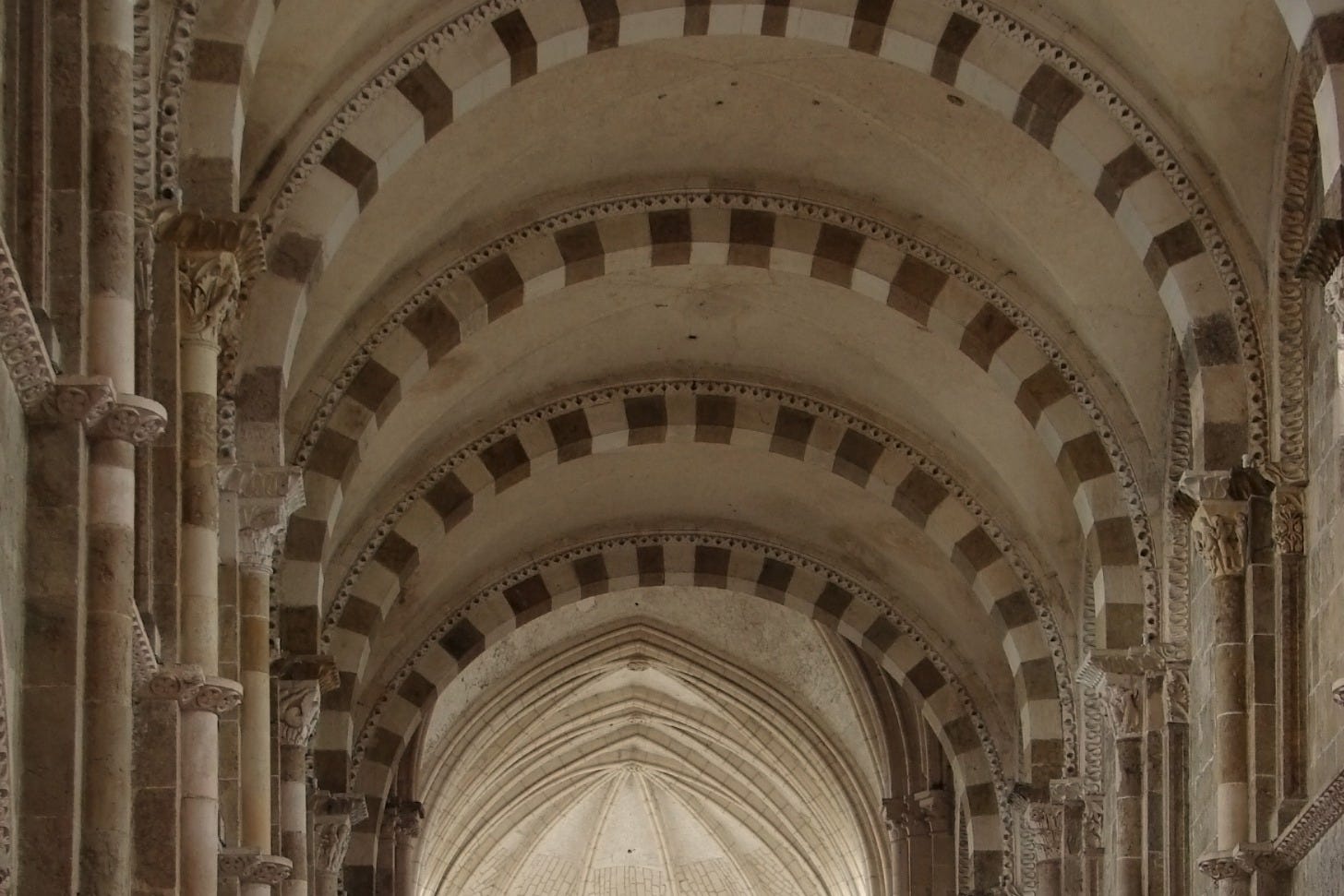
Basilica of Sainte-Marie-Madeleine | Vézelay, France, ca. 1140
Photo Credit: Vassil via Wikimedia Commons
Why did monks build churches for crowds of strangers?
Key Terms for this Lesson
Illuminated Manuscript · Book of Kells · Romanesque
The Book of Kells | ca. 800 CE
A defining art of the age of Charlemagne was the illuminated manuscript, a book copied by hand and decorated with color, and often gold, so that its pages seem to give off light (Lt. illuminare, to light up). These books were written on parchment (animal skins) in the monastery’s scriptorium, its writing room (cf. Sec. 12.3), and most of them held sacred texts like the Gospels or the Psalms. Charlemagne’s own Dagulf Psalter (ca. 783–795 CE) was bound in carved ivory.
One of the finest came from the edge of the known world. The Book of Kells is a Latin copy of the four Gospels, made around 800 CE by Irish monks, probably begun at the monastery of Iona off the coast of Scotland. When Viking raids struck Iona, its monks moved to Kells in Ireland, and the book went with them. Today its 340 calfskin leaves are kept at Trinity College, Dublin. An older cousin, the Lindisfarne Gospels (ca. 715 CE), is credited to Eadfrith, bishop of Lindisfarne.
Almost every page of the Book of Kells is alive. Its painters wove spirals, knots, and ribbon-like animals into the letters, a style shared with Irish metalwork and with the gold of Sutton Hoo (cf. Sec. 12.2). On its most famous page, the Greek letters chi and rho (cf. Sec. 10.1) begin Matthew’s account of Jesus’ birth (Matthew 1:18) and fill the whole page. Look closely, and there are cats, mice, otters, and moths hidden in the design. Like the Muslim calligraphers of the same centuries (cf. Sec. 11.6), the Irish monks made the sacred word itself into the picture.
Around 1185, the Welsh churchman Gerald of Wales (d. ca. 1223) saw a similar Gospel book at Kildare, now lost, and wrote down what close looking showed him:
But if you apply yourself to a more close examination, and are able to penetrate the secrets of the art displayed in these pictures, you will find them so delicate and exquisite, so finely drawn, and the work of interlacing so elaborate, while the colours with which they are illuminated are so blended, and still so fresh, that you will be ready to assert that all this is the work of angelic, and not human, skill. Topography of Ireland (2.38, trans. Thomas Forester)
From Aachen to the Pilgrim Roads | 792–1100 CE
Charlemagne modeled much of what he did on ancient Rome, and his palace at Aachen was no different. The Palatine Chapel at Aachen, consecrated in 805 CE, was modeled after San Vitale in Ravenna, a church of the emperor Justinian’s age. Einhard says the king had its marble columns brought from Rome and Ravenna. Tradition says his stone throne, raised on six steps, was modeled after the throne of King Solomon (1 Kings 10:19).
Two centuries later, the roads filled. In the 1000s, pilgrimages became popular as travel became safer. Thousands of pilgrims walked each year to the shrine believed to hold the apostle James at Santiago de Compostela in Spain, and to Rome. Monasteries along the way needed churches that could hold them. The pilgrimage church answered with a long nave, side aisles that continued around the altar in a walkway called the ambulatory, and small chapels opening off it. Crowds of strangers could move through the church while the monks kept their hours of prayer (cf. Sec. 12.3). And the pilgrims’ gifts helped pay for the building. The greatest monastery of the age, Cluny in Burgundy (founded 910 CE), raised a church that stayed the largest in Western Christendom for some four hundred years.
Stone & Sculpture | 1000–1150 CE
The style of these churches is called Romanesque, “Roman-like,” for its round Roman arches and heavy stone vaults (cf. Sec. 8.4). The name was coined in the 1800s. Builders laid the old Roman basilica plan (cf. Sec. 10.6) in the shape of a cross, then roofed it in stone. Heavy stone arches and vaults gave the church a fireproof stone roof. Keep in mind that there is no electricity at this time, and the risk of fire is ever-present. In a church lit by candles, a wooden roof could burn, and many did.
A stone roof demanded thick walls, and thick walls allowed only small windows. That brought a notable lack of interior light. This drove much of the decoration outside. Over the main doorway, the portal, carvers filled the tympanum, a half-moon of stone, with scenes for the pilgrims to read before they entered. At Vézelay, a starting point for the road to Santiago, the tympanum shows Christ sending the apostles out to the nations of the world (Mark 16:15). Carved capitals atop the columns told more stories.
Within a few generations, builders in France would find a way to raise the walls higher and open them to light (cf. Sec. 13.5). But the Romanesque church came first, built of stone to last, and big enough to welcome the world.
Sec 12 • The Holy Roman Empire
12.1 History & Politics • Charlemagne & Feudal Europe
12.2 Literature & Drama • Beowulf & the Heroic Code
12.3 Religion • Monks, Popes, & Canon Law
12.4 Philosophy • The Trivium & the Carolingians
12.5 Art & Architecture • Romanesque & the Book of Kells
12.6 Music • Gregorian Chant
Course Page: Humanities I & II