

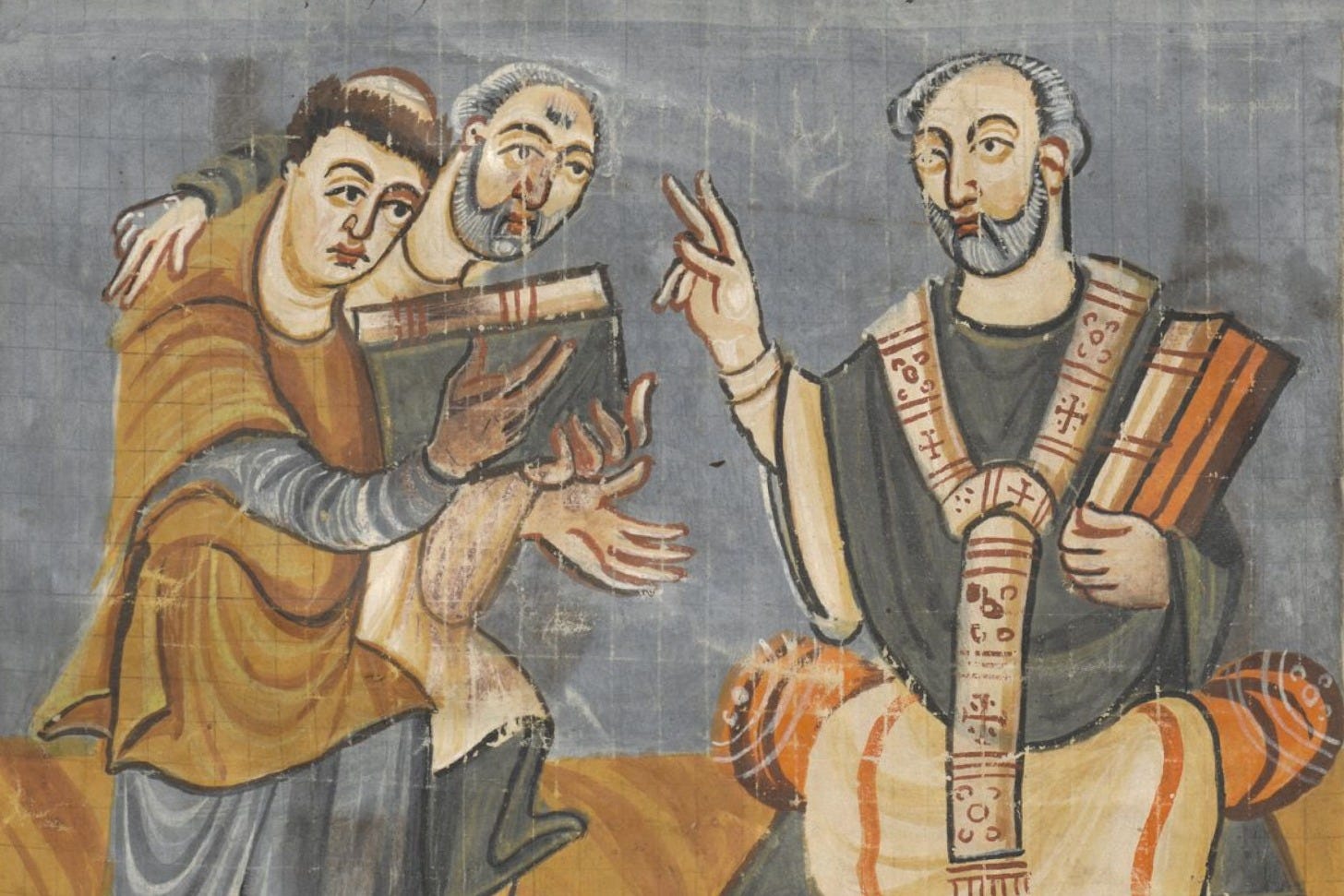
Alcuin Presents Rabanus Maurus to Otgar of Mainz | Fulda, ca. 831–840 CE
Why did a king who never learned to write build schools?
Key Terms for this Lesson
Carolingian Renaissance · Liberal Arts · Trivium
The Palace School | 781–814 CE
In addition to his wars and his laws, Charlemagne had a huge impact on education. Literacy, the ability to read and write, belonged mostly to the clergy and a few nobles. The emperor himself spoke Latin as well as his native Frankish, Einhard says, and could understand Greek better than he could speak it. But writing never came:
He tried also to learn to write, and for this purpose used to carry with him and keep under the pillow of his couch tablets and writing-sheets that he might in his spare moments accustom himself to the formation of letters. But he made little advance in this strange task, which was begun too late in life. Life of Charlemagne (25, trans. A. J. Grant)
So Charlemagne gathered scholars who could. In 781 CE he met Alcuin of York (d. 804 CE) in Italy and brought him to run the Palace School at Aachen. Einhard calls Alcuin “the most learned man of his time.” From Italy came the grammarian Peter of Pisa and the historian Paul the Deacon, and from Spain the poet Theodulf. The king studied with them, and they gave each other nicknames: Charlemagne was “David,” Alcuin “Flaccus.”
Why? Charlemagne’s own letter to the abbot of Fulda answers in plain terms. Letters had reached him from monasteries full of errors, and he began to fear “that, as their skill in writing was less, so too their wisdom for understanding the holy scriptures might be far less than it rightly ought to be” (On the Cultivation of Letters, ca. 785 CE, my translation). After all, church leaders can’t read from the Bible if they haven’t been taught to read. So in 789 CE, Charlemagne ordered every monastery and cathedral to keep a school where boys would learn the Psalms, writing, chant, reckoning, and grammar (Admonitio Generalis 72).
The result is called the Carolingian Renaissance, the revival of learning, books, and the arts under Charlemagne and his heirs. It predates the Italian Renaissance by hundreds of years, but it shares some of the same features. Much of what survives of ancient Rome’s literature survives in Carolingian copies. Alcuin presented a corrected Latin Bible to Charlemagne in 800–801 CE. A new, clear script, Carolingian minuscule, gave Europe the ancestor of the lowercase letters on this page. Even laywomen read and wrote: the noblewoman Dhuoda wrote a handbook of Christian living for her son around 843 CE.
The Seven Liberal Arts | ca. 400–800 CE
What did those schools teach? The liberal arts, the studies fit for a free person (Lt. liber, free), the heirs of Rome’s humanitas (cf. Sec. 1.1). Late Roman scholars had set their number at seven. Martianus Capella (fl. ca. 420 CE) pictured them as seven handmaids at a wedding of the gods, and Boethius named the second group of four. Alcuin wrote textbooks on them, one as a dialogue between himself and the king.
The seven fell into two groups:
• Trivium (Lt. three roads) | grammar (reading and writing), rhetoric (speaking), and dialectic (logic)
• Quadrivium (Lt. four roads) | arithmetic, geometry, music, and astronomy
The scheme essentially divided fields of study into verbal arts and numeric arts. Music has a lot to do with numbers (cf. Sec. 6.4), and so it was grouped with the quadrivium. The trivium came first, and grammar came first within it, because Latin grammar opened every other book: the Bible, the Church Fathers, and the classics. Consider how this compares to modern curriculum in college, where general-education courses (this one included) come before the major.
Boethius & the Old Logic | 480–877 CE
The Carolingian scholars did their philosophy with the books Rome had left them. The most important came from Boethius (d. ca. 524 CE), a Roman senator in the service of a Gothic king. Boethius planned to translate all of Plato and Aristotle into Latin (cf. Sec. 7.6). He finished only a few of Aristotle’s books on logic before he was accused of treason and imprisoned. For six centuries, those few translations were most of what Western Europe knew of Aristotle, until new translations, many from Arabic (cf. Sec. 11.3), reached the Latin schools (cf. Sec. 13.6).
Awaiting execution, Boethius wrote The Consolation of Philosophy. In it, Lady Philosophy visits his cell and teaches him that fortune cannot touch the good. Philosophy, speaking as Fortune, says: “I turn the wheel that spins. I delight to see the high come down and the low ascend” (2.2, trans. H. R. James). The Consolation became one of the most copied books of the Middle Ages, and Alfred the Great of England translated it into Old English.
Charlemagne’s own favorite was Augustine. At dinner, Einhard says, he had The City of God read to him (cf. Sec. 10.5), and its picture of a heavenly city shaped the Carolingian idea of a Christian empire. A generation later, at the court of Charlemagne’s grandson, the Irish scholar John Scotus Eriugena (d. ca. 877 CE) read Greek theology in the original and wrote the most ambitious philosophy of the age. The schools had done their work.
Sec 12 • The Holy Roman Empire
12.1 History & Politics • Charlemagne & Feudal Europe
12.2 Literature & Drama • Beowulf & the Heroic Code
12.3 Religion • Monks, Popes, & Canon Law
12.4 Philosophy • The Trivium & the Carolingians
12.5 Art & Architecture • Romanesque & the Book of Kells
12.6 Music • Gregorian Chant
Course Page: Humanities I & II