

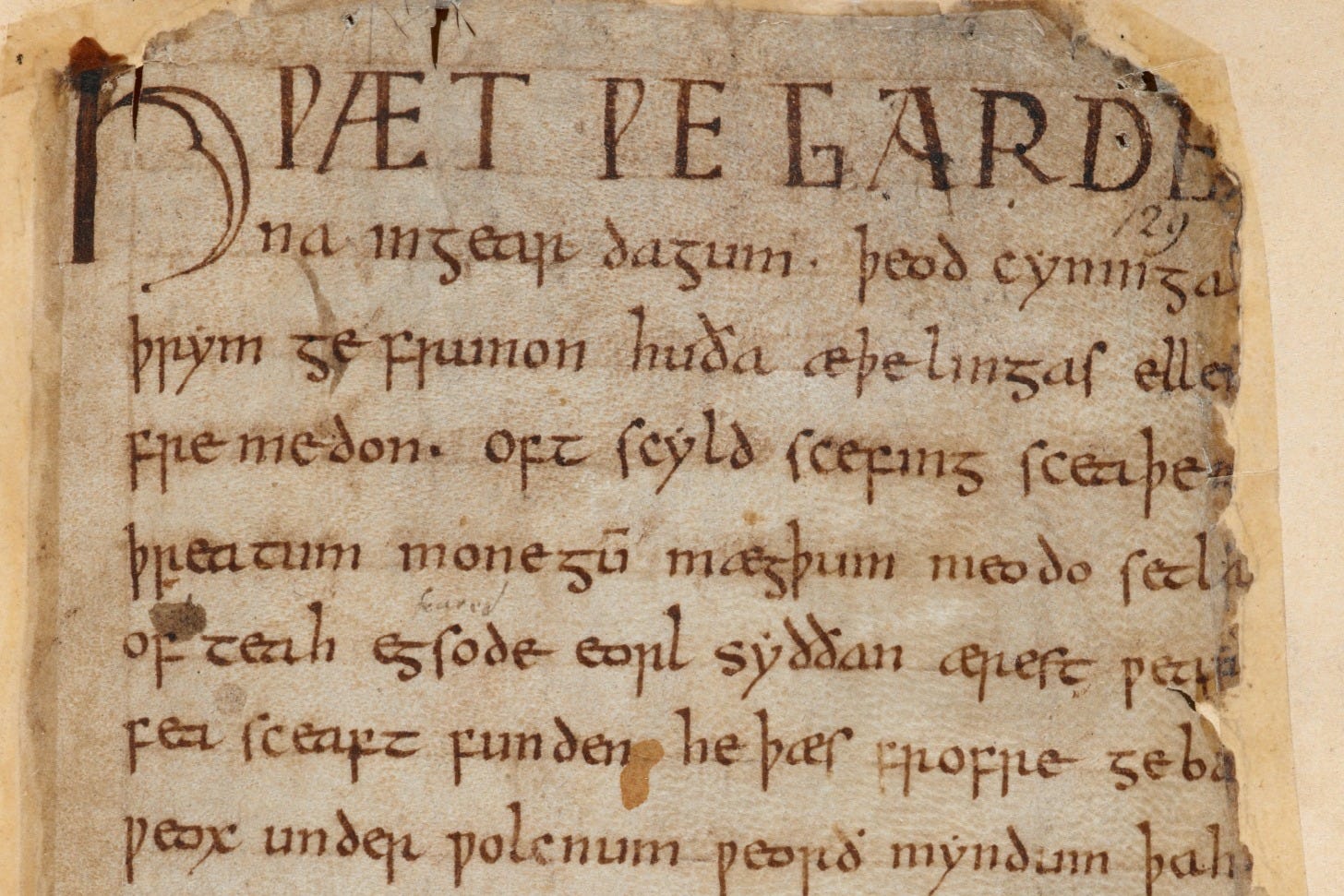
Beowulf, folio 132r | British Library, ca. 1000 CE
Why did a good king give away his gold?
Key Terms for this Lesson
Beowulf · Heroic Code · Kenning
The Poem & the Manuscript | ca. 700–1000 CE
Charlemagne, Einhard tells us, “wrote out the barbarous and ancient songs, in which the acts of the kings and their wars were sung” (Life of Charlemagne 29). Not one of those Frankish songs survives. Across the Germanic North, kings and warriors heard the deeds of their ancestors sung in the hall by a scop (OE. shaper), an oral poet much like Homer’s singers (cf. Sec. 6.2). Almost all of that singing is lost.
One great poem came through. Beowulf is the longest epic poem in Old English, 3,182 lines, and it survives in a single manuscript copied around 1000 CE. That book nearly burned in a London library fire in 1731, and its edges are still scorched. When the poem itself was composed is disputed: some scholars place it in the 700s, others closer to the copy.
The poem was written in England, by and for the Anglo-Saxons, but it is set in their ancestors’ homeland, in Denmark and southern Sweden in the 500s. One of its kings, Hygelac, even turns up in a Frankish history of the period, killed on a raid around 520.
Its world is real in another way. In 1939, at Sutton Hoo in Suffolk, archaeologists uncovered the burial of an East Anglian king, laid in a 27-meter ship around 625 CE with his helmet, his sword, and a gold buckle. The poem opens with a ship funeral much like it, a dead king laid “on the breast of the boat” with “a heaped hoard” beside him.
Heorot, Grendel, & the Dragon | The Story
The Danish king Hrothgar builds a great hall, Heorot, where his scop sings of how the Almighty made the earth. The song enrages a monster of the moors, Grendel. The poet names Grendel’s ancestor plainly: he is of the “kin of Cain” (cf. Genesis 4:8). For twelve years, Grendel raids the hall by night.
Across the sea, a young warrior of the Geats hears the news. Beowulf sails to Denmark with fourteen companions and meets Grendel in the dark with his bare hands. The monster flees, mortally wounded. When Grendel’s mother comes for revenge, Beowulf follows her to her lair beneath a lake and kills her too. Hrothgar loads him with gifts: a golden banner, a helmet, a mail-shirt, a sword, and eight horses.
Fifty years later, Beowulf is the old king of the Geats. A dragon wakes over a stolen cup and burns the land. Beowulf goes out to fight it, and his chosen men run for the woods. Only young Wiglaf stays. Together they kill the dragon, but Beowulf is mortally wounded. The poem ends at his barrow by the sea, where twelve riders circle and sing his praise.
The Heroic Code | Gold, Loyalty, & Fame
The poem’s world runs on the heroic code, the bond of gift and loyalty between a lord and his warriors. The Roman historian Tacitus (d. ca. 120 CE) had described it among the Germanic tribes centuries earlier, in his Germania (14): the chief fights for victory, and his companions fight for their chief. Latin calls the war band the comitatus. The lord gives treasure, land, food, and a place in the hall. The warrior gives courage and, if it comes to that, his life. Fame (OE. lof) is the reward that outlives both. Achilles, too, had refused to fight when a prize of honor was taken from him (cf. Sec. 6.2).
That is why the good king gives away his gold. A hoard kept in the treasury buys nothing. A ring given in the hall buys loyalty. The poem says it outright in its opening lines:
So becomes it a youth to quit him well / with his father’s friends, by fee and gift, / that to aid him, aged, in after days, / come warriors willing, should war draw nigh, / liegemen loyal: by lauded deeds / shall an earl have honor in every clan. Beowulf (20–25, trans. Francis B. Gummere)
Hrothgar warns Beowulf of the opposite king. Heremod of the Danes grew proud, and “no bracelets gave he / to Danes as was due” (1719–1720). He ended alone, cut off from his own men. The dragon is the code’s last image: a hoard guarded for its own sake, and useless. Beowulf’s men break the code at the end, and Wiglaf keeps it. As the poet says, with bitter accuracy, the treasure goes into the barrow, “useless to men as of yore it was.”
The poet’s language is a craft of its own. Old English verse is built on stressed sounds that begin alike (alliteration), and on the kenning, a short compound metaphor that names a thing by a picture of it. The sea is the hronrad, the “whale-road.” The body is the banhus, the “bone-house.” A sword is the beadoleoma, the “battle-light.” A king is a “ring-giver,” named for the very act that made him good.
The poet was a Christian, writing of his pagan ancestors. He gives them his own Bible’s Creator, Cain, and Abel, and he lets them keep their own code. The last word of the poem is their highest praise: Beowulf was “keenest for praise.”
Sec 12 • The Holy Roman Empire
12.1 History & Politics • Charlemagne & Feudal Europe
12.2 Literature & Drama • Beowulf & the Heroic Code
12.3 Religion • Monks, Popes, & Canon Law
12.4 Philosophy • The Trivium & the Carolingians
12.5 Art & Architecture • Romanesque & the Book of Kells
12.6 Music • Gregorian Chant
Course Page: Humanities I & II