

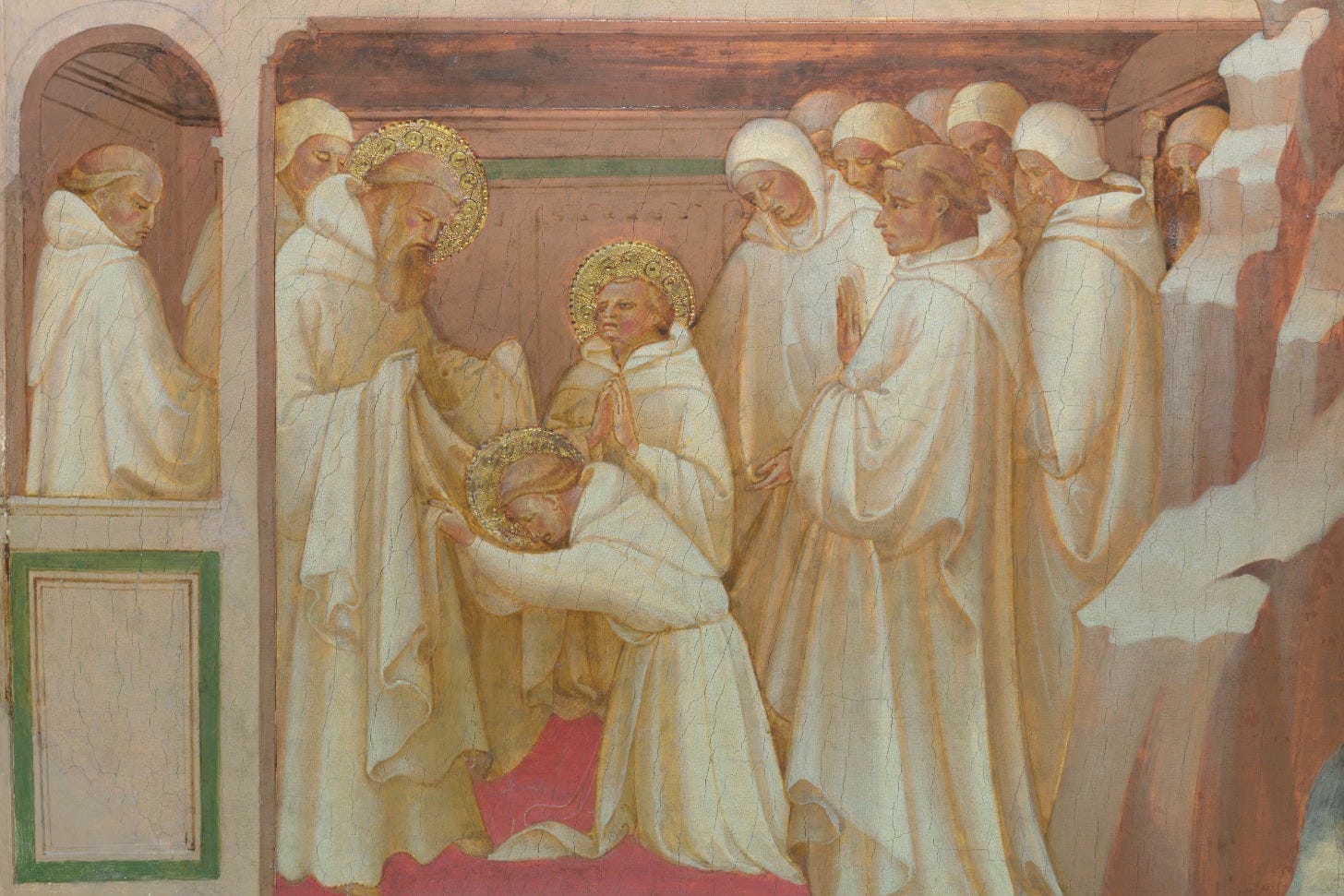
Saint Benedict Admitting Saints into the Order | Lorenzo Monaco, ca. 1409
Why did monks vow to stay in one place for life?
Key Terms for this Lesson
Rule of St. Benedict · Papacy · Canon Law
Benedict & the Rule | ca. 480–547 CE
Christian monks began in the deserts of Egypt, where men like Anthony (d. 356 CE) went out alone to pray. By 500 CE, the early practices of monks and nuns in the West were diverse. They had varied expectations for how they should live, and no predominant rule to govern their practices. Irish monks kept their own strict customs. Some Italian monks lived a very simple life in small houses. And there were many wandering monks who traveled from town to town.
The Rule of Saint Benedict changed all that. Benedict of Nursia (d. ca. 547 CE) founded his monastery at Monte Cassino, south of Rome, around 529 CE, and wrote its rule in the decade that followed. The Rule of St. Benedict is a handbook of 73 short chapters for monks living together under an abbot. It has been called the Magna Carta of monasticism in the West, and for good reason. Like the Magna Carta, a political document written in England nearly 700 years later, the Rule establishes the role of the leadership and the responsibilities and liberties of followers. The abbot (from Aramaic abba, father) rules, but he must consult the whole community before any important decision (Rule 3).
Benedict’s first chapter describes the kinds of monks he did not want. The worst were the gyrovagues, who pass their lives drifting from one house to the next, “always roaming and never stable” (Rule 1, my translation). Benedict’s answer was a vow. On the day a new monk was received, he stood in the chapel and made his promise:
Let him promise, before all, his stability, the conversion of his way of life, and obedience, before God and His saints. Rule of St. Benedict (58, my translation)
Stability (Lt. stabilitas) bound a monk to one community and one abbot for life. Conversatio morum meant fidelity to the monastic way of life. And obedience meant the abbot’s word, given in the Rule’s spirit. The monastery became a family that could not be walked away from, and Benedict called it “a school for the Lord’s service” (Prologue, my translation).
The Monastery’s Day | 529–817 CE
A Benedictine day balanced prayer, work, and study. Seven times each day, and once in the night, the monks gathered in the church to chant the Divine Office. Benedict took the schedule from the Psalms: “Seven times a day do I praise thee” (Psalm 119:164), and “At midnight I will rise to give thanks unto thee” (Psalm 119:62). Over each week, the monks sang all 150 Psalms (Rule 18, cf. Sec. 9.4). Between the hours, they farmed, copied books, and read.
Charlemagne admired the Rule. He sent to Monte Cassino for an exact copy, and his son Louis the Pious made the Rule binding on every monastery in the empire at Aachen in 816–817 CE. In the countryside, a monastery was more than a dwelling for men who dedicated their lives to God. A monastery was like a community center. It held the region’s school, library, infirmary, and guesthouse. It was often the most secure structure for miles, and it provided needed aid to impoverished peasants. “All guests who arrive should be received as Christ” (Rule 53, my translation).
Women took the same vows. Tradition holds that Benedict’s sister, Scholastica (d. ca. 543 CE), led a community of nuns nearby. In England, the abbess Hilda of Whitby (d. 680 CE) ruled a house of both monks and nuns, and five of her monks became bishops. Later, the abbess Hildegard of Bingen would write and compose (cf. Sec. 13.4).
Popes & Canon Law | 440–1000 CE
Monks prayed apart from the world. Bishops governed the Church within it. Since the apostles’ time, Christians had honored Rome as the city where, by early tradition, Peter and Paul were martyred. The papacy is the office of the bishop of Rome, the pope. The title pope (Lt. papa, father) had been an honorary title of respect for senior bishops. Pope Leo the Great (d. 461 CE) built a legal argument that the bishop of Rome held authority over the whole Church, from Jesus’ words to Peter (Matthew 16:18). The Eastern patriarchs answered that Rome was first in honor among equals. The question would split Christendom in 1054 (cf. Sec. 13.1).
Gregory the Great (d. 604 CE) was a monk before he was pope, and he wrote the only early life of Benedict. He called himself “servant of the servants of God” (servus servorum Dei), and he sent the monks who reached England in 597 CE to convert the Anglo-Saxons of Beowulf’s England (cf. Sec. 12.2).
The Church governed itself by canon law, the body of rules made by councils and popes. The word comes from the Greek kanōn, a measuring rod. Its first sources were the canons of councils like Nicaea, which issued twenty (cf. Sec. 10.3), and the popes’ letters of judgment, called decretals. Canon law set the rules for clergy, monasteries, marriage, and oaths, and the Church kept its own courts to judge them. In 774 CE, Pope Hadrian I gave Charlemagne a collection of canons, and the king drew on it for the Church’s law across his realm. Roman law (cf. Sec. 8.6) had found a second home in the Church.
Sec 12 • The Holy Roman Empire
12.1 History & Politics • Charlemagne & Feudal Europe
12.2 Literature & Drama • Beowulf & the Heroic Code
12.3 Religion • Monks, Popes, & Canon Law
12.4 Philosophy • The Trivium & the Carolingians
12.5 Art & Architecture • Romanesque & the Book of Kells
12.6 Music • Gregorian Chant
Course Page: Humanities I & II